
Two operators, one forklift, a 200‑pound die half-slid off a chest‑high shelf. One guy’s guiding it with his thigh so it doesn’t tip. The press behind them is quiet. Clock’s running.
They’ll call that a “20‑minute setup.” I call it a pit stop with the hood welded shut.
Walk the floor and look at your die rack. Is it helping you swap tools like a tire crew, or is it a garage shelf you wrestle steel off of?
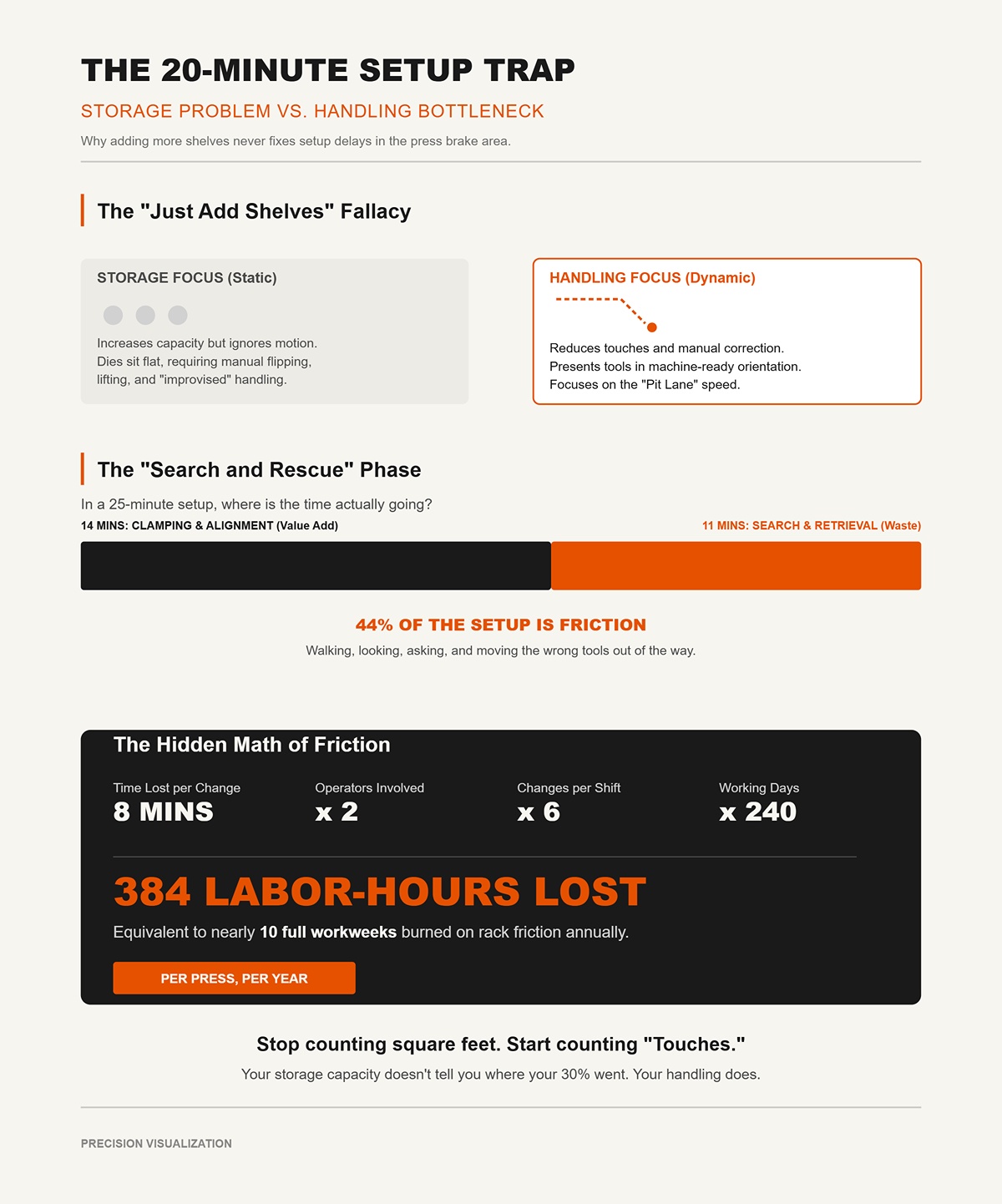
If your die change needs a forklift, a second set of hands, and a prayer, you don’t have storage — you have a handling bottleneck.
I’ve seen shops add three more bays of shelving because “we’re out of room.” The racks were tall, dense, beautifully painted. Changeovers didn’t get faster. They got slower. More places to look. More lifting. More turning a precision-ground edge into a pry bar.
The press brake area is a pit lane. Every changeover is a tire swap. The rack is either a tool cart that presents the die in machine-ready orientation — height, angle, weight supported — or it’s a static shelf that makes grown adults improvise.
Improvisation is where minutes leak and edges chip.
Picture a fixed shelf at chest height. The die sits flat. To load it, you slide it forward, rotate it, lower it to a cart or forks, then reverse the dance at the machine. Every move is manual correction because the shelf doesn’t guide anything. It just holds weight.
Now add more of those shelves.
You increased capacity. You did nothing to reduce motions.
A roll‑out shelf with full extension and an auto‑lock? Better. At least the die comes to you instead of you crawling into the rack. But if it still sits flat when the machine needs it upright, you’re flipping 50, 100, 200 pounds of precision steel to make up the difference. I’ve watched operators use the floor as a pivot point. That’s not storage. That’s a knuckle‑busting setup disguised as organization.
The real question isn’t how many dies you can store. It’s how many touches it takes to get one into the press.
In one shop I audited, a supervisor told me, “Our setups take 25 minutes.” We timed it. Clamping and alignment took 14. The other 11? Walking. Looking. Asking. Moving the wrong die out of the way.
Search and retrieval were eating over a third of the setup before a wrench ever turned.
That’s the “search and rescue” phase — when operators hunt through similar profiles, wipe off grease to read faint stamps, and shift three tools to reach the fourth. You can spend ten grand on custom-ground punches and give it all back in labor because the rack doesn’t make the right tool obvious and immediately accessible.
Custom tooling improves bending accuracy by thousandths.
Organization improves changeover by minutes.
Which one hits cost-per-minute harder?
And here’s the kicker: search time and handling time stack. The more you dig, the more you lift. The more you lift, the more you risk a nicked shoulder or a chipped edge. Tool degradation isn’t bad luck. It’s mechanical consequence.
So what does that add up to over a year?
Let’s stay conservative. Say you lose 8 unnecessary minutes per die change — between searching, repositioning, and extra handling. Two operators involved. That’s 16 labor-minutes per change.
Run 6 changes per shift. That’s 96 labor-minutes a day. An hour and a half of paid time not making parts.
Multiply by 240 working days. You’ve burned 384 labor-hours a year — the equivalent of nearly ten full workweeks — on friction your rack created.
And that’s before you price the chipped dies, the near-miss back strains, the forklift idling while the press waits.
When you start doing the math in cost-per-minute instead of square feet per rack, the conversation shifts. You stop asking, “How many shelves do we need?” and start asking, “How many touches does this design force?”
Walk the floor tomorrow and count the touches. That number — not your storage capacity — tells you where your 30 percent went.
A 200‑pound bottom die sits half‑exposed on a rack, tagged for the next job. The operator is ready. The clamps are open. But the forklift is outside unloading steel from a flatbed. Five minutes pass. Then eight.
The press behind them is quiet.
You can talk about storage density all day, but the moment a die move depends on yard traffic, you’ve tied production capacity to logistics noise. That’s not a space problem. That’s a mechanical choke point baked into the rack’s design.
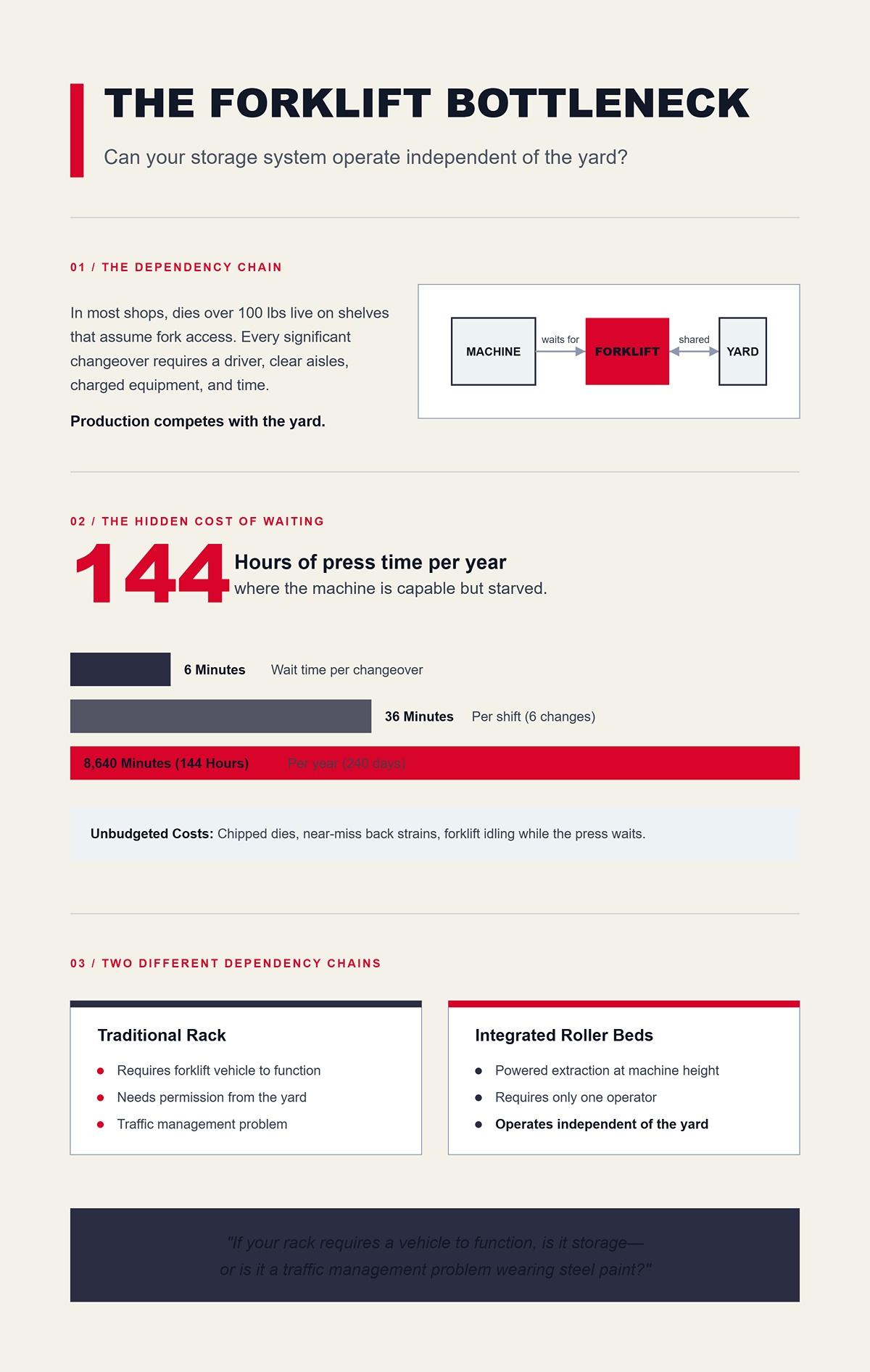
In most shops I walk, dies over 100 pounds live on shelves that assume fork access. That means every significant changeover requires a driver, clear aisles, charged equipment, and time. If the forklift is shared with shipping or raw material handling, production is now competing with the yard.
Track it for a week. Not theoretically—stand there with a notepad. Time from “ready to swap” to “die at machine.” In one mid-size fab I audited, average wait for fork availability during peak hours was six minutes per change. Six. No one budgets that into setup time because it feels incidental.
It isn’t.
Six minutes × 6 changes per shift × 240 days. That’s 8,640 minutes a year. One hundred forty-four hours of press time where the machine is capable but starved.
And that’s before you price the chipped dies, the near-miss back strains, the forklift idling while the press waits.
Now compare that to a rack with integrated roller beds or powered extraction that lets one operator present the die at machine height without fork involvement. Same die. Same weight. Different dependency chain. One design operates independent of the yard. The other needs permission from it.
If your rack requires a vehicle to function, is it storage—or is it a traffic management problem wearing steel paint?

Picture a flat shelf at chest height. The die lies horizontal. The press brake needs it vertical, tang down, aligned to the backgauge. So the operator slides it forward, rotates it 90 degrees, lowers it to a cart, then reverses the sequence at the machine.
Each rotation is a gravity negotiation.
A 150‑pound die doesn’t glide; it resists. So you see the micro-adjustments: lift an inch, shuffle left, tap with a dead blow, re-seat because the tang didn’t drop clean. None of this is dramatic. It’s ten seconds here, twenty there. Add alignment correction because the die wasn’t presented square. Add the second operator because the first doesn’t trust the balance.
That’s how 10–15 minutes evaporate without anyone noticing a single “big delay.”
Automation studies will tell you robotic cells eliminate this entirely. They’re right. But most shops don’t have a seven‑figure budget sitting idle. So the question isn’t whether robots solve it. It’s whether your rack reduces the manual corrections that remain unavoidable.
A rack that stores dies in machine-ready orientation—angled, supported, constrained laterally—turns rotation into translation. You slide, you lock, you load. No flipping. No re-seating. Fewer touches.
Every extra touch is a chance for misalignment. Every misalignment is a tap. Every tap is time.
Walk the floor and count how many times the die changes direction between rack and ram. That number tells you how hard gravity is working against you.
I once pulled a bottom die off a painted steel shelf and ran my thumb along the tang. Felt a ridge. Not visible—felt. That ridge came from years of sliding across bare steel.
A press brake die is ground to tight tolerances. The tang locates it in the holder. When you drag that surface across a hard shelf edge, you’re not gouging chunks off. You’re raising microscopic burrs. High spots.
Those high spots change seating.
A die that doesn’t sit perfectly flush forces operators to compensate at the machine—tighter clamping, slight re-alignment, maybe a shim if they’re desperate. Over time, you see inconsistency in bend angles that gets blamed on material variation or hydraulic drift.
Sometimes it’s storage abrasion.
Hydraulic machines can drift during long idle periods, sure. Oil warms, pressure shifts. But that’s machine behavior. Shelf abrasion is cumulative mechanical damage. One is operational physics. The other is preventable contact.
If your rack surface is harder than the precision-ground surface it carries, friction will win. Add vibration from forklifts bumping the frame. Add debris—scale, grit—caught between die and shelf. That’s lapping compound. Slow, steady wear.
Every time a die is dragged across a bare steel shelf or nudged into place with a dead blow hammer, you’re converting precision tooling into scrap one microscopic burr at a time.
And when bends start wandering a degree off, how much time do you spend chasing ghosts before you look at the rack?
Watch closely during a busy shift. Not the smooth changes. The rushed ones.
A die clears the shelf lip. The operator shifts grip. For half a second, the weight isn’t fully supported. It drops a quarter inch onto the cart or fork. You hear it more than see it. A dull steel knock.
That’s the “drop” factor.
Even a short drop concentrates force at edges and corners. Over time, corners mushroom. V-edges chip. Punch tips get hairline fractures that only show up when they start marking parts.
Automation eliminates this by controlling transfer speed and support continuously. But in manual environments, rack design decides whether drops are likely. Full-extension drawers with captive rollers support the die through the entire travel path. Side guides prevent lateral slip. Height matched to the press bed eliminates vertical transfer altogether.
A flat shelf with no front restraint? It invites that quarter-inch drop every single change.
You won’t log it as downtime. You’ll log the consequences—unexpected tool polishing, inconsistent bends, a cracked insert that “just happened.”
Mechanics don’t care about intentions. They care about force paths and contact surfaces.
If your rack doesn’t control those, it’s not neutral. It’s an amplifier.
And once you see the forklift waits, the gravity fights, the abrasion, and the drops as design outcomes—not operator habits—you’re ready for the real question:
What does a die rack look like when it’s built like a pit crew cart instead of a garage shelf?
Walk into three different shops and you’ll see three different “racks.”
In the first, dies lie flat on welded steel shelves, tags hanging off the ends. In the second, long bottom dies sit on roller arms that extend toward the press, already oriented tang-down. In the third, an enclosed carousel hums, presenting a labeled slot at chest height while the operator waits with empty hands.
Same job. Same press. Three completely different motion paths between rack and ram.
That’s the point. You’re not buying storage capacity; you’re buying a sequence of movements. Lift or slide. Rotate or translate. Support continuously or risk a drop. Align by eye or by constraint. Each architecture dictates how many touches happen, how much gravity you fight, and how many chances you give steel to bruise steel.
And if motion is cost-per-minute, why are we still shopping by price per shelf?
Picture a standard welded shelf rack: 4-inch angle iron lips, painted steel decks, dies stacked flat. A 120-pound bottom die sits 36 inches off the floor. To load it, the operator slides it forward, tips it, deadlifts one end to clear the lip, rotates it vertical, then lowers it onto a cart.
Count the direction changes. Horizontal slide. Vertical lift. Rotation. Controlled drop. Reverse it at the press.
Even if each movement is “only” 10–20 seconds, you stack them. In a job shop running eight changeovers a day, add a conservative four extra minutes per change because of shelf-induced motion. That’s 32 minutes a day. Roughly 130 hours a year on one brake.
You’ve burned the equivalent of over three workweeks on geometry your rack forced.
And that’s before you price the chipped dies, the near-miss back strains, the forklift idling while the press waits.
Drawer-style racks improve retrieval but not physics. Full-extension drawers reduce the initial lift, yes. But if the die is still stored flat and the press requires vertical insertion, the operator still rotates mass in midair. Fatigue accumulates in the shoulders and wrists. Under fatigue, alignment accuracy drops. That’s not opinion; that’s biomechanics.
Now, low-variety shops will argue they don’t care. “We run the same tooling all week.” Fair. If you change once a shift, the motion tax shrinks. In that environment, simplicity and low capital cost can win. Traditional holders and flat racks aren’t sins; they’re proportional tools.
But the moment variety climbs—short runs, prototype batches, mixed materials—the shelf architecture scales badly. Motion multiplies with every SKU. What looked cheap at purchase becomes a permanent overtime machine.
So what changes when the rack is designed to remove motion instead of store weight?
I watched a long, 10-foot bottom die come off a horizontal roller arm rack. The operator pulled the arm out; the die rolled toward him, already oriented tang-down, supported along its length. He slid it directly into the press bed without lifting more than a few pounds of effective weight.
No rotation. No deadlift. Translation only.
That’s the mechanical difference. These systems control orientation at rest. The die sits in machine-ready position—angled or vertical—so the transfer path is a straight line. Rollers or low-friction supports carry the mass; side guides constrain lateral drift; height is matched to the press bolster within millimeters.
We’ve eliminated re-positioning, which is where most micro-delays hide.
This is where people bring up 4-way dies or precision-ground European tooling with auto-clamping. And they’re right—those systems slash changeover time. But walk the floor and watch what happens if that precision die is dragged off a flat shelf and rotated by hand before it ever reaches the clamp.
You’ve protected the last inch and abused the first ten feet.
Precision racks complement precision tooling. They keep the tang protected, prevent burr formation, and present the die square to the holder so auto-clamps actually snap home without tapping and re-seating. The rack becomes the first stage of alignment, not an afterthought.
Now we’re talking about reducing touches from six to two. Slide out. Slide in.
If fixed shelves are cheap storage, arm systems are manual pit crew carts. Still human-powered. But engineered to remove wasted motion.
At what point does even that human translation become the bottleneck?
Stand in front of a vertical carousel during a busy shift. The operator keys in a tool number. The machine rotates internally and stops with the correct die at waist height. No searching. No walking. No reaching above shoulders or below knees.
Cycle time to present the tool is predictable—often under 20 seconds depending on size and indexing speed. More important, it’s consistent. Variability disappears.
But here’s the hard truth: if you run three changeovers a day, you will not justify a $50,000 carousel on time savings alone.
Let’s run a clean hypothetical. Suppose a carousel saves five minutes per change compared to a well-designed arm rack. If you perform ten changeovers per day, that’s 50 minutes saved daily. At a fully burdened shop rate of $120 per press-hour, that’s $100 per day in recovered capacity. Roughly $25,000 per year on a single shift.
Now the math starts to talk.
Add second shift? Double it. Add the reduction in search errors and tool damage from controlled storage? The payback window tightens further. High-mix, high-frequency environments cross that threshold fast.
But below that volume, automation is overkill. You’re paying for speed you don’t consume.
The architecture only makes sense once your changeover frequency turns presentation time into a dominant cost-per-minute driver.
Which brings us to the uncomfortable trade-off every shop has to face.
Carousels win on density. They stack tooling vertically and compress footprint. Fixed shelves can also go high—if you’re willing to bring in ladders or forklifts. Arm systems usually sacrifice some density to keep dies at ergonomic height and near the press.
More density means more walking if the rack isn’t point-of-use. More walking means more non-cutting minutes.
I’ve seen shops centralize all tooling in a beautiful, climate-controlled tool room 100 feet from the brake area. Perfect organization. Terrible flow. Operators become runners. The press behind them is quiet.
Point-of-use racks—especially arm systems mounted directly beside the brake—eat floor space but slash travel time. You trade square footage for minutes. If your floor is cheap and your press-hour is expensive, that’s an easy call.
This is where you stop thinking like a warehouse manager and start thinking like a race engineer. A pit crew cart isn’t optimized for storage density; it’s optimized for speed of exchange.
So the real comparison isn’t shelf versus arm versus carousel.
It’s this: how many minutes per day does each architecture force into your changeover path—and at your press-hour rate, which one actually costs more?
You’re running eight changeovers a shift. Each one idles the brake ten minutes while the operator walks, searches, rotates, and wrestles steel off a flat shelf. That’s 80 minutes a day. At a conservative $120 per press-hour, you’re bleeding $160 per shift in pure machine time.
Add a second shift and you’re north of $80,000 a year.
That’s the break-even conversation. Not “what does the rack cost,” but “how many press-minutes does it free, and what are those minutes worth in parts out the door?”
If you can’t answer that in your own numbers, walk the floor with a stopwatch tomorrow morning. Time from last good part of Job A to first good part of Job B. Then subtract actual clamping time. What’s left is rack-driven friction.
Now let’s turn that into a decision threshold instead of a gut feel.
Picture a 20-piece bracket run. Bending time per part: 30 seconds. Ten minutes of changeover wrapped around it.
That job consumes 10 minutes of setup and 10 minutes of bending. Half your time is non-cutting.
Now imagine that same shop with a load-arm rack that cuts the changeover to five minutes because dies are presented in machine-ready orientation. Same 20 parts. Now it’s 5 minutes setup, 10 minutes bending. Setup drops from 50% of the job to 33%.
That shift changes your minimum profitable order size.
With the shelf, you quietly avoid 20-piece orders because they “aren’t worth it.” You push customers toward 100-piece batches just to dilute setup time. Inventory creeps up. Lead times stretch. The rack just dictated your business model.
I’ve seen robotic brake cells handle small batches profitably—but only when tool presentation and change sequences are engineered into the system. Properly configured, the robot doesn’t care if it’s 15 parts or 150. Misconfigured, it chokes on tool variety and you’re back to manual intervention with a very expensive ornament.
So here’s the uncomfortable math: if your rack forces 10-minute changeovers, your minimum profitable batch size rises whether you admit it or not. If your market is trending to smaller lots, the shelf is taxing every quote you send.
Are you pricing parts to cover that friction, or just absorbing it?
A company I worked with spent $10,000 on setup reduction—standardized tooling, quick-change clamps. They cut changeovers from 30 minutes to 15 and saved 48 setup hours per month. Payback in under four months.
Notice what they didn’t buy first: a new rack.
That matters. If clamping and standardization are the big rocks, handle those before you chase storage hardware. Otherwise you automate chaos.
Now suppose your rack alone is responsible for four of those 15 remaining minutes—searching, walking, rotating heavy dies. Four minutes per change. Eight changes per shift. That’s 32 minutes a day. Roughly 130 hours a year on a single shift.
You’ve burned 384 labor-hours a year — the equivalent of nearly ten full workweeks — on friction your rack created.
At $120 per press-hour, 130 hours is $15,600 in machine capacity. That’s your annual “budget” for a rack upgrade on one shift before you even count reduced damage or labor strain. Two shifts? Double it.
But here’s where shops fool themselves: they compare that $15,600 to the sticker price of a $50,000 carousel and stop thinking. What they should compare is $15,600 per year times the life of the rack. Over five years, that’s $78,000 in recoverable capacity.
The rack is capital. The idle time is rent you pay every day.
Which one compounds?
Watch an operator deadlift a 120-pound die off a low shelf at 7:15 a.m. Clean movement. Controlled.
Now watch the same lift at 3:40 p.m.
The mechanics change. Slower setup. More micro-adjustments lining up the tang. A tap with a mallet to seat what should have slid home. Those seconds stack.
And that’s before you price the chipped dies, the near-miss back strains, the forklift idling while the press waits.
Fatigue isn’t just a safety line item. It’s a throughput variable. As the shift wears on, changeovers lengthen. If your morning swaps take eight minutes and your afternoon swaps take eleven, that’s not operator attitude. That’s cumulative load from bad handling geometry.
Arm systems and waist-height presentation don’t just save the first minute. They flatten the fatigue curve so the tenth change of the day looks like the first.
If you’re calculating ROI only on average changeover time, you’re missing the tail-end slowdown that quietly eats your afternoon capacity.
Have you ever charted changeover duration by time of day?
Let’s strip it down to a clean hypothetical.
Difference between shelf and load-arm rack: 5 minutes per change. Difference between load-arm and carousel: 3 minutes per change. Press-hour value: $120.
If you run 4 changeovers a day, shelf to arm saves 20 minutes. That’s $40 per day. About $10,000 per year on one shift. Hard to justify a big spend unless damage and injury are biting you.
At 8 changeovers, you’re at 40 minutes saved. $80 per day. Roughly $20,000 per year. Now a $25,000–$35,000 arm system starts to look rational over a few years.
At 15 changeovers a day, the math turns aggressive. Five minutes saved each time is 75 minutes daily—$150 per day, $37,000 per year per shift. That’s where even a $50,000 automated presentation system can earn its keep, assuming your part mix and tool variety actually fit the machine’s constraints.
That last clause is where feasibility studies matter. High die variety, odd lengths, specialty tooling—those can break automated assumptions fast. Automation pays in repetition and predictable sequences. If your tool library looks like a scrapyard of one-offs, you’d better simulate before you sign a purchase order.
So here’s the decision rule I give clients:
The rack isn’t a shelf. It’s pit-lane equipment. If you’re swapping tires twice a race, a folding chair works. If you’re in and out every ten laps, you build a system.
The only question left is this: how many tire swaps are you actually running per day, and does your floor layout support that intensity—or fight it?
You don’t pick the rack first. You walk the floor with a stopwatch and ask one question: where does the press actually wait?
The press behind them is quiet. The operator is not bending; he’s searching, shimming, or wrestling steel into alignment. That silence is your starting point. You already ran the math on how many changeovers justify an upgrade. Now you have to diagnose which kind of friction is stealing the minutes, because a carousel fixes a different problem than a load arm, and both are useless if your real bottleneck is bad sequencing.
So before you look at catalogs, you reverse-engineer your own pit lane. What is slowing the tire swap?
Stand ten feet back and watch three changeovers without talking.
If the operator spends most of the time walking, scanning shelves, and pulling tools down, your bottleneck is retrieval. A front-loading rack, arm presentation, or automation that brings the die to waist height attacks that directly.
If he gets the tool quickly but then taps, nudges, and shims for four minutes, your bottleneck is alignment precision. That’s a clamping and standardization issue first. I’ve filmed shops where a beautiful point-of-use cabinet shaved 30 seconds off retrieval while eight minutes vanished into shimming. New rack. Same chaos.
If you see two operators or a forklift hovering because the dies are too heavy or too awkward to handle safely, your bottleneck is safety geometry. That’s when arm systems, roller supports, or automated loading earn their keep by removing the knuckle-busting lifts that slow every swap after lunch.
Three different problems. Three different capital decisions.
Most shops answer the wrong one because they start with “we need more storage” instead of “what is the press waiting on?”
And if the press isn’t waiting on storage at all?
Then your rack upgrade is theater.
I’ve heard managers say, “It’s right there next to the brake.” Then we measure it. Twelve steps. Turn. Unlock. Pull. Turn back.
Ten feet doesn’t sound like much until you multiply it by eight changes a shift, two operators walking, and a year’s worth of repetition. Even a conservative hypothetical—60 seconds of walking and repositioning per change—at eight changes per shift is eight minutes a day. Roughly 30 hours a year per shift. That’s machine capacity, not exercise.
And that’s before you price the chipped dies, the near-miss back strains, the forklift idling while the press waits.
But here’s the catch most people miss: point-of-use only works if the tool set is rationalized. I’ve seen cabinets parked beautifully at the brake, every slot labeled, and operators still hunting because there are 40 bottom dies when 18 standardized ones would cover 80 percent of bends. Now the cabinet is just a closer junk drawer.
Walk the floor and trace the exact path of a 10-foot bottom die from rack to bed. Does it slide straight across a roller arm into position, or does it dip, twist, and get muscled into place? If the path isn’t linear and waist-height, you’ve designed fatigue into every change.
Ten feet is too much when the motion is clumsy.
Zero feet is still too much if the tool mix is wrong.
So how do you decide between adding arms, buying a carousel, or doing nothing at all?
Shops love to compare racks by shelf count and height. That’s storage thinking. You’re not buying cubic footage. You’re buying minutes.
Workflow intensity is the real selector. How many full tool changes per shift? How heavy are the common dies? How predictable is the sequence?
Low intensity—four or five changes a day, mostly light tools, stable families of parts—rarely justifies automation. Fix clamping. Clean up layout. Keep the rack simple and close.
Medium intensity—eight to ten changes, mixed weights, real variation—demands engineered handling: front-loading access, roller arms, orientation control that lets a die move in one smooth plane from rack to ram. This is where you flatten the fatigue curve and protect precision.
High intensity—fifteen-plus changes, heavy sectionalized tooling, high mix—starts to look like a race pit. Automation makes sense if your tool library is standardized enough to fit its constraints. If your tooling looks like a scrapyard of one-offs, the machine will expose that disorder fast.
Here’s the non-obvious part I want you to carry forward: the right rack is the one that matches the frequency and geometry of motion in your shop, not the one that holds the most steel per square foot.
When you evaluate a system, don’t ask, “How many dies can it store?” Ask, “For my specific mix, how many touches does this eliminate per change, and does it introduce any new ones?”
Walk the floor. Time the travel. Watch the lift. If you see wasted motion, you’ve already found the rack you shouldn’t buy again.