
A 22-year-old press brake sits quiet because a $3,000 control board failed and the manufacturer stopped supporting it. The iron still holds parallel under load. The cylinders don’t leak. The ram tracks straight within a few thousandths.
Yet the purchase order on my desk says “new machine.”
That gap—between what the steel can still do and what the brains can’t—is where most shops light cash on fire.
We talk about a “20-year-old brake” like it’s a worn-out truck. That’s lazy thinking.
A press brake frame is thick plate and weldments stress-relieved to take millions of cycles. Properly built iron doesn’t fatigue on a calendar; it fatigues from overload, poor foundations, and abuse. I’ve seen 35-year-old frames still crowning evenly across 10 feet because they were never run past tonnage charts.
The control, though? Different animal. Proprietary boards, aging capacitors, obsolete drives. Ten years in, parts get scarce. Fifteen, they’re on eBay. Twenty, you’re praying the screen boots.
So when production stops, what actually failed—the 40,000 pounds of steel, or the shoebox-sized brains bolted to the side?

Look at the mass. A mid-size brake might weigh 30,000–60,000 pounds. That iron exists to resist deflection. Unless you’re routinely exceeding rated tonnage, you’re operating at a fraction of its structural limit.
Hydraulics wear, yes. Seals age. Pumps get tired. But those are service items. Replace seals, rebuild cylinders, flush oil. The core frame doesn’t care.
Electronics age differently. Heat cycles crack solder joints. Vendors discontinue processors. Software stops updating. No amount of preventive maintenance keeps a 1990s control current with modern CAD/CAM workflows.
And here’s the uncomfortable detail: accuracy gaps often blamed on “old machines” trace back to feedback systems and controls. A mechanical stop brake might repeat at ±0.1 mm. Modern CNC with linear scales can hold ±0.02 mm. That’s brains and sensing, not thicker steel.
If your parts are drifting, is the ram flexing—or is the feedback blind?
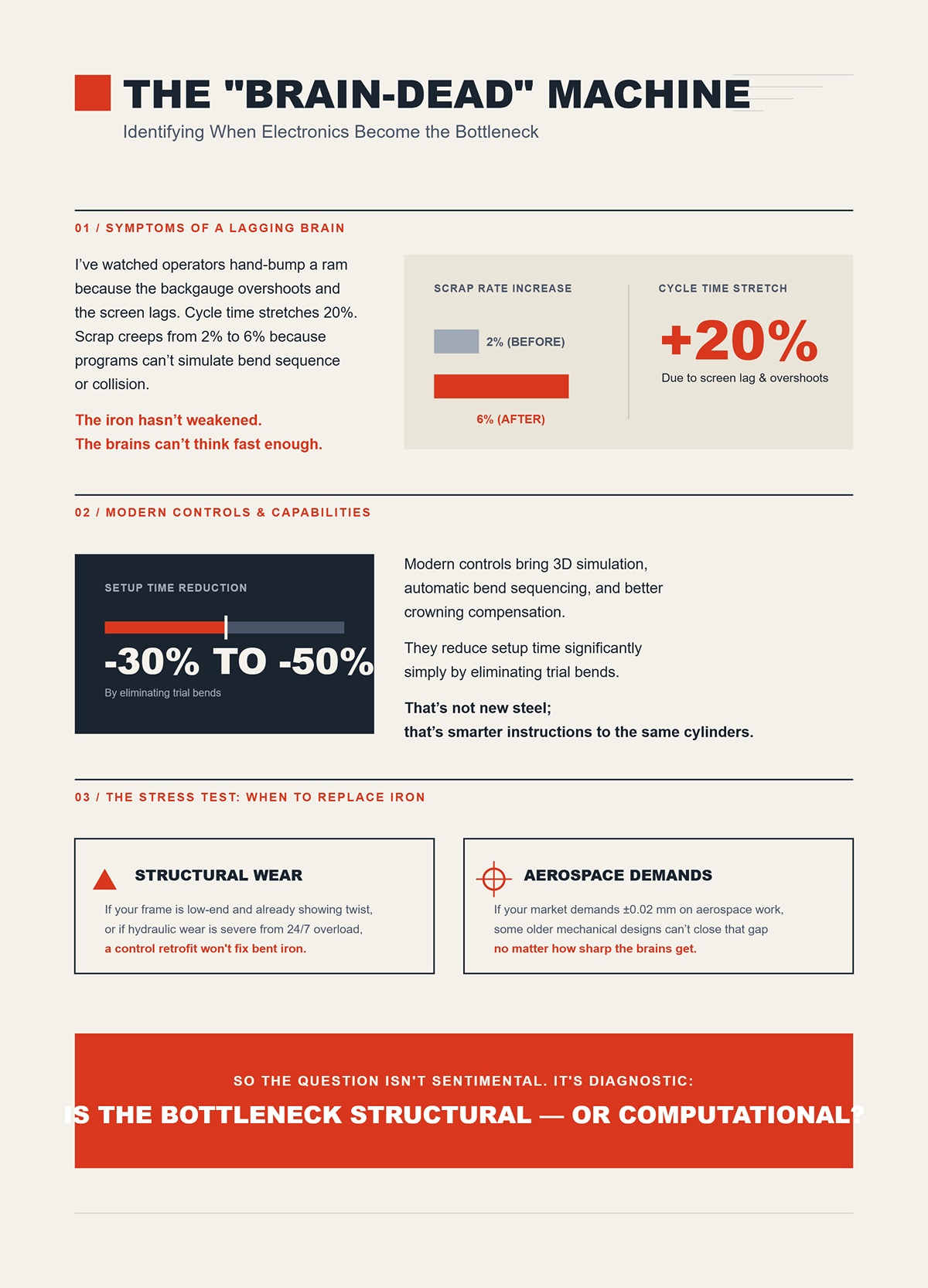
I’ve watched operators hand-bump a ram because the backgauge overshoots and the screen lags. Cycle time stretches 20%. Scrap creeps from 2% to 6% because programs can’t simulate bend sequence or collision.
The iron hasn’t weakened. The brains can’t think fast enough.
Modern controls bring 3D simulation, automatic bend sequencing, better crowning compensation. They reduce setup time by 30–50% in some shops simply by eliminating trial bends. That’s not new steel; that’s smarter instructions to the same cylinders.
Now, stress test the argument. If your frame is low-end and already showing twist, or if hydraulic wear is severe from 24/7 overload, a control retrofit won’t fix bent iron. And if your market demands ±0.02 mm on aerospace work, some older mechanical designs can’t close that gap no matter how sharp the brains get.
So the question isn’t sentimental. It’s diagnostic: is the bottleneck structural—or computational?
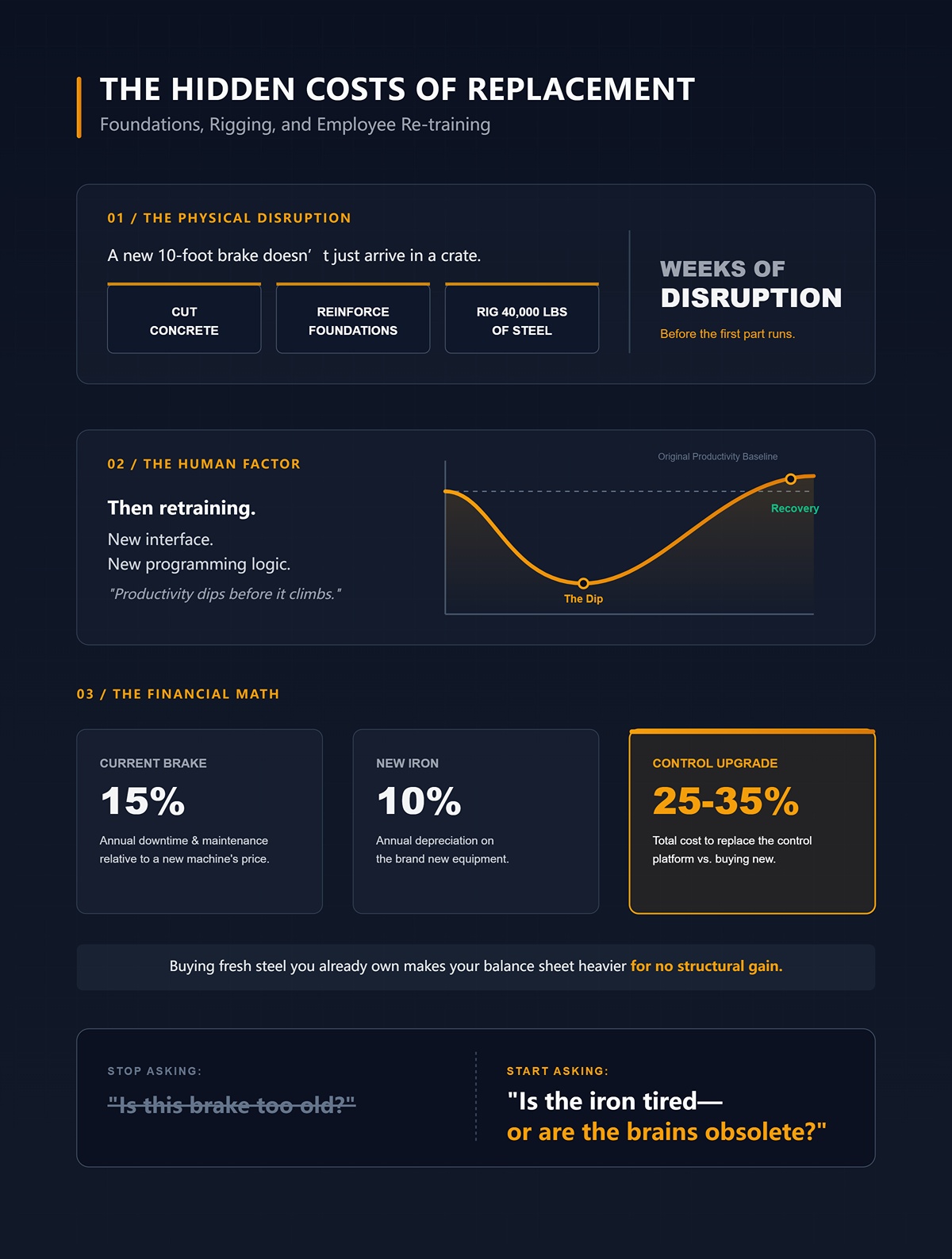
A new 10-foot brake doesn’t just arrive in a crate. You cut concrete. You reinforce foundations. You rig 40,000 pounds of steel through a live shop. That’s weeks of disruption before the first part runs.
Then retraining. New interface. New programming logic. Productivity dips before it climbs.
Call it a clean hypothetical: if annual downtime and maintenance on your current brake equal 15% of a new machine’s price, and depreciation on new iron runs 10% a year, the math might favor replacement. But if the only chronic failure is a control platform you can replace at 25–35% the cost of new, buying fresh steel you already own makes your balance sheet heavier for no structural gain.
By the end of this section, I want one shift in your head: stop asking, “Is this brake too old?” and start asking, “Is the iron tired—or are the brains obsolete?”
You want a practical rule, not philosophy.
Here’s mine: if the iron is straight, repeatable, and holds tonnage without flinching, you do not write a $250,000 check to replace it until you’ve priced the brains at half that or less. If a control retrofit lands at 50% or under the cost of new—and the frame passes inspection—you’re buying productivity, not steel. That’s the 50% rule.
This isn’t about nostalgia. It’s about capital discipline.
A 22-year-old press brake sits quiet because a $3,000 control board failed and the manufacturer stopped supporting it. The iron still holds parallel under load. Yet someone thinks the solution is a quarter‑million dollars of new steel. That’s not a technical decision. That’s a cash flow decision pretending to be technical.
So how do you actually decide?
Run a clean hypothetical. Mid-size hydraulic brake. New machine: $250,000. Control retrofit with new CNC, drives, wiring cleanup, maybe linear scales: $60,000–$90,000 depending on scope.
Call it $75,000.
That’s 30% of new.
For that 30%, you keep 40,000 pounds of iron that already fits your floor, your tooling, your operators’ muscle memory. You avoid rigging, foundation work, and the three-week productivity dip while everyone learns new brains. The steel doesn’t move. The brains get smarter.
Now stress-test it.
If inspection shows the frame is twisted, ram guides worn past tolerance, cylinders scored, and you’re staring at $40,000 in mechanical repairs before you even touch controls, the math shifts. A retrofit isn’t a magic wand. It assumes “working condition” iron. If you have to rebuild the skeleton and transplant the brain, you’re approaching 50–60% of new before gaining a single feature.
That’s the line. Around half the cost of new, you stop and ask hard questions.
And yes, automation muddies the water. I’ve seen large plants drop serious money on robotic press brakes, cut labor 25%, boost output 20%, and pay it back in two years. A control retrofit won’t give you robotic loading. If your bottleneck is labor content per bend, not programming time, then comparing $75,000 to $250,000 is the wrong fight.
But most shops aren’t choosing between retrofit and full robotics tomorrow. They’re choosing between a brain transplant and replacing steel that still does its job. So why are we acting like those dollars buy the same thing?
Stop thinking in purchase price. Think in bends.
Say you run 10,000 bends a month. Over five years, that’s 600,000 bends. If a modern control cuts setup time in half—like the case where a shop spent $10,000 standardizing tooling and dropped setup from 30 minutes to 15—you’re not shaving minutes for vanity. You’re buying hours. That shop freed 48 hours a month and paid the investment back in under four months.
That wasn’t new steel. It was smarter process.
Now apply that logic to brains. If upgraded controls reduce scrap from 6% to 3% because simulation prevents bad sequences, on 600,000 bends that’s 18,000 fewer bad parts over five years. Multiply by your average part value. The number gets real fast.
Energy? A brand-new hybrid-drive brake may sip power compared to an older hydraulic unit. Over a full lifecycle, that matters. But over the next five to ten years—the window most shops actually plan around—the delta often doesn’t outrun a 70% capital savings on day one.
So ask yourself: over the next 10,000 bends, what costs you more—slightly higher kilowatts, or slow setups and avoidable scrap?
There’s a stigma that retrofit means you couldn’t afford new.
I don’t buy that.
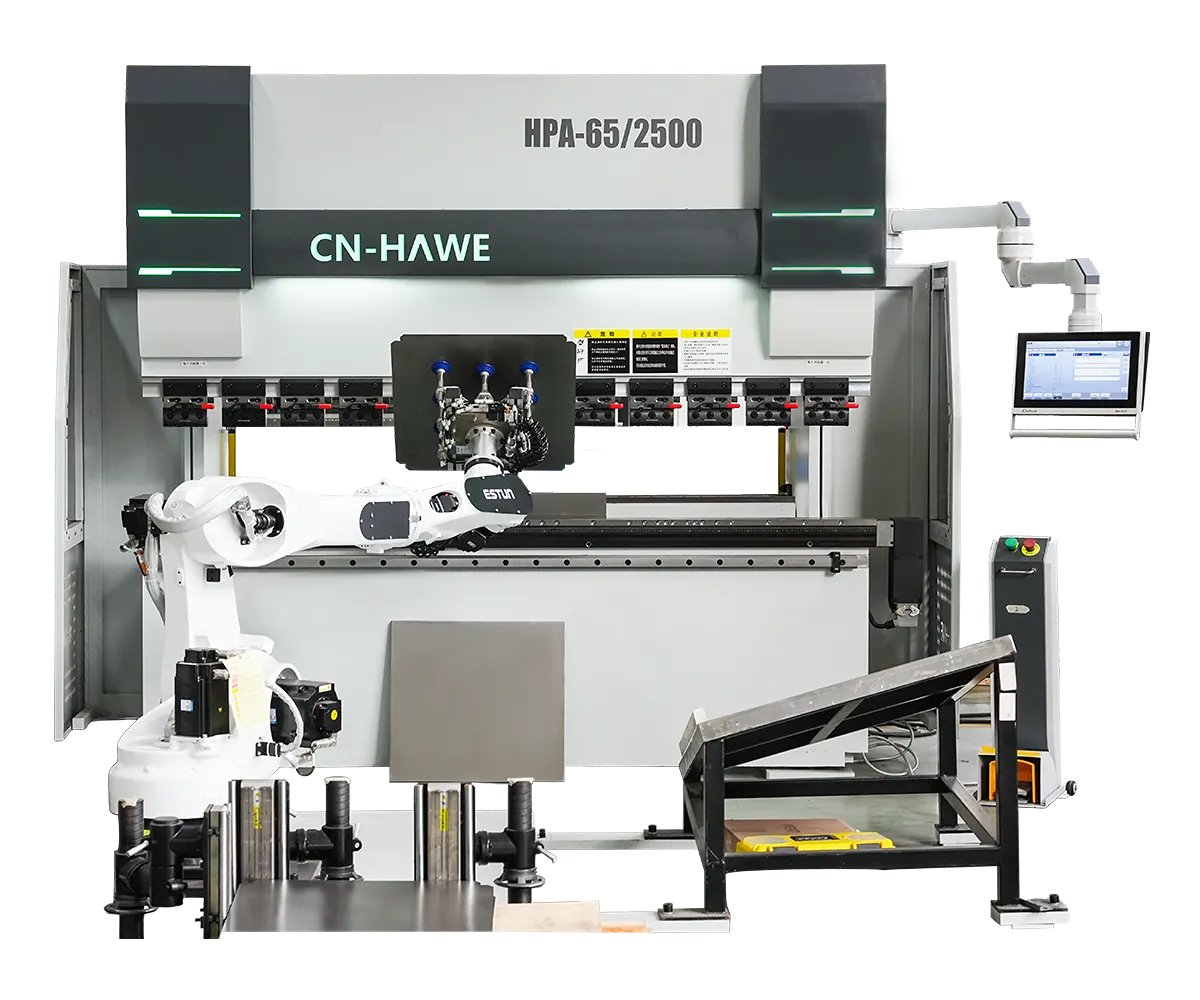
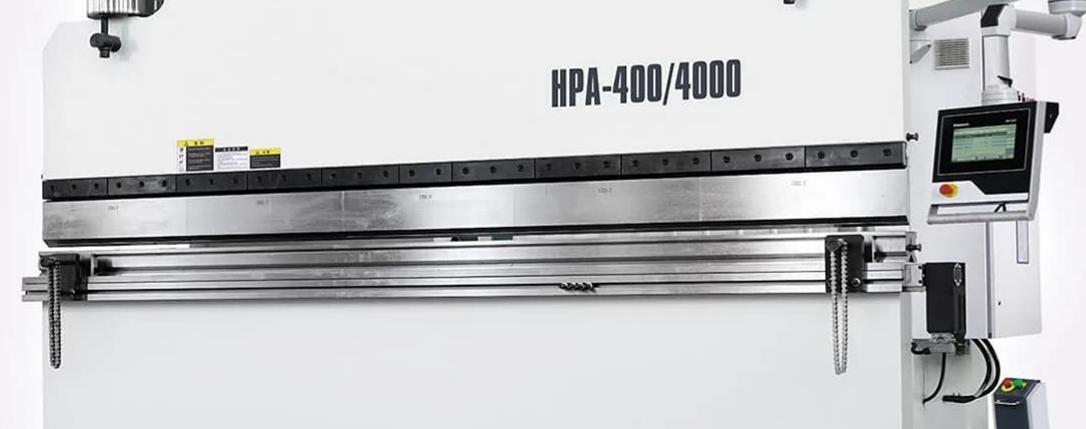
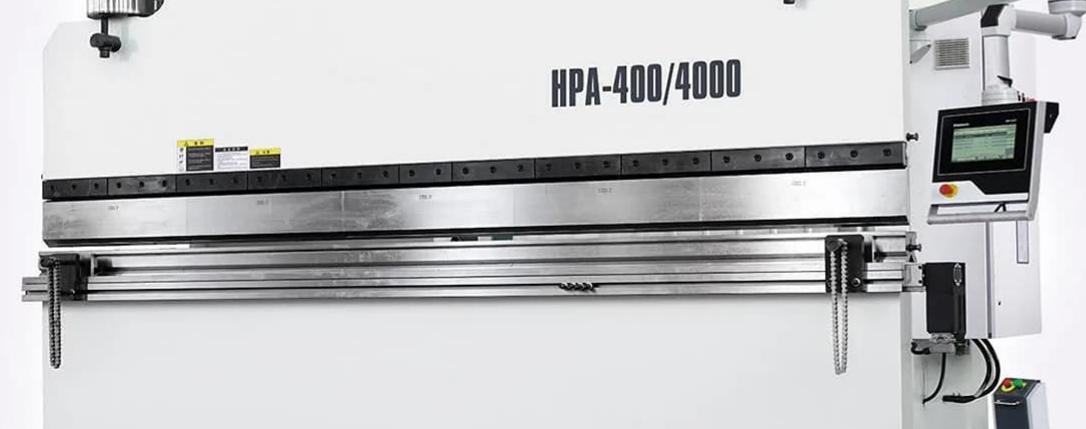
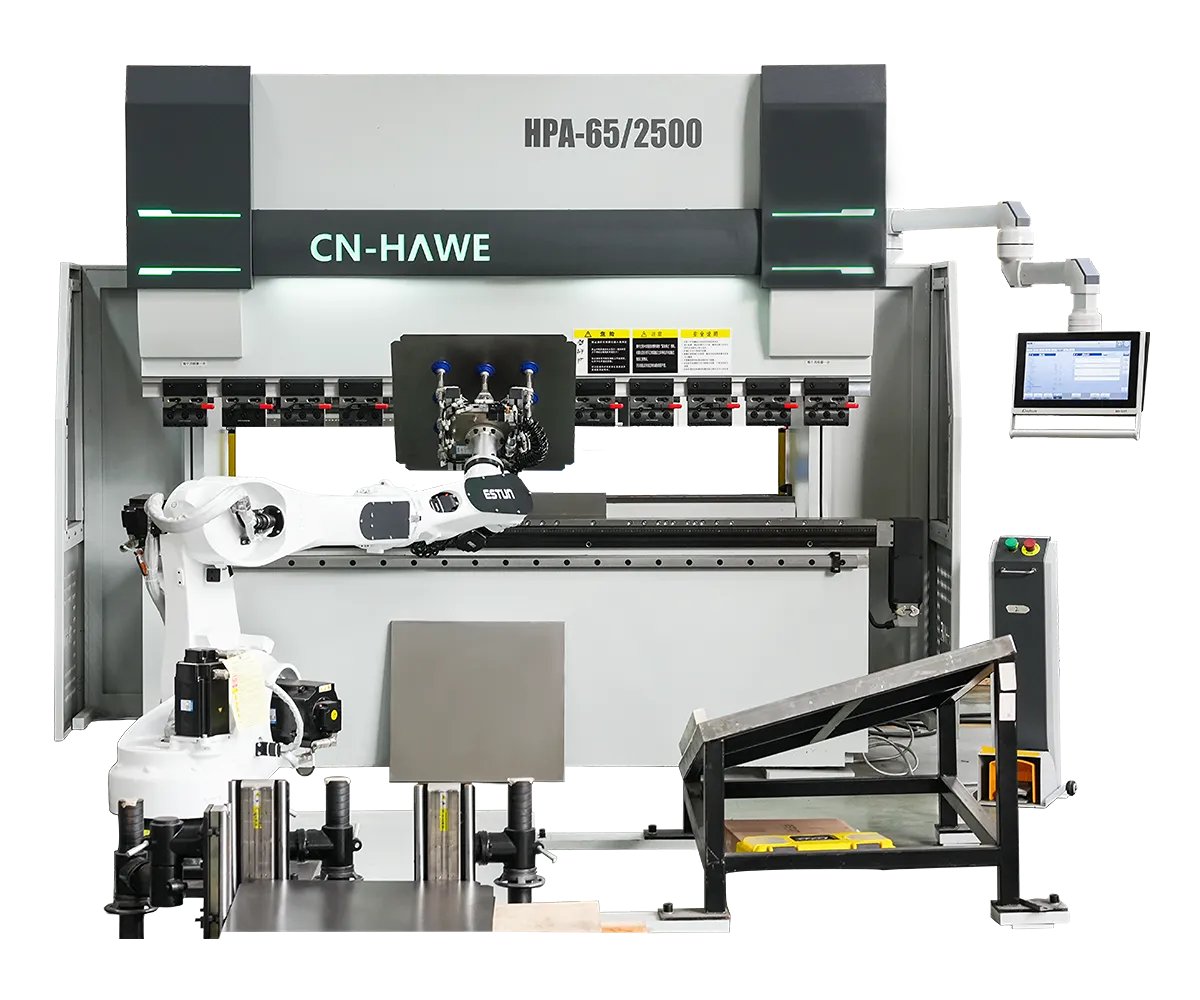
If the iron is sound and you choose to invest 30–50% of replacement cost to unlock modern programming, better crowning control, network integration, and faster setups, you’re not cutting corners. You’re separating body from brain and upgrading the limiting factor. That’s strategy. For shops weighing upgrade versus replace, reviewing fully CNC-based platforms like CN-HAWE press brake solutions—designed for advanced bending applications and integration into broader sheet metal automation—can clarify what today’s control, crowning, and connectivity capabilities should look like before you commit capital.
It also keeps options open. A control retrofit doesn’t lock you out of future automation. Many modern CNC platforms are designed to integrate with offline programming and even staged automation later. You can phase capital instead of swallowing it whole. First the brains. Then, if volume justifies it, add feeders or robots around steel you already amortized.
That’s not small thinking. That’s sequencing.
The mistake is binary thinking: old equals obsolete, new equals competitive. The truth is messier. A 50-year mechanical foundation can carry multiple generations of brains. Each transplant resets capability without resetting your balance sheet.
So before you sign for new iron, answer this without flinching: are you buying capability—or are you buying steel you already own?
“[CORE] The “Smart Iron” Transformation: Modern CNC Capabilities on an Existing Frame” 生成失败: Failed to fetch
“[CORE] The ROI of Precision: Quantifying Setup Time and Scrap Reduction” 生成失败: Failed to fetch
“[BRIDGE] The Mechanical Triage: Identifying the “Point of No Return”” 生成失败: Failed to fetch
“[LANDING] The Decision Framework: Are You Replacing Steel or Replacing Capability?” 生成失败: Failed to fetch
Walk your brake with a dial indicator and a flashlight.
Check ram parallelism under load. Inspect guides for scoring. Look at cylinder rods for pitting. If The iron still holds parallel under load and the hydraulics don’t bleed down, you’re looking at a mechanical foundation that will outlive most operators. Now open the cabinet. If the machine is dead because of an obsolete control card, or the interface looks like a 1998 answering machine, you’ve found your bottleneck.
That’s your first filter under the 50% rule: sound steel, obsolete brains.
Second filter: architecture. If it’s a hydraulic or synchro hydraulic brake where the CNC commands ram position, pressure, and sequence, a control transplant changes what the machine can physically produce. If it’s a flywheel-style mechanical brake, you can add a CNC backgauge, but you cannot program multi-step ram sequences. The stroke is the stroke. On that platform, “smart iron” means positioning precision, not adaptive bending. Are you expecting sequencing from steel that was never built for it?
Once you pass those gates, the transformation is not cosmetic. It’s functional.
A modern CNC doesn’t just replace buttons. It rewires the relationship between operator, tooling, and steel. Three capabilities do most of the heavy lifting: 3D simulation, servo-driven gauging and crowning, and integrated safety that doesn’t strangle throughput. If those sound like software features, good. Because they are—and software is cheaper to upgrade than 40,000 pounds of iron.
What actually changes on the floor?
Picture a 10-foot panel, four bends deep, with a return flange that wants to crash into the punch on the third hit.
On an older control, the operator discovers that collision in real time. You hear the hesitation. Sometimes you hear steel kiss tooling. Then you scrap a part or rework it. That’s not incompetence. That’s trial-and-error programming at the machine.
With 3D graphical simulation, the entire bend sequence is modeled before the ram moves. The control calculates flange growth, tool clearances, and backgauge positions in a virtual environment. If the part collides, it shows you on the screen, not in your scrap bin. The operator adjusts sequence or tooling offline, then runs first piece with a high probability it’s right.
I’ve seen shops cut setup time from 30 minutes to 15 just by standardizing tooling and adding smarter brains. Half the setup time is often hunting sequence errors and gauge positions. When the brains handle that in simulation, the steel just executes.
But here’s the catch: offline programming requires workflow discipline. Engineers build jobs at desks, not at the machine. High-mix, one-off shops still benefit from on-board 3D, but the real 50% setup reduction shows up when jobs repeat. Are your bends tribal knowledge, or are they digital assets you can reuse?
If simulation prevents even a 3% scrap rate from creeping to 6% on complex parts, the math compounds over 600,000 bends. Scrap is margin leaving the building in a dumpster. Why discover mistakes at 200 tons when you can find them at 0 tons?
Stand behind an older hydraulic brake with a tired DC backgauge motor. You’ll hear it—overshoot, correction, settle. It hits position, but not elegantly.
Replace that with servo-driven backgauges tied into a modern CNC. Servo means closed-loop control: the brains read encoder feedback and correct position in milliseconds. Instead of “close enough,” you get repeatable positioning within thousandths, cycle after cycle. That’s not new steel. That’s new motion control bolted onto existing iron.
Now add programmable crowning. Crowning compensates for deflection in the bed and ram under load. Without it, you shim manually or accept angle variation across part length. With CNC-controlled crowning, the system calculates required compensation based on tonnage and material data, then adjusts dynamically. Long parts stop smiling in the middle.
This is where “near-new performance” gets concrete. Accuracy and repeatability are functions of feedback and control, not frame paint. If the frame is rigid and guides are within tolerance, servo gauging plus programmable crowning closes much of the gap between a 20-year-old brake and one that just rolled off a truck.
But those are service items—linear scales, servo drives, ball screws. They wear. The iron doesn’t, not at the same rate. So ask yourself: are you replacing fatigue-prone components and brains, or discarding steel that still does its job?
Twenty years ago, adding safety often meant slowing the machine down. Big light curtains. Large safety distances. Operators waiting on green lights.
Modern safety systems integrate laser-based guarding directly at the point of operation. The beam follows the punch tip. The ram can approach at high speed, then decelerate only when fingers enter the zone. You maintain productivity while meeting current standards.
That matters for two reasons.
First, compliance. Standards evolve. If your existing brake requires a control to function and that control fails, replacing it with a modern CNC that integrates current safety can be cleaner than trying to retrofit piecemeal relays into a dead architecture. Second, liability. One incident can erase years of capital savings.
And here’s the strategic angle: safety integrated through the brains scales with future automation. If you later add a robot cell, remember it typically demands 15–20% more floor space for fencing and access. Planning brains that can talk to safety PLCs and future peripherals keeps your steel in play. Are you upgrading in isolation, or are you preparing the foundation for what comes next?
When you bolt simulation, servo precision, programmable crowning, and integrated safety onto proven iron, you’re not polishing an antique. You’re expanding what it can reliably produce.
So if smarter brains change setup time, scrap rate, repeatability, and compliance, the next question isn’t philosophical.
It’s numerical.
A shop I know was quoted $250,000 for a new 10-foot hydraulic brake. Instead, they spent $75,000 transplanting new brains onto 18-year-old iron. Same tonnage. Same bed length. The difference showed up in the first quarter, not on the invoice.
Before the retrofit, average setup on repeat jobs ran 45 minutes—manual gauge dialing, bend sequencing at the control, first-piece tweaking. Afterward, it dropped to 10–15 minutes using stored programs and on-screen simulation. Call it 30 minutes saved per setup. They averaged four setups a shift, two shifts a day. That’s four hours reclaimed daily.
Four hours on a brake billed internally at $125 per hour is $500 a day. Roughly $10,000 a month in capacity. The brains paid for themselves in well under a year, and the iron never left the floor. What would a new machine have done differently in that first year besides drain another $175,000 in cash?
Stand next to a veteran operator running an old control. He bends from memory. Knows springback by feel. Adjusts depth in tenths. Now put a newer hire on that same steel. Setup stretches. Scrap creeps. Tribal knowledge doesn’t scale.
Modern CNC interfaces change the starting point. Material libraries store tensile strength and thickness. Tool libraries hold punch and die geometry. The brains calculate bend deduction automatically—the flat length adjustment that used to live in a notebook. Instead of dialing in depth three times to hit 90 degrees, the first part often lands within tolerance.
That’s not magic. It’s closed-loop feedback from linear scales and servo-driven backgauges feeding position data back into the control in milliseconds. The operator enters angle; the brains translate it to ram depth based on known tooling and material data. You’ve replaced guesswork with math.
Training time shrinks accordingly. I’ve watched new operators become productive in weeks instead of months because the interface guides sequence, tooling selection, and even flags collisions before the ram moves. When learning curve drops by 50%, overtime tied to “only Joe can run that job” drops with it.
But this only holds if the underlying iron is square, leveled, and within tolerance. If the ram guides are worn or the bed is twisted, no software bandage will hold angle across 10 feet. Have you measured parallelism under load, or are you blaming brains for what’s really steel fatigue?
Picture a batch of 200 stainless brackets, 0.125-inch thick, laser-cut blanks at $12 each. Material alone is $2,400. On an older control, you might burn two or three pieces dialing in angle and flange length. Call it 3% scrap on setup and early production—six parts, $72 in material, before you count labor.
Now add 3D simulation and stored bend programs. First part is bent against a proven recipe—tooling, sequence, backgauge positions locked in. Scrap on startup drops from six pieces to two. That’s a 66% reduction in setup scrap on that job.
Stretch that across 20 similar jobs a month. If average startup scrap falls from 3% to 2%, that 1% delta on $200,000 monthly material throughput is $2,000. Twenty-four thousand a year. And that’s conservative; complex multi-bend parts see bigger swings because collision errors and sequence mistakes are front-loaded costs.
The mechanism is straightforward. The brains simulate flange growth and tool clearances at 0 tons instead of discovering errors at 200 tons. They apply programmable crowning based on tonnage calculations so you don’t chase angle variation across the bed. First-part accuracy improves because variables are modeled, not guessed.
If your current scrap rate is already under 1%, the gain narrows. If you’re bending simple 90-degree brackets all day on a mechanical brake without programmable ram control, the ceiling is lower; you can upgrade the backgauge, but you won’t gain multi-angle sequencing. That’s where doing nothing may beat spending 30% of a new machine’s price. Do you know your actual scrap percentage by job family, or are you arguing from anecdotes?
One plant I walked into had three brakes, none talking to the ERP system. When a job ran long, nobody knew why. Was it setup? Rework? Waiting on tooling? The steel stayed busy; the management stayed blind.
After a control retrofit with network connectivity, each cycle, setup time, and alarm logged automatically. Setup averaged 38 minutes on paper; data showed 52. The difference was interruptions and manual adjustments nobody recorded. Once visible, they standardized tooling carts and pre-staged punches. Setup dropped to 20 minutes—not because the iron changed, but because the brains exposed waste.
Data logging also protects margin in quoting. When you know a job averages 14 minutes of run time and 12 minutes of setup, you price accordingly. Without that, you guess low to win work and bleed 5% on execution. Visibility alone can swing profitability by single-digit percentages that dwarf the cost of a control upgrade over five years.
And connectivity future-proofs the steel. If you later add offline programming or a robot cell, the control can handshake with external systems. A 22-year-old press brake sits quiet because a $3,000 control board failed and the manufacturer stopped supporting it. That’s what happens when the brains are isolated and obsolete.
So here’s the arithmetic: cut setup by 30 minutes, reduce scrap by 1–3%, tighten quoting with real data, and avoid unplanned downtime tied to unsupported electronics. On a retrofit costing 30% of a new machine, the payback often lands inside 12–24 months. After that, it’s margin.
But ROI assumes the iron deserves saving. If the frame won’t hold parallel under load, if the hydraulics leak pressure, if alignment is out beyond correction, you’re pouring new brains into a failing body. The next question isn’t how much you save—it’s which machines earn the transplant and which should be cut loose.
You don’t start with a brochure. You start with a dial indicator and a pressure gauge.
If we’re going to bolt new brains onto old iron, the first question isn’t what the software can do — it’s whether the steel can repeat within spec when it’s actually working. The iron still holds parallel under load, or it doesn’t. Everything else is noise.
This is triage, not optimism.
A press brake is a 50-year body that lives or dies on three things: straightness under tonnage, hydraulic integrity, and geometry that hasn’t drifted beyond correction. If those are intact, the machine is a candidate for a brain transplant. If they’re not, you’re funding a cosmetic surgery on a structural failure. Do you know which side of that line your brake sits on?
Ram repeatability is the heartbeat.
Set up a simple test: indicator on the bed, cycle the ram to a fixed depth at working tonnage, not air. Ten strokes. If you’re chasing more than a few thousandths variation stroke to stroke, the problem isn’t code — it’s wear in guides, bushings, or hydraulic inconsistency. Closed-loop controls assume the iron responds predictably; if the steel wanders, the brains amplify the error.
Hydraulics tell the second half of the story. Pressure that drifts under load, valves that hunt, cylinders that bypass internally — those show up as angle variation you can’t “program out.” I’ve seen shops blame controls for 1-degree swing across a 10-foot part when the real culprit was pressure loss at peak tonnage. New electronics won’t seal a worn piston. But those are service items.
Now step back.
If a $10,000 quick-change tooling project cuts setup time in half without touching the control, that tells you something about where your real bottleneck lives. Sometimes the fastest payback sits in mechanical housekeeping — clamps, crowning calibration, alignment — not in a touchscreen. Are you sure the brains are the constraint?
Even perfect iron can be strategically wrong.
If your market is drifting toward 3/8-inch plate and you’re sitting on a 150-ton frame that lives at 140 tons all day, you’re running at 93% capacity before you talk about speed or safety margin. That’s not a control problem. That’s physics.
Bed length is just as blunt. If customers want 12-foot panels and you own 10 feet of steel, no software patch adds two feet. You can gang tools, flip parts, get creative — and burn labor doing it. At some point the workaround tax exceeds 30% of a new machine’s payment.
Speed hides in plain sight. Older hydraulics may top out at approach and return rates that cap throughput no matter how smart the brains become. If cycle time is mechanically limited, your ROI math shrinks. Are you upgrading capability, or polishing a ceiling you can’t raise?
Here’s where discipline matters.
I’ve walked through plants where a retrofit was pitched as salvation, but the ram guides had visible scoring and the bed needed shimming every quarter to hold angle across length. A 22-year-old press brake sits quiet because a $3,000 control board failed and the manufacturer stopped supporting it — that’s a brain problem. A brake that can’t hold parallel within tolerance is a body problem.
And bodies are expensive to rebuild.
Given that CN-HAWE’s product portfolio is 100% CNC-based and covers high-end scenarios in laser cutting, bending, grooving, shearing, if the next step is to speak with the team directly, Contact us fits naturally here.
If the steel is twisted, if the frame deflects inconsistently because of fatigue, if alignment correction becomes a monthly ritual, you’re stacking precision electronics on a moving foundation. Scrap doesn’t drop 30%. It sometimes rises, because the new brains assume a stability that no longer exists.
This is the “point of no return.”
When repair estimates for guides, cylinders, and alignment climb toward 40–50% of a new machine’s cost, and you still face tonnage or length limits, the math flips. At that point you’re not protecting cash flow — you’re delaying an inevitable capital expense and risking margin in the meantime.
So before you sign off on a retrofit, answer it clean: does your iron repeat, hold pressure, and meet the work your market is demanding — or are you trying to buy intelligence to compensate for worn-out steel?
Assume the iron passed triage. It holds parallel under load. Pressure stays steady. Geometry is within correction. Now the question isn’t “Can we save it?” but “What exactly are we buying if we don’t?”
A new press brake purchase splits into two checks: one for steel, one for brains. The steel gives you tonnage, length, and speed. The brains give you repeatability, simulation, data, safety logic, and faster setups. If your current steel already meets your market’s tonnage and length demands, and its hydraulic speed isn’t the ceiling, then 50–70% of a new machine’s price is paying for iron you already own.
That’s the non-obvious part. Most ROI comparisons stack “$250,000 new” against “$75,000 retrofit” and call the delta savings. Wrong math. The right comparison isolates the capability delta. If the retrofit delivers 80–90% of the productivity gain because the bottleneck lives in setup time, scrap, and programming—not tonnage—then you’re buying back performance at 30–40% of the capital. Why would you finance steel that doesn’t increase billable bends per hour?
But there’s a second layer.
A proper retrofit might extend useful life 10–20 years, not 50. So ask a harder question: how many revenue-generating hours will this iron run in that window? If you’re a mid-sized shop running one shift with seasonal peaks, a 15-year extension can cover two equipment cycles for the cost of one new purchase. If you’re running three shifts at 85% spindle-equivalent utilization, 15 years might compress into 7 before fatigue and wear creep back into tolerance. Your utilization rate quietly decides whether 40–60% of new cost is cheap or expensive. Are you measuring life in years, or in strokes under tonnage?
That’s the framework:
Miss one, and the math starts sliding.
So when you price a new brake, strip out the steel value you don’t need, discount the years you won’t use, and then compare capability gained per dollar of capital deployed. Are you replacing worn-out structure, or are you replacing capability that your current iron could deliver with a smarter brain?
First condition: structural sufficiency. The frame is straight, guides are within spec, hydraulics hold pressure. Not cosmetically acceptable—structurally sufficient. If the iron still holds parallel under load, you’ve cleared the largest capital hurdle.
Second condition: strategic fit. Tonnage and bed length align with your next five years of quoting, not your last five. If 90% of your jobs live under 70% of rated tonnage and within existing length, buying more capacity is ego, not strategy.
Third condition: bottleneck location. If setup time, programming errors, scrap from angle drift, and lack of offline simulation are costing you margin, the constraint sits in the brains. A modern control with offline programming and angle correction can cut setup by 30–50% in the right environment. That’s not theory; that’s workflow. But if your choke point is material handling or downstream welding, faster bends just stack WIP. Where is margin actually bleeding?
Fourth condition: capital efficiency. Add retrofit cost plus any mechanical catch-up—seals, valves, guide adjustments. If that total lands at 40% of a new machine and delivers 80% of the throughput improvement, your return on invested capital is roughly double. Hypothetical: $80,000 retrofit yielding $120,000 annual incremental gross margin versus $250,000 new yielding $140,000. Which one clears faster and leaves borrowing capacity for the next constraint?
If you meet all four, retrofit isn’t a compromise. It’s the rational default. If you miss two, you’re rationalizing.
Mid-sized shops don’t lose bids because their steel is 20 years old. They lose because they can’t quote fast, can’t predict bend sequences, or pad pricing to cover scrap risk.
Modern brains on proven iron attack that directly. Offline programming lets you quote with real cycle times instead of tribal estimates. Angle measurement tightens first-part accuracy, cutting the “sneak up on it” dance that eats 15 minutes per setup. Networked data shows which operators and jobs actually make money. None of that requires new steel if the structure is sound.
Here’s the advantage most owners miss.
Large OEMs buy new iron on schedule; depreciation is baked into their model. Small job shops run equipment into the ground. The mid-sized shop that upgrades brains at 30–50% of new cost every decade keeps steel for 40 years while cycling electronics twice. Capital outlay stays lumpy but controlled. Capability stays current. Cash stays available for lasers, automation, or acquisitions.
You’re effectively separating the body from the brain and managing them on different clocks.
That shift turns equipment strategy from “replace when old” to “upgrade when constrained.” It’s a different lens. Instead of asking how old the machine is, you ask where the margin leak lives and whether steel or brains are responsible.
And once you start looking at every major asset that way—what part of this is 50-year iron, and what part is a 10-year brain—you stop buying whole machines to solve half problems.