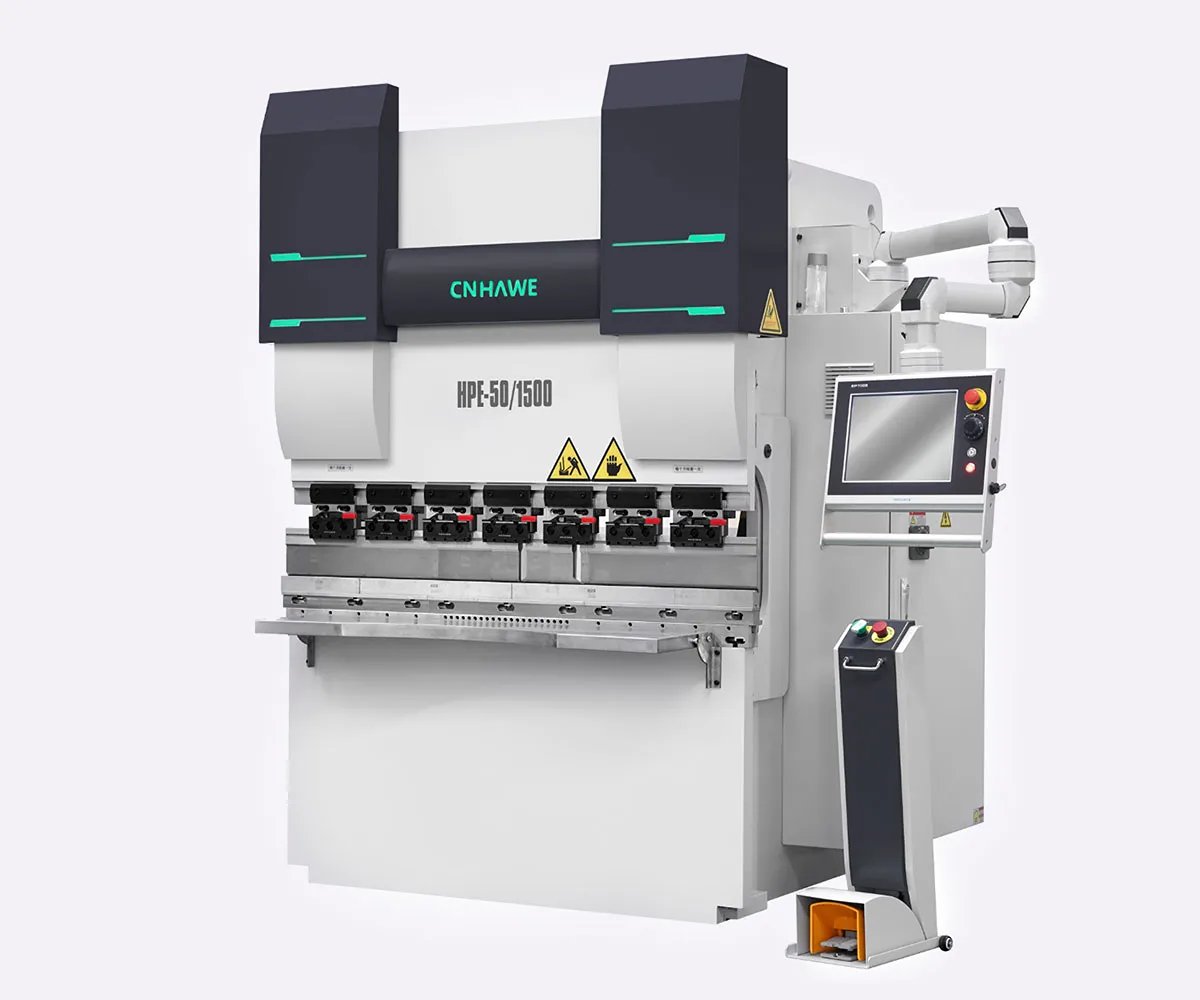

He’s running a 6‑second cycle on 11-gauge mild steel. Every stroke, he has to pull his hands and torso back 300mm to clear the light curtain. Five hundred parts on the traveler. Do the math: 2 seconds of step‑back and re‑entry per cycle is nearly 17 minutes per 500 strokes. Add hesitation, real human movement, and it creeps toward an hour of dead time in a long shift.
Nobody budgets for that hour.
Light curtains don’t stop at the beam. They stop at the physics behind it.
Most units have internal response times around 20–50 milliseconds. Add clutch‑brake delay—another 15–30 milliseconds—and then the actual mechanical stopping time of your press, which varies by tonnage, tool weight, and wear. When you run a proper 90‑degree crank test instead of trusting the brochure, you usually find the stop time is longer than you assumed.
Longer stop time means greater minimum safety distance. Greater distance means your operator must stand farther out of the work envelope.
So the “quick stop” becomes a geometry problem. And geometry steals seconds.
Light curtains absolutely allow open access for box bending and tight alignment work. I’ve run them. On small, repetitive parts, they feel fast because nothing physical blocks you. But that speed only holds if the operator’s natural working position already clears the calculated safety zone. The moment the job forces him inside that invisible fence, cycle time stretches.
The question isn’t whether they’re compliant. It’s whether they’re costing you in ways you stopped noticing.
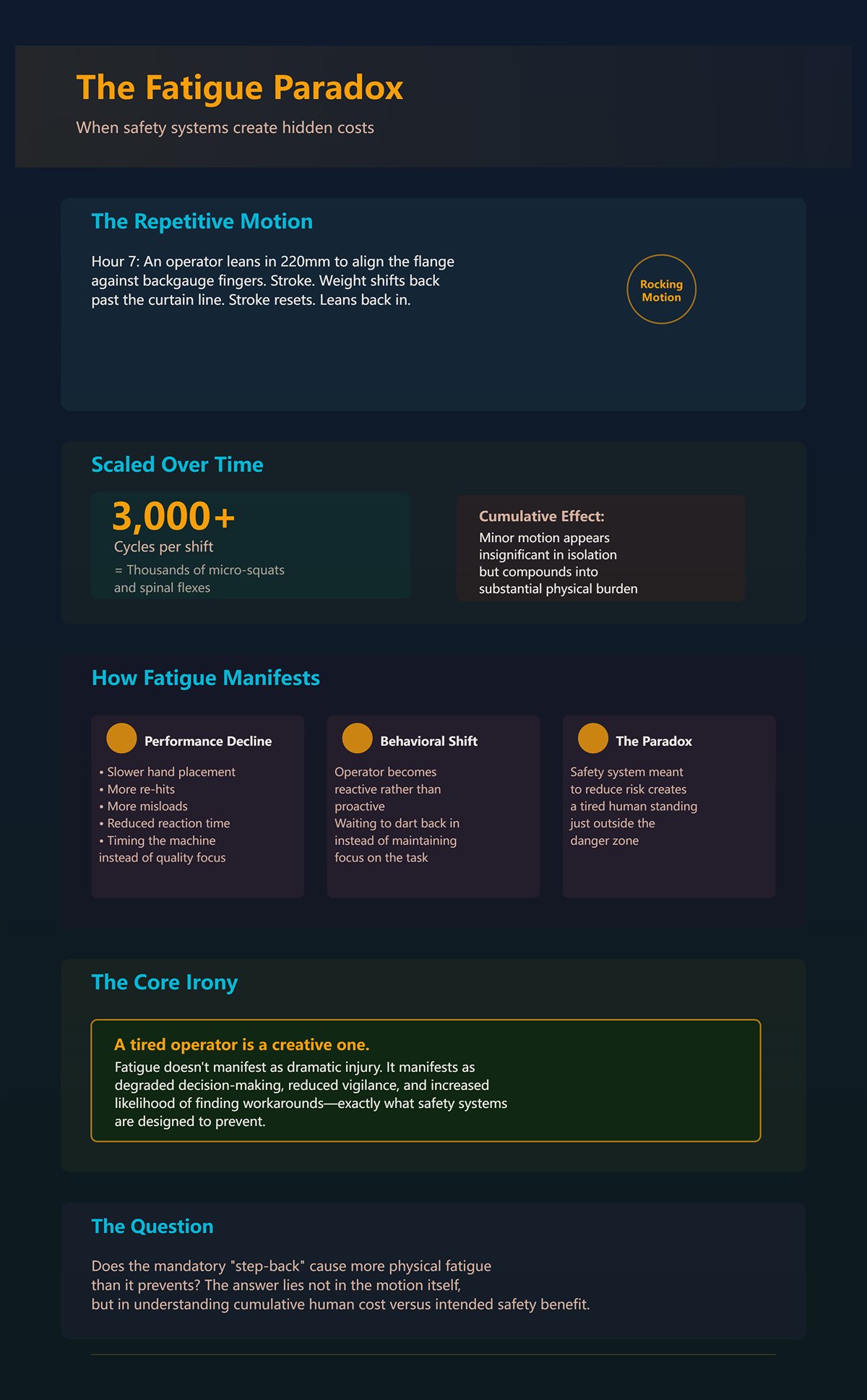
Watch an operator on hour seven.
He leans in 220mm to align the flange against the backgauge fingers. Stroke. He shifts his weight back past the curtain line. Stroke resets. He leans back in.
That rocking motion looks minor. Over 3,000 cycles, it becomes thousands of micro‑squats and spinal flexes.
Fatigue doesn’t show up as a dramatic injury. It shows up as slower hand placement, more re-hits, more misloads. The operator starts timing the machine instead of focusing on part quality. Reaction time drops. Ironically, the system meant to reduce risk creates a tired human standing just outside the danger zone, waiting to dart back in.
And a tired operator is a creative one.
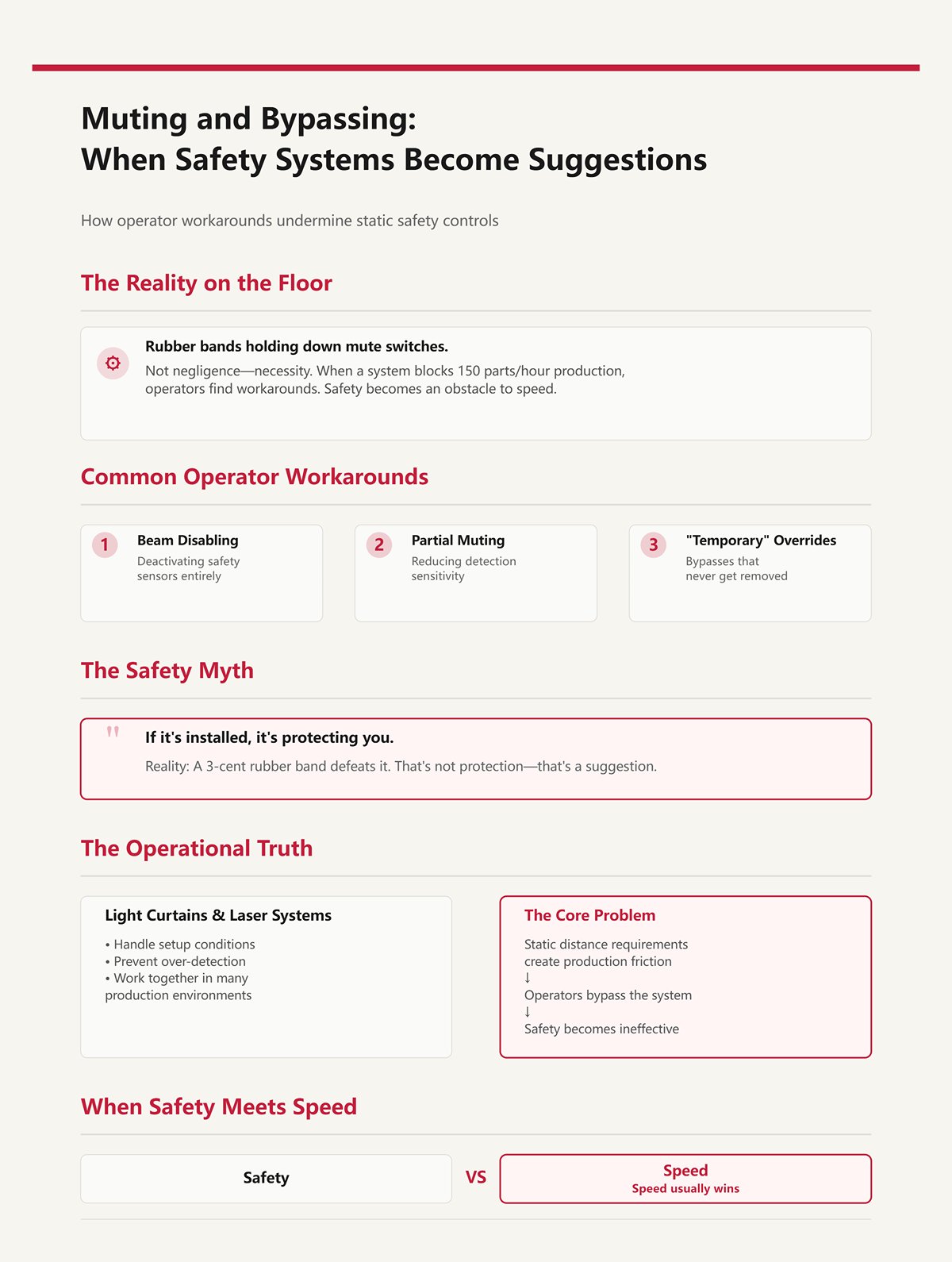
I’ve walked into shops where a rubber band held the mute switch down.
Not because the owner didn’t care. Because the job demanded 150 parts an hour and the curtain kept tripping during box bends. When a system blocks production, production finds a way around it.
Beam disabling. Partial muting. “Temporary” overrides that never get removed.
Safety myth: “If it’s installed, it’s protecting you.”
If an operator can defeat it with a 3-cent rubber band, it’s not a control—it’s a suggestion.
Now, to be fair, light curtains and laser systems often run together. Curtains handle setup conditions where a dynamic device might over-detect. But here’s the operational truth: the more your protection relies on keeping people a fixed distance away, the more temptation there is to cheat when that distance interferes with throughput.
When safety and speed fight, speed usually wins on a production floor.
What does that tell you about a system built on static distance?
High-mix work is where this really bleeds.
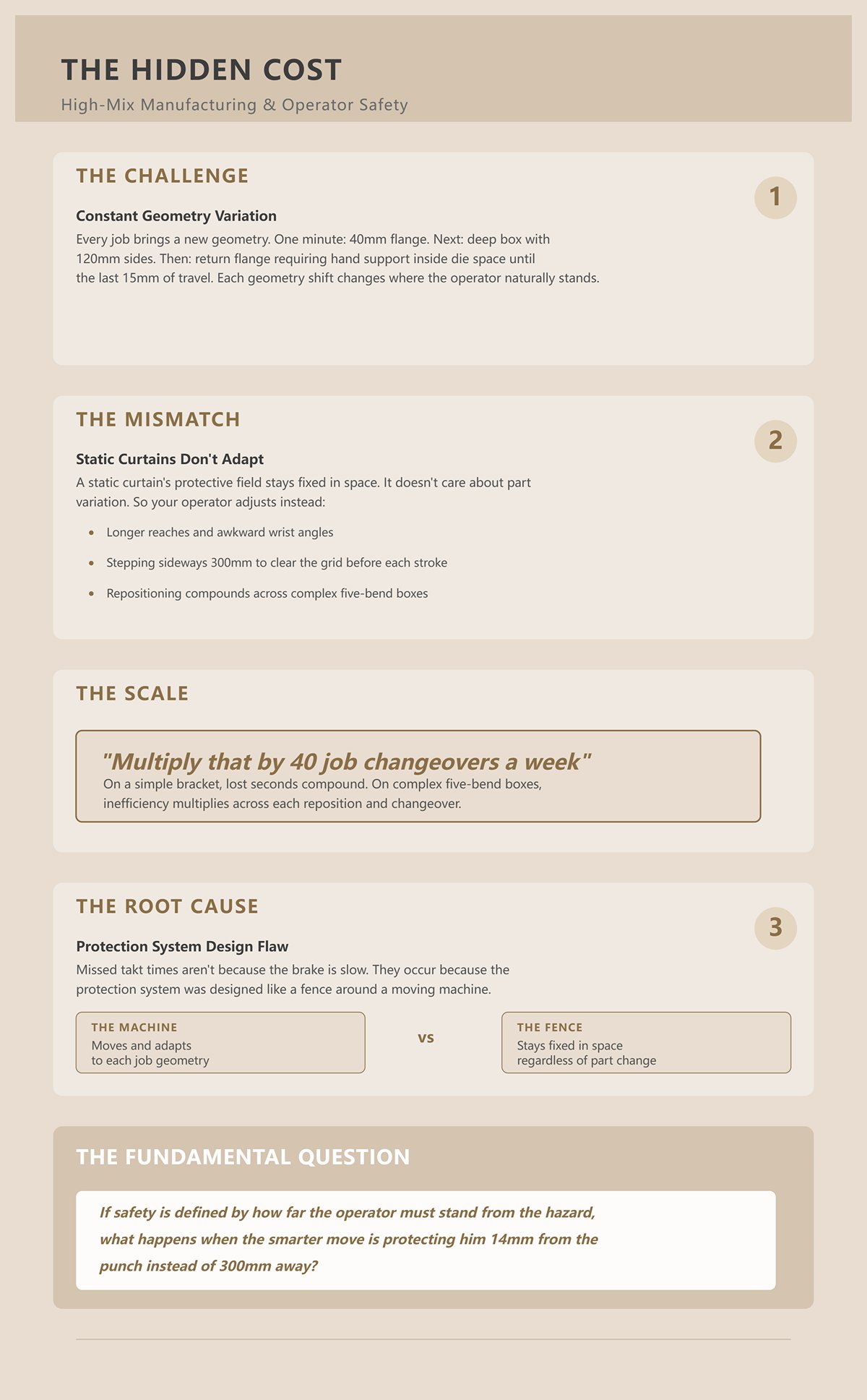
One minute it’s a 40mm flange. Next it’s a deep box with 120mm sides. Then a return flange that forces hand support inside the die space until the last 15mm of travel. Every geometry change shifts where the operator naturally stands.
A static curtain doesn’t care about part variation. Its protective field stays fixed in space.
So your operator adjusts instead—longer reaches, awkward wrist angles, stepping sideways 300mm to clear the grid before each stroke. On a simple bracket, that might cost you seconds. On a complex five-bend box, it compounds across each reposition.
Multiply that by 40 job changeovers a week.
You start seeing missed takt times not because the brake is slow, but because your protection system was designed like a fence around a moving machine. The machine moves. The fence doesn’t.
If safety is defined by how far the operator must stand from the hazard, what happens when the smarter move is protecting him 14mm from the punch instead of 300mm away?
Picture the punch tip 14mm above the sheet. Not 300mm back at the operator’s chest line. Fourteen. That’s roughly the thickness of a Sharpie cap. That’s where the pinch point actually forms as the upper tool closes on the V‑die.
A static light curtain throws an invisible wall somewhere out in front of that—calculated from total stopping time, clutch delay, hydraulic overrun, everything stacked together. It protects by distance. The laser guard protects by proximity.
That difference sounds small until you trace what actually moves during a stroke.
A light curtain creates a fixed rectangular grid in space. The ram travels through it, but the protective field does not travel with the ram. So when the punch is 120mm above the die, the curtain is already enforcing the same boundary it will enforce 2mm above contact. It doesn’t know where the danger truly begins; it just knows worst-case stopping distance.
A tool-following laser mounts on the upper beam and projects a horizontal sensing field just under the punch tip. As the ram descends, that sensing field descends with it—tracking the tool within roughly 14mm of the tip on modern hydraulic systems with tight stop control. The hazard moves. The protection moves.
That’s not a fence anymore. That’s a spotter walking shoulder-to-shoulder with the tool.
But does tracking the punch actually change anything in the real world, or is this just a cleaner diagram on a brochure?
Let’s run a real scene.
Operator’s aligning a 120mm-deep box. His left hand is 18mm from the punch centerline, fingers supporting the flange inside the die space. On a curtain system calculated at, say, 280mm safety distance based on stop time, he has to withdraw completely before the downstroke can even begin. The system cannot distinguish between “hand near but safe” and “hand in the pinch.” It only sees perimeter breach.
With a point-of-operation laser, the machine runs at safe speed while his hands are in the zone. Safe speed under most area optic protective device rules means under 10mm per second until the mute point. That’s slow, yes—but it allows hands-in positioning without tripping the system because the beam is monitoring the actual pinch line 14mm under the punch, not empty air 300mm away.
The change is geometric.
Static curtain: safety is defined as a rectangular prism in front of the machine.
Tool-following laser: safety is defined as a moving plane directly under the tool edge.
When the operator’s natural working position already clears the calculated safety zone, both systems feel fast. But the moment the job demands fingers inside that rectangle—tight returns, hemming setups, awkward offsets—the curtain forces full withdrawal. The laser allows controlled presence until danger is real.
That’s why dynamic systems feel different on high-mix work. They shrink the protected volume from “everything in front of the brake” to “only what’s about to get crushed.”
There’s a machine-type caveat here. Mechanical press brakes with long fixed stopping distances—sometimes measured in feet, not millimeters—can’t support tight tracking. Their overrun makes precise muting unreliable. On those, you’re back to barriers and big distances because the physics won’t cooperate. Hydraulics and modern servos with consistent stop times are where tool-following actually works.
So geometry improves. But geometry alone doesn’t buy you cycle time unless the machine can stop fast enough to justify that 14mm claim.
Which brings us to milliseconds.
| Aspect | Perimeter Blocking (Light Curtain) | Point-of-Operation Tracking (Tool-Following Laser) |
|---|---|---|
| Basic Safety Logic | Detects intrusion into a predefined perimeter zone | Monitors the actual pinch point directly under the tool |
| Safety Geometry | Fixed rectangular prism in front of the machine | Moving plane directly beneath the tool edge |
| Example Scenario | Operator’s hand 18mm from punch centerline still triggers system if within perimeter | Operator can position hands near punch; system monitors 14mm under punch |
| Required Operator Action | Full withdrawal before downstroke begins | Hands allowed in zone at safe speed until mute point |
| Safe Speed Operation | Not applicable; machine stops if perimeter is breached | Operates under 10mm/sec until mute point when hands are detected |
| Sensitivity to Hand Position | Cannot distinguish between “near but safe” and “in the pinch” | Detects actual danger at pinch line |
| Impact on Tight or Complex Jobs | Forces full withdrawal during tight returns, hemming, offsets | Allows controlled presence until real danger occurs |
| Effect on High-Mix Work | Feels restrictive when frequent repositioning is needed | Feels more efficient due to reduced protected volume |
| Protected Volume | “Everything in front of the brake” | “Only what’s about to get crushed” |
| Machine Compatibility | Works on most machines, including mechanical types | Best suited for hydraulics and modern servos with consistent stop times |
| Limitation on Mechanical Press Brakes | Large stopping distances require bigger safety zones | Overrun makes precise muting unreliable |
| Dependency on Stop Time | Safety distance increases with longer stop times (e.g., 280mm) | Tight tracking (e.g., 14mm) only valid if machine stops quickly |
| Cycle Time Impact | Reduced efficiency when frequent withdrawals are required | Improved efficiency if machine can stop fast enough to justify close tracking |
Take a hydraulic brake with a verified stop time of 60 milliseconds at bending speed. At 10mm per second safe speed, in 60 milliseconds the ram travels 0.6mm. That’s tight control. That’s predictable.
Now push the machine into high-speed approach—say 200mm per second. In 60 milliseconds, the ram moves 12mm. Suddenly your 14mm tracking margin isn’t theoretical; it’s almost fully consumed by motion during stopping.
This is why stop-time testing matters more than spec sheets. I’ve seen brakes advertised with aggressive approach speeds, but when we ran a proper 90-degree test, real stopping distance forced the speed-change point much higher—sometimes 20mm or more above the sheet. That erases the advantage. You’re basically creeping the last 20mm every cycle.
And creep time adds up.
On a 6-second cycle, if the last 20mm are limited to 10mm per second, that’s 2 extra seconds just in guarded approach. Multiply by five hundred parts on the traveler and you’ve handed back over 16 minutes—again. Same math as the step-back problem, just hiding inside the stroke instead of the operator’s feet.
Advanced systems tighten that window. They use progressive muting logic—switching from safe speed to high speed only when the laser confirms the pinch line is clear and the material is detected. That’s how you get the mute point down near 6mm instead of 20-plus. But not all “laser guards” do this. Some are just slower light curtains wearing different clothes.
Electric brakes complicate it further. They can stop extremely fast—millisecond-level response with minimal hydraulic drift—so in theory they pair beautifully with tight tracking. But push them toward their upper tonnage limits and stopping consistency can vary under heavy loads, especially near capacity. You gain precision; you may sacrifice stability at the extremes.
So milliseconds aren’t academic. They decide whether your protection hugs the tool… or forces you to crawl the last inch of every bend.
Which leads to the most misunderstood part of the whole system.
Watch the last 10mm of travel on a well-tuned hydraulic brake with a modern laser guard.
At about 6mm above the sheet surface, the system detects material presence and confirms no obstruction in the protected plane. The laser mutes—meaning it temporarily suspends detection—because below that point, the punch and material themselves block the sensing field. The risk area is now mechanically enclosed by tool and sheet.
Six millimeters is not arbitrary. It’s set above the material to account for deflection, sheet variation, and verified stopping distance at approach speed. Close enough to protect the true pinch. High enough to allow the machine to complete the bend at full speed without nuisance trips.
Contrast that with older or poorly integrated systems muting at 20–23mm because the machine’s overrun can’t guarantee a tighter stop. That extra 14–17mm of slow approach is pure dead time. You feel it most on shallow bends where the total forming travel might only be 25mm to begin with.
The laser isn’t “turning off early.” It’s handing off protection from optics to physics at the exact moment the pinch point becomes enclosed by the tooling itself.
That’s the shift.
Safety stops being a static perimeter you must retreat from and becomes a dynamic zone that collapses down to the real hazard line—14mm, then 6mm, then zero as the tools close.
When protection can live that close to the punch without forcing you to step back 300mm every cycle, what does that unlock for hands-in alignment and complex bends you used to dread?
When protection can live 14mm from the punch instead of 300mm in front of the machine, the operator stops stepping back and starts working inside the bend window.
That’s the shift you actually feel on the floor. Not in a spec sheet. In your wrists.
With a static curtain, hands have to clear an invisible wall every cycle. On simple parts, fine. On high-mix jobs—tight returns, offset flanges, shallow hems—you’re constantly breaking plane, resetting, re-approaching. The machine dictates your body position. But when the protected zone collapses down to the true pinch line, the operator can hold the blank 22mm from a forming flange, 18mm from a backgauge finger, and still let the ram approach at speed because the system only cares about the 14mm directly under the tool.
That’s where “hands-in” becomes real.
The question isn’t whether operators keep their fingers in during the entire stroke—they don’t. Physics still wins. The question is how long they can stay in control before withdrawal is required, and how far they have to retreat.
And that difference shows up fast on box work.
Take a 120mm-deep box with 25mm side flanges already formed.
On a curtain, those rising sides break beams constantly unless you start channel blanking. Blank too much and you’ve just created a window big enough for a hand. Blank too little and the machine trips every stroke. So the operator adapts: pre-lift the part, lean back, re-square mid-air, then rush hands out before the last approach. It works. It’s slow.
Now shrink the guarded zone to a plane tracking 14mm below the punch tip.
The side flange can travel upward because it’s outside the pinch line until the final closure. The operator can guide the box walls with fingertips 30mm from the forming edge while the ram descends at approach speed. Withdrawal happens later—closer to the real hazard—because the hazard is defined tightly.
Small flanges amplify this. A 12mm return doesn’t give you much to hold. With a static barrier, the operator often supports from the far side or uses awkward grips just to stay outside the curtain. With tool-following protection, they can stabilize directly adjacent to the bend line until the last controlled moment.
Less choreography. More control.
But that only works if the system knows the difference between steel moving up and flesh moving sideways.
It has to.
If it can’t reliably stop before contact, it doesn’t pass inspection. Period. I’ve sat across from inspectors who don’t care how modern the brochure looks—they care whether the ram stops before a finger would be touched. That means verified stopping time, consistent hydraulics, and detection resolution tight enough to see intrusion inside that 14mm envelope.
Here’s the mechanism.
The laser projects a continuous plane directly under the punch. As the material rises during a box bend, the system expects obstruction aligned with the programmed bend line and tool geometry. That’s predictable. A hand entering from the side breaks the plane in a different vector and location—outside the allowed material profile—and the control reacts within the tested stop time window.
Is it magic? No. It’s geometry plus milliseconds.
And yes, there are limits. Mechanical brakes with long overrun can’t support this because their stopping distance might be 20mm at speed. You can’t promise protection at 14mm if the machine coasts past it. That’s why this is a hydraulic and modern servo conversation.
The real-world test is simple: run a complex box job and watch whether the system trips on every rising flange. If it does, operators stop trusting it. If it doesn’t—and still stops instantly when a dowel rod intrudes where a hand shouldn’t be—you stop fighting the machine.
Trust is earned in strokes, not brochures.
Which leads to something most owners miss.
Every nuisance stop teaches an operator that the machine is wrong.
Do that fifty times in a shift and someone will look for a workaround. I’ve seen mute switches held down with tape. I’ve seen channel blanking widened until you could pass a 30mm socket through. And I’ll say it the same way I say it in audits: ”If an operator can defeat it with a 3-cent rubber band, it’s not a control—it’s a suggestion”
When dynamic blanking allows legitimate material movement without constant false trips, you remove the incentive to cheat the system. The operator keeps both hands engaged in controlled positioning until physics—not frustration—forces withdrawal.
That’s safer.
And it’s faster, because you’re no longer burning two seconds per stroke on reset delays and re-approach creep. Over five hundred parts on the traveler, that’s the difference between finishing before second shift or explaining to a customer why their high-mix job slipped a day.
Hands-in isn’t about bravado. It’s about letting skilled people work naturally inside a tightly defined hazard zone instead of bouncing off an oversized perimeter.
So if close-proximity bending can be both controlled and compliant when the machine can truly stop on time, the next question isn’t about speed anymore.
It’s about whether your existing brake—and your next audit—can live with it.
I was standing next to a 1992, 135-ton hydraulic brake when we ran the stop-time test. Full approach speed. Triggered at 12mm above a test block. The ram overran 9mm after the signal. Not theory. Measured with a calibrated scale bolted 14mm from the punch centerline.
The owner looked at the laser spec sheet—response time in single-digit milliseconds—and said, “So we’re covered, right?”
No. Because the laser doesn’t stop the ram. The hydraulics do.
A millisecond detection means nothing if your proportional valve and pump take 40 milliseconds to build counter-pressure. Stopping distance is physics: speed × total reaction time. That total includes sensor response, control processing, valve shift, and fluid deceleration. If that stack adds up to 70 milliseconds at 200mm per second approach, you’ve already traveled 14mm before deceleration even begins. You can’t claim protection at 14mm if your machine eats that in reaction lag alone.
This is where audits are won or lost. Not on brochures. On measured overrun.
If close-proximity protection shrinks the guarded zone to the real pinch line, then the machine and the safeguarding system have to be evaluated as one unit. Otherwise you’re selling acceleration on a brake system that can’t stop.
So what does that look like when an auditor walks in with light curtains in his mental template?
I sat through a CE review where the first question was simple: “Show me your stopping time calculation.” No one cared whether it was a light curtain or a laser. They cared whether the safety distance formula matched measured performance under EN 12622.
Under CE, the machine builder (or retrofitter) has to demonstrate that the protective device, control system category, and stopping performance meet the required performance level. That means documented stop-time tests at maximum speed, worst-case tonnage, and verified safety distance. It’s math tied to metal.
OSHA 1910.212 in the U.S. is less prescriptive about formulas, but just as blunt about outcome: the point of operation must be guarded to prevent contact. In an investigation, they don’t debate brand names. They ask: could the operator reach the hazard before the machine stopped?
Here’s where shop owners get nervous. Light curtains are familiar. Auditors have seen them for 20 years. Lasers feel new, even when they’ve been on the market for a decade.
So you anchor the conversation in mechanism, not novelty.
A static light curtain throws a vertical plane several hundred millimeters in front of the die. Safety distance is calculated from stopping time, so the faster the brake stops, the closer that plane can be. But it’s still a fence around the front of the machine.
A laser guard projects a horizontal plane directly under the punch, typically 10–20mm below the tip depending on configuration. It follows the tool. The safety distance is now vertical, tied to the ram’s approach and stop performance. Different geometry. Same compliance logic: detect intrusion, stop before contact.
The auditor’s real concern isn’t technology. It’s defeatability.
Remember the 36-ton brake where 75–100mm of a curtain was blanked for a previous job and never restored? Three fingertips gone because a static zone was manually widened and left that way.
Dynamic systems change that failure mode. Properly configured laser guards don’t rely on permanent blanking across the opening. They monitor within a defined envelope around the punch and use programmed tool geometry. You can still misconfigure them—any system can be abused—but you’re not leaving a 100mm invisible tunnel across the whole front of the machine.
And I tell owners this plainly: safety doesn’t mean “no one got hurt yet.” It means you can prove, with data, that the machine stops before contact under worst-case conditions. If you can’t show the stop-time report, the performance level, and the wiring category, you’re not surviving a serious audit.
But compliance on paper is one thing. Compatibility with a 30-year-old hydraulic system is another.
Mechanical brakes built before the mid-80s had long stopping times because of clutch and flywheel inertia. That’s why light curtains were often impractical—you needed a safety distance so large it killed usability.
Hydraulics improved that. Faster valve response, better control of deceleration. That’s what made closer protection viable.
But not all hydraulics are equal.
Suppose your brake approaches at 180mm per second. You run a measured total stop time of 85 milliseconds at full speed. That’s 15.3mm of travel before full stop, not counting mechanical compliance or load variation. If your laser plane is 14mm below the punch, you’re already in violation of your own geometry. You’re promising protection inside a distance the machine physically cannot honor.
You have three options:
This is why I say the laser and the brake are a married couple. You can’t evaluate one without the other.
And here’s the uncomfortable part: sometimes a physical barrier door is the smarter retrofit. Barrier guards contain secondary hazards—flying slugs, sparks from adjacent processes—that neither light curtains nor lasers address. In tight-floor layouts, a door can let operators stand closer because it contains the hazard rather than calculating distance from it.
Laser guards are production accelerators when the bottleneck is nuisance stops and oversized safety zones. They are not magic shields against debris, smoke, or bad hydraulics.
So before you sign a purchase order, you ask one hard question: what is my measured stopping distance at maximum approach speed, and how stable is it across shifts and loads?
Because the next risk isn’t mechanical. It’s human.
I’ve watched a 25-year operator test a new safeguard the way a machinist tests a vise—by pushing on it.
He slid a 10mm dowel into the detection plane from the side during approach. The ram stopped instantly. He nodded.
Then he tried to “ride” the material upward during a box bend, expecting nuisance trips. None came. The system distinguished the rising flange from a lateral intrusion. He nodded again.
Trust builds in strokes, not meetings.
But veterans also have muscle memory. If the old curtain tripped every third cycle, they learned to hover, pre-lift, or—worse—mute. Bring in a new system and they’ll look for the same workaround patterns.
This is where configuration and supervision matter.
If the system requires constant manual blanking or has easily accessible override modes, you’re back to the rubber band problem. And I’ll repeat it the same way I do on the floor: ”If an operator can defeat it with a 3-cent rubber band, it’s not a control—it’s a suggestion”
Modern laser systems tied into the machine’s safety PLC (programmable logic controller) can lock out override functions without keyed authorization and log intrusion events. That audit trail changes behavior. When operators know every mute, every reset, every fault is recorded with a timestamp, casual bypassing drops fast.
But here’s the bigger shift.
When nuisance stops disappear, the incentive to cheat disappears with them. The operator keeps fingertips 30mm from the forming edge until physics—not frustration—forces withdrawal. That preserves both control and cycle time. Over five hundred parts on the traveler, eliminating even a 1.5-second reset per stroke is over 12 minutes back in your day.
The audit survival question isn’t “Is laser better than curtain?”
It’s this: can your specific brake, with documented stopping performance, integrated controls, and disciplined configuration, support close-proximity protection without inviting either hydraulic overrun or human workaround?
Answer that with measurements and behavior—not marketing—and you don’t just survive the retrofit reality check.
You earn the right to run closer, faster, and still sleep at night.
Which raises the harder question.
Where does this approach not make sense at all?
You want the straight answer? Close-proximity laser safeguarding does not make sense when the environment lies to the optics or when the scale of the work dwarfs the protection zone.
I love what a well-tuned laser system can do. I’ve seen it run 14mm below the punch, muting at 6mm before contact, letting an operator keep fingertips exactly where muscle memory wants them. It feels like a trained spotter walking shoulder-to-shoulder with the tool instead of a fence set 800mm back.
But a spotter still needs clear eyes.
When the air turns opaque, or the part behaves like a mirror, the physics that made close protection so elegant start working against you. And when you’re wrestling a 4-meter sheet that weighs as much as a compact car, proximity isn’t your only risk variable anymore.
So where does it actually break down?
Optical systems assume light travels in a straight, predictable path. That assumption is fragile.
Take heavy plate bending after plasma or oxy-fuel cutting. You’ve got fine oxide scale floating in the air, sometimes visible in the beam of the overhead lights. That particulate doesn’t care about your safety category rating. It scatters and attenuates the laser signal. The receiver sees noise. The control sees interruption. You see nuisance stops.
Two stops per sheet on a 6-minute cycle sounds trivial until you stack it over five hundred parts on the traveler. That’s not a safety debate anymore. That’s a bottleneck at forming starving welding.
Highly polished stainless brings a different problem. Instead of scattering the beam, it can reflect it. Now you’re dealing with potential false readings or signal instability if alignment isn’t exact within millimeters. A light curtain—static emitters and receivers spanning a fixed plane—tends to be more tolerant of environmental chaos because it protects space, not just the pinch line.
And neither optical system contains debris.
If you’re bending next to a weld cell throwing sparks or you’ve got slugs occasionally popping from a poorly maintained punch, the laser doesn’t stop shrapnel. A physical barrier door does. I’ve specified barrier guards in cells where both curtains and lasers were technically compliant but operationally blind to secondary hazards.
That’s not a knock on lasers. It’s a reminder that they solve one problem precisely—the point of operation—and nothing else.
Which makes you ask: what happens when the problem isn’t just the point of operation?
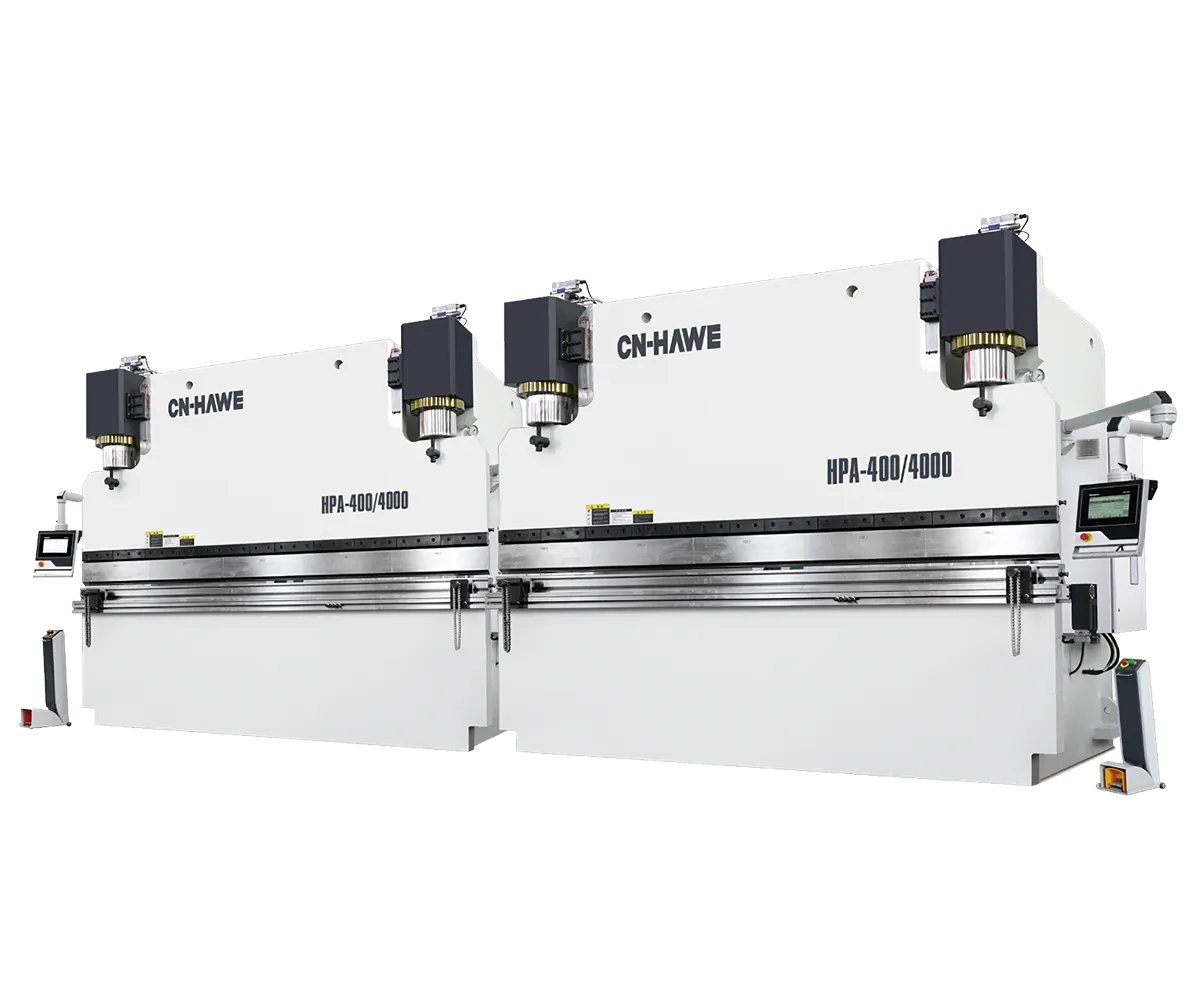
Now picture a 320-ton brake with a 4,000mm bed running 8mm mild steel panels. Two operators. Sometimes three. The sheet flexes 20mm under its own weight before it even hits the die shoulders.
Your risk envelope just expanded beyond 14mm below the punch.
On large-format work, hands aren’t hovering near a single pinch line. They’re stabilizing, guiding, counteracting sag across meters of material. A tool-following laser protects the immediate forming zone beautifully. It does not create a perimeter around the rest of that moving mass.
A light curtain, set at a calculated safety distance based on measured stop time, creates a defined boundary. Step inside during approach, and the machine won’t stroke. Simple geometry. Fewer variables. In team bending scenarios, that simplicity matters more than proximity.
Deep box tooling can push you there too.
If you’re running tall-sided parts that require channel blanking or special muting strategies to accommodate flange return, you’re increasing configuration complexity. Complexity invites misconfiguration. And misconfiguration invites the same old problem: protection on paper, gaps in reality. I’ve seen setups where the protected zone and the real hazard zone didn’t fully overlap because the part geometry forced compromises.
At that point, the question shifts.
Not “Which device is more advanced?” but “Which one protects the actual risk envelope of this job with the least operator gymnastics?”
Because sometimes the fixed fence around the machine is exactly what the job needs—and trying to force a shoulder-to-shoulder spotter into that scenario just adds moving parts where you can’t afford them.
And that’s where this stops being about technology preference and starts being about operational goals.
You’re not choosing between “laser” and “curtain.” You’re choosing how many finished parts leave the floor before second shift clocks out.
That’s the non-obvious part. Most owners still frame the decision around incident rates and audit language. I frame it around throughput under real constraints: stop time, part geometry, operator behavior, and how often the machine gets reset because someone’s natural movement crossed an invisible line.
Static light curtains are a fixed fence around a moving process. Laser guards are a sensor riding 14mm below the punch, muting at 6mm before contact, collapsing protection down to the actual pinch point. One protects space. The other protects motion. Only one of those scales with cycle speed.
So how do you decide without guessing?
Walk to the brake. Don’t look at the safeguarding first. Look at the hands.
Are they stabilizing a 4,000mm sheet that flexes 20mm under its own weight? Are there two operators stepping in and out of each other’s zones? Or is it a single operator running repeat brackets, fingers living within 30mm of the die shoulders all day?
You’re not protecting “a press brake.” You’re protecting a specific human movement pattern inside a specific risk envelope.
If the real hazard is the pinch line 14mm below the punch on short-run brackets, a dynamic laser that follows the tool makes sense. It shrinks the protected zone to match the danger zone. The operator works naturally. No stepping back 800mm to clear a curtain plane.
If the hazard includes flying scale from plasma-cut plate or a second operator drifting into the work envelope, that’s not a pinch-line problem. That’s a perimeter problem. A physical barrier or properly distanced light curtain protects the larger geometry.
Here’s the filter I use: map the operator’s closest intentional hand position in millimeters from the punch at peak risk. Then map the farthest unintentional exposure—team bending, material whip, debris. The safeguarding method has to cover both. If one device forces you to distort normal movement just to stay compliant, it’s the wrong fit.
Because protection that fights the way people actually work gets bypassed.
Let’s talk money, not manuals.
Take a hypothetical but realistic job: 6-second cycle, 500 parts on the traveler. That’s 3,000 seconds of pure stroke time—50 minutes. Now add 0.5 seconds per cycle because the operator has to step back to clear a curtain and step in again. That’s 250 extra seconds. Over 4 minutes gone.
Doesn’t sound catastrophic.
Now multiply that by four travelers a day on the same brake. Sixteen minutes. Over a month, you’ve buried hours of spindle time in geometry alone. Welding waits. Shipping waits. Overtime creeps in.
Laser guards don’t magically make the ram faster. They remove the forced choreography around a static safety plane. If the operator’s natural working position already clears the calculated safety zone, you gain nothing. But that speed only holds if the operator’s natural working position already clears the calculated safety zone. When it doesn’t, dynamic protection gives those seconds back.
And here’s the hard truth: both light curtains and lasers are presence-sensing devices. If your brake can’t stop within verified parameters, neither saves you. The system’s stopping performance—tested, documented, repeatable—is the foundation. Without it, you’re arguing about paint color on a cracked frame.
The real ROI question isn’t “Which has fewer incidents?” It’s “Which lets me run closest to the hazard, safely, with the least artificial movement per stroke?”
That answer shows up in cycle time, not injury logs.
Most safety upgrades are sold as constraints. Bigger distance. Bigger buffer. Bigger box around the machine.
That mindset assumes the operator is the problem to be kept out.
Dynamic, tool-following protection flips that. It assumes the operator is part of the process and keeps the control system 14mm from the punch instead of 800mm from the floor tape. It doesn’t block access; it rides the hazard.
There’s a behavioral piece here owners miss. When protection aligns with how the job is actually done, workarounds disappear. When it doesn’t, someone finds a way. “If an operator can defeat it with a 3-cent rubber band, it’s not a control—it’s a suggestion.”
Enabling doesn’t mean permissive. It means calibrated. Verified stop time. Correct safety distance calculation. Protection matched to the real risk envelope. Then you let the operator work at full, natural speed inside that envelope.
Stop buying devices because they look more advanced or more traditional. Start buying the configuration that lets you run closest to the true hazard—no closer, no farther—with the fewest wasted millimeters of movement per stroke.
Once you see safety as a cycle-time variable instead of a compliance checkbox, the decision stops being emotional.
It becomes operational.