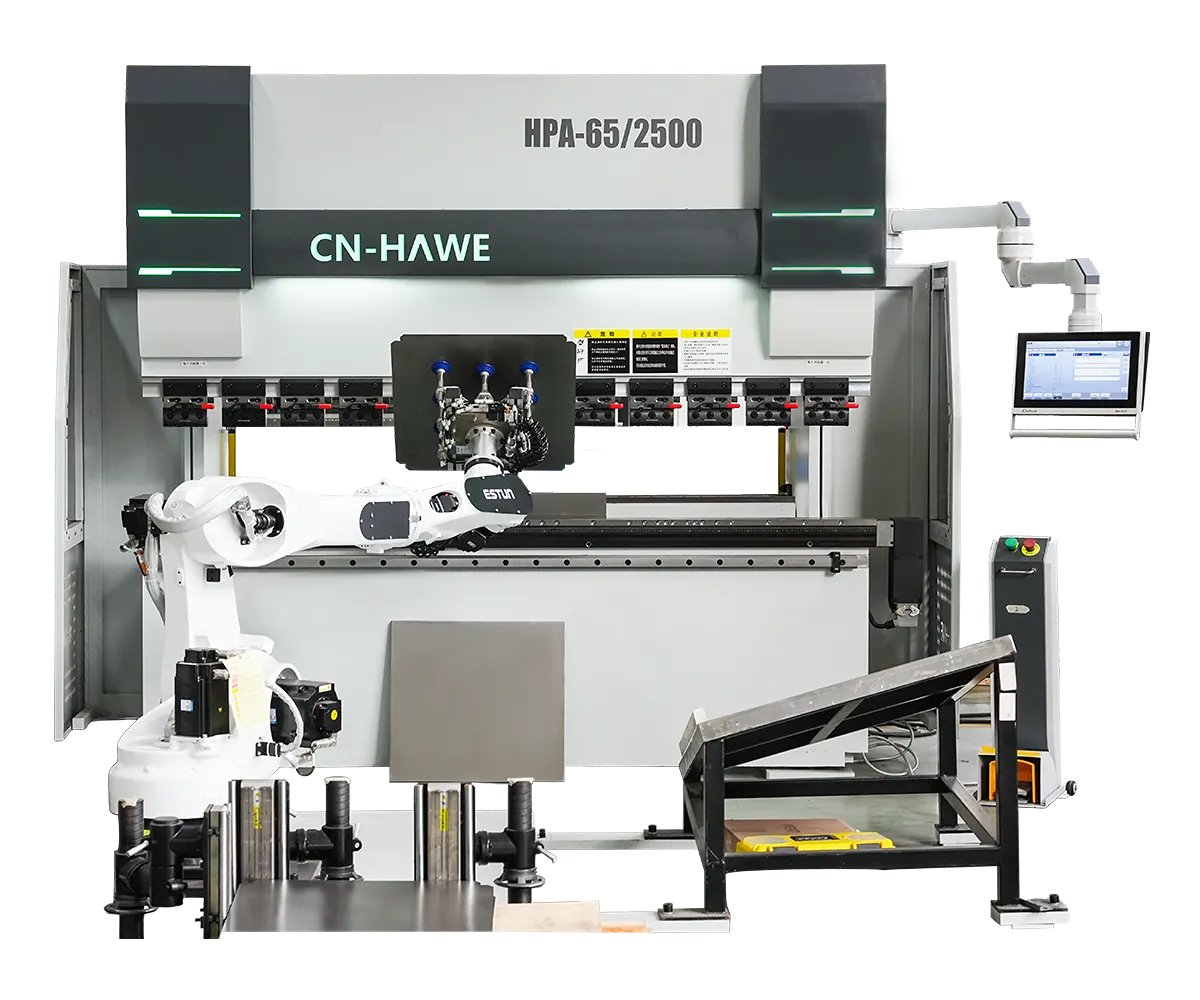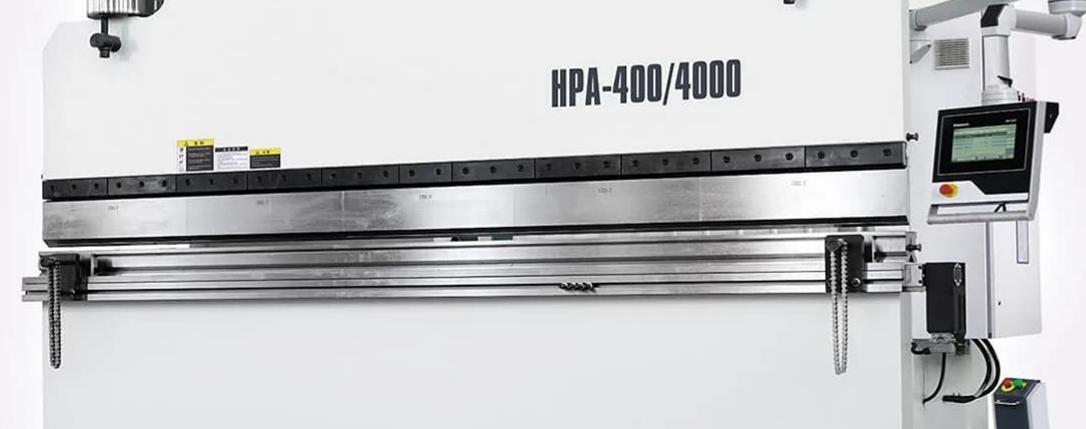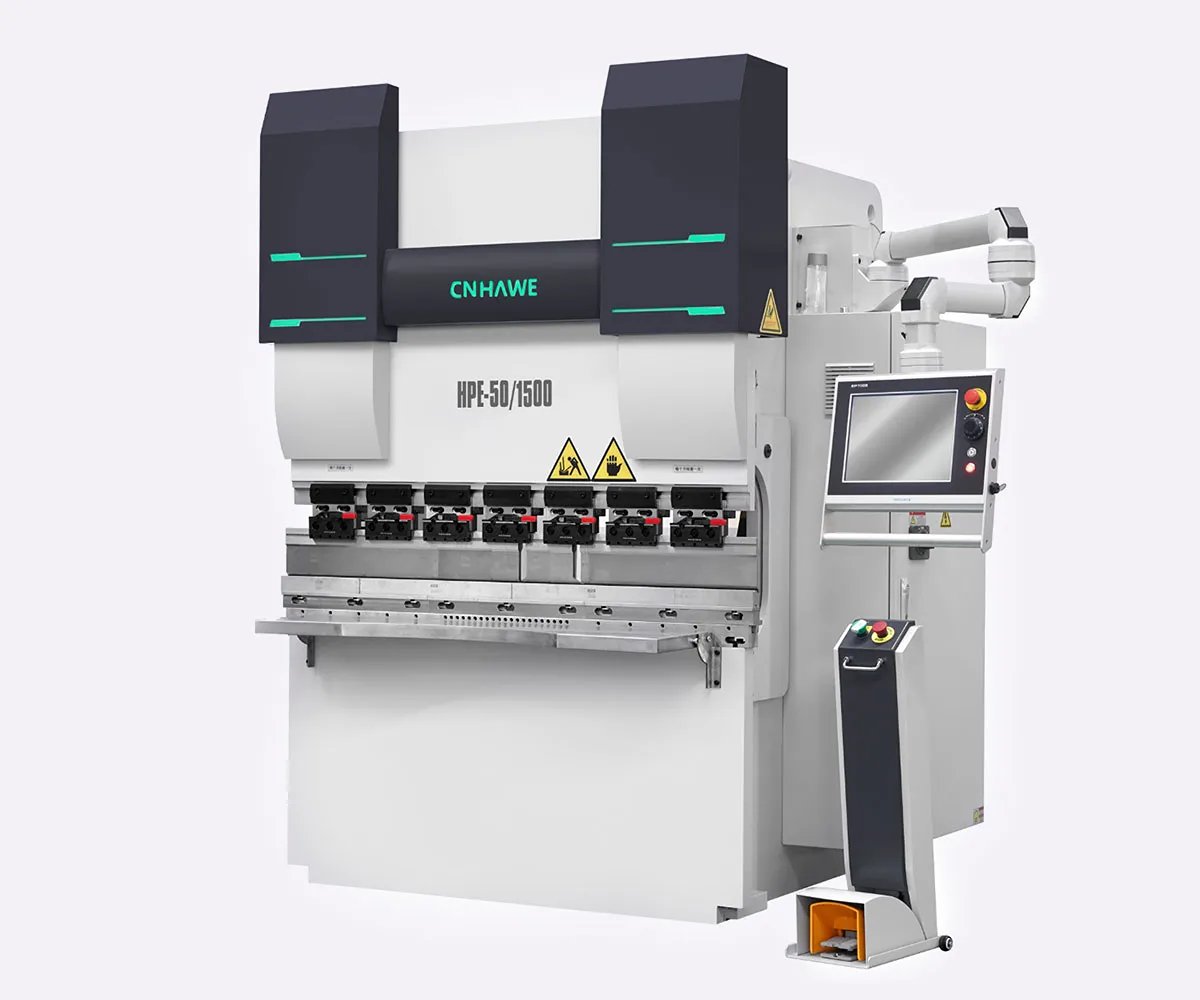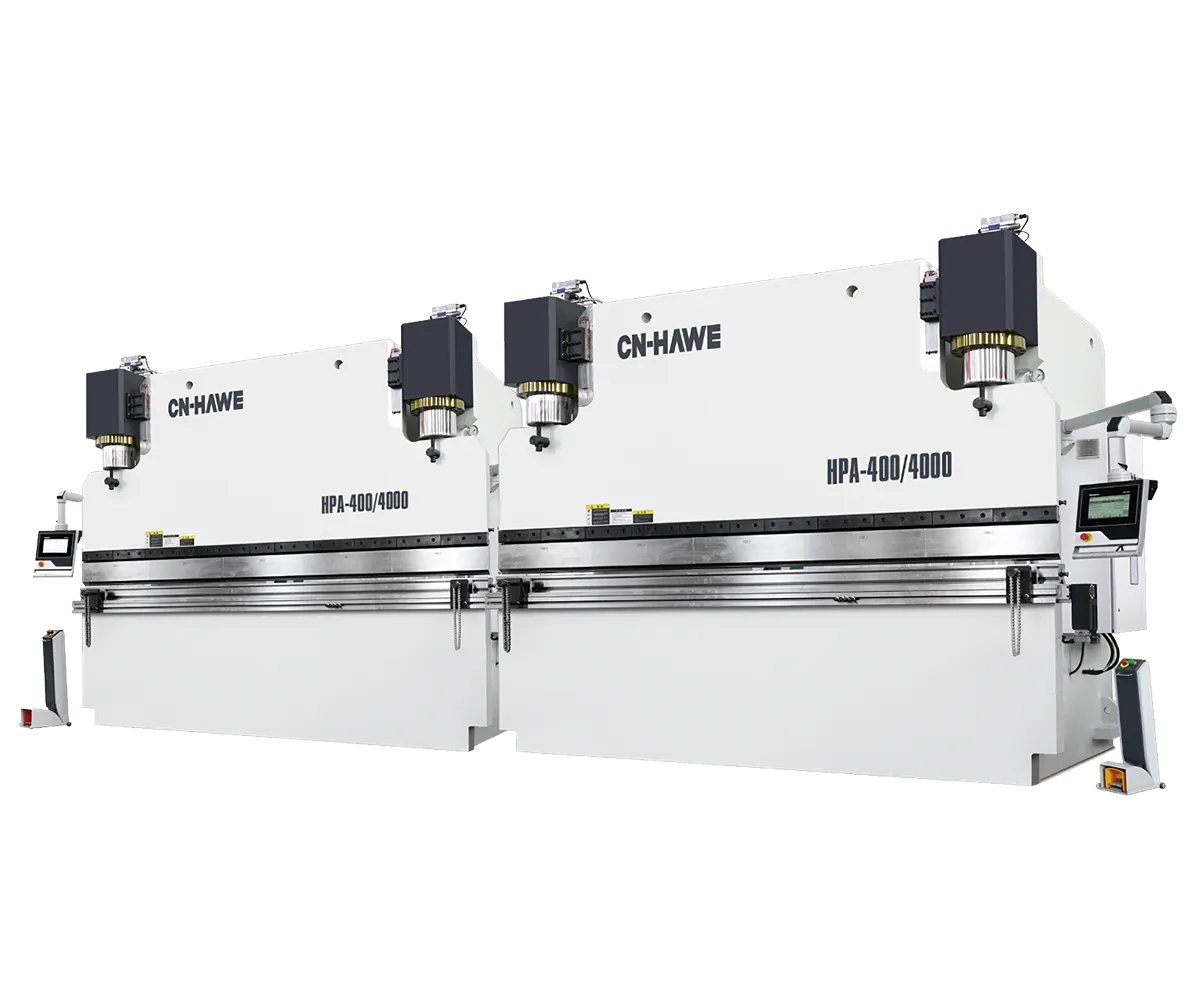

The first time someone told me their shop had “direct drive,” I heard it before I saw it.
That rising whine. The flywheel spooling up like it’s clearing its throat. Then the clutch snaps and the whole frame shudders into the stroke. If that’s what you’re picturing when you hear direct drive, we need to slow down.
Because that sound is yesterday.
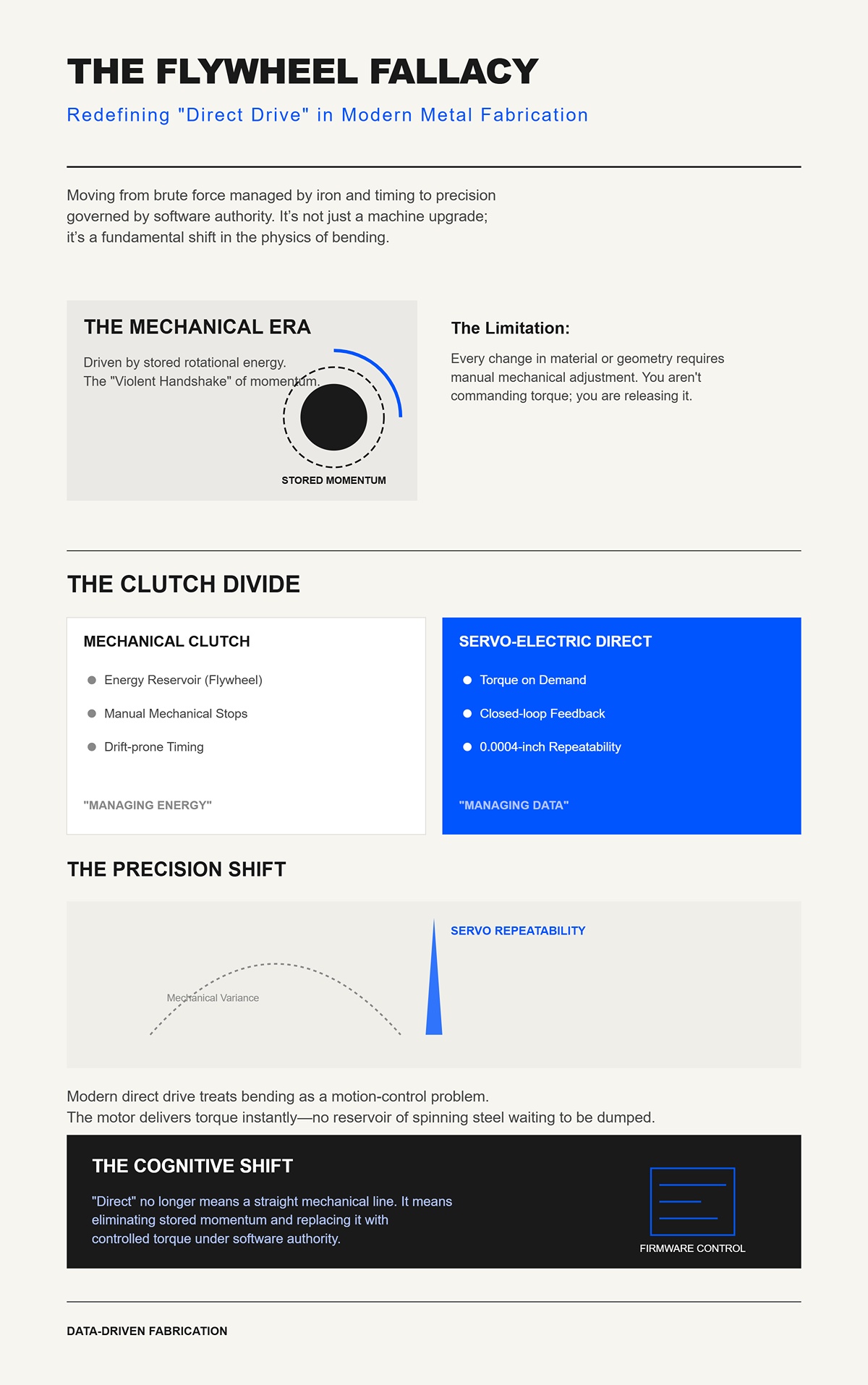
Walk up to a press brake with a spinning mass the size of a truck tire and a mechanical clutch tying motor to ram. You can feel the stored energy in the floor. That machine bends by momentum. It hoards rotational energy, then dumps it in one violent handshake.
That was “direct” once—motor to flywheel to crank to ram, no oil in between. But it’s still brute force managed by iron and timing, not software. And when you change material thickness or punch geometry, you’re not dialing in torque—you’re swapping setups and chasing stroke limits.
So what changed?
A real modern direct drive brake doesn’t wind up. It waits.
Servo-electric motors sit coupled to ball screws or belt systems. No clutch. No spinning mass banking energy. When you call for 32.4 mm of travel, it moves 32.4 mm. When you call for 0.0004-inch repeatability, it holds it—because the motor position is read, corrected, and corrected again in a closed loop measured in microseconds.
Shop Floor Reality Check: a clutch machine can be dead accurate in the sweet spot mid-stroke, but change the job and you’re back to mechanical stops and timing adjustments. Every adjustment is minutes. Every minute is labor. Every labor hour divided across parts is dollars per bend. That’s not nostalgia—that’s math.
If it has a clutch, you’re still dealing with stored momentum. You’re not commanding torque; you’re releasing it.
And that’s the mental shift most shops haven’t made yet.
Imagine two operators.
One stands at a mechanical brake, listening for rhythm, feeling vibration through the pedal. The other stands at a servo-electric machine, watching a screen that shows position feedback, tonnage curves, angle correction in real time. One manages energy. The other manages data.
That’s the real divide.
Modern direct drive treats bending as a motion-control problem. The motor delivers torque on demand—no reservoir of spinning steel waiting to be dumped. If the control sees deviation, it corrects instantly. Not after a clutch cycle. Not after a mechanical overrun. Instantly.
Short stroke. Stop. Reverse. Hold position under load without drifting.
You’re not fighting inertia. You’re commanding it.
And once bending becomes a digital command instead of a mechanical event, the whole conversation shifts. It’s not about how hard you can hit. It’s about how precisely you can land.
Which brings up the part that confuses people.
Direct used to mean fewer parts. Fewer linkages. Cleaner power path.
Now it means something else entirely.
On a servo-electric brake, “direct” means the motor’s torque is applied straight to the drive mechanism without hydraulic fluid acting as a middleman. But behind that simplicity is software measuring encoder feedback thousands of times per second, adjusting current, compensating for load, temperature, even deflection.
There’s nothing simple about it.
You traded grease and clutch pads for firmware and control algorithms. You stopped bleeding mechanical play out of linkages and started dialing in parameters on a touchscreen. Different tools. Same goal: repeatable tolerances that don’t wander at 3 p.m. when the shop heats up.
So the cognitive shift is this: direct drive is no longer about a straight mechanical line from motor to ram. It’s about eliminating stored momentum and replacing it with controlled torque under software authority.
Once you see that, you stop comparing it to flywheels.
You start asking how it stacks up against oil.
It’s 7:05 a.m. in January. The shop’s at 58 degrees because propane isn’t free. First job is 10-gauge stainless, 32-inch flange, tight angle tolerance. The operator runs the first part and it opens up half a degree light. He bumps pressure. Second part’s closer. Third part’s dead on.
Nothing changed in the program.
What changed was the oil.
Hydraulic fluid isn’t a passive medium. It thickens in the cold, thins as it heats, and its viscosity — that’s just resistance to flow — directly affects how fast pressure builds and how precisely the ram stops. You’re not commanding position. You’re pushing on a column of liquid that behaves differently at 58 degrees than it does at 90.
That’s not a maintenance issue. That’s physics.
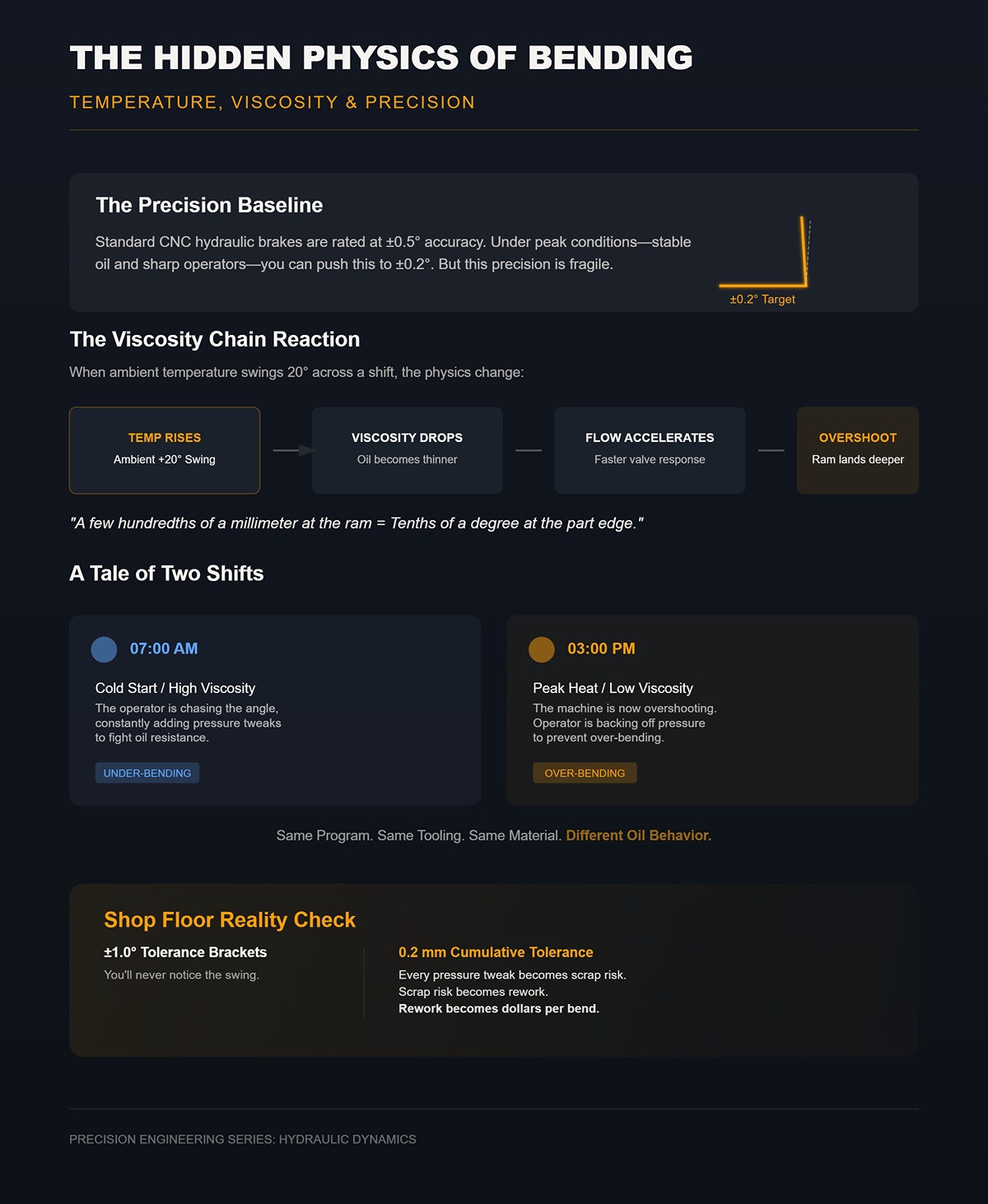
Take a standard CNC hydraulic brake rated at ±0.5° angle accuracy. Under stable conditions, with warm oil and balanced valves, you can hold ±0.2° if the machine’s tight and the operator’s sharp. I’ve done it.
Now let ambient temperature swing 20 degrees across a shift. Oil viscosity drops as temperature rises. Lower viscosity means faster internal flow through proportional valves. Pressure builds quicker. The ram decelerates differently near bottom dead center. That last few thousandths of travel — the part that determines your final bend angle — lands in a slightly different place.
On paper, that’s a few hundredths of a millimeter at the ram.
At the part edge, 24 inches out, that’s tenths of a degree.
Imagine two operators running the same job — one at 7 a.m., one at 3 p.m. The morning operator is chasing angle with pressure tweaks. The afternoon operator is backing it off because now the machine’s overshooting. Same program. Same tooling. Same material lot.
Different oil behavior.
Shop Floor Reality Check: if you’re bending brackets with ±1° tolerance, you’ll never notice. If you’re forming panels that have to nest into laser-cut assemblies with 0.2 mm cumulative tolerance, every pressure tweak becomes scrap risk. Scrap risk becomes rework. Rework becomes dollars per bend.
And that’s before we talk about compressibility.
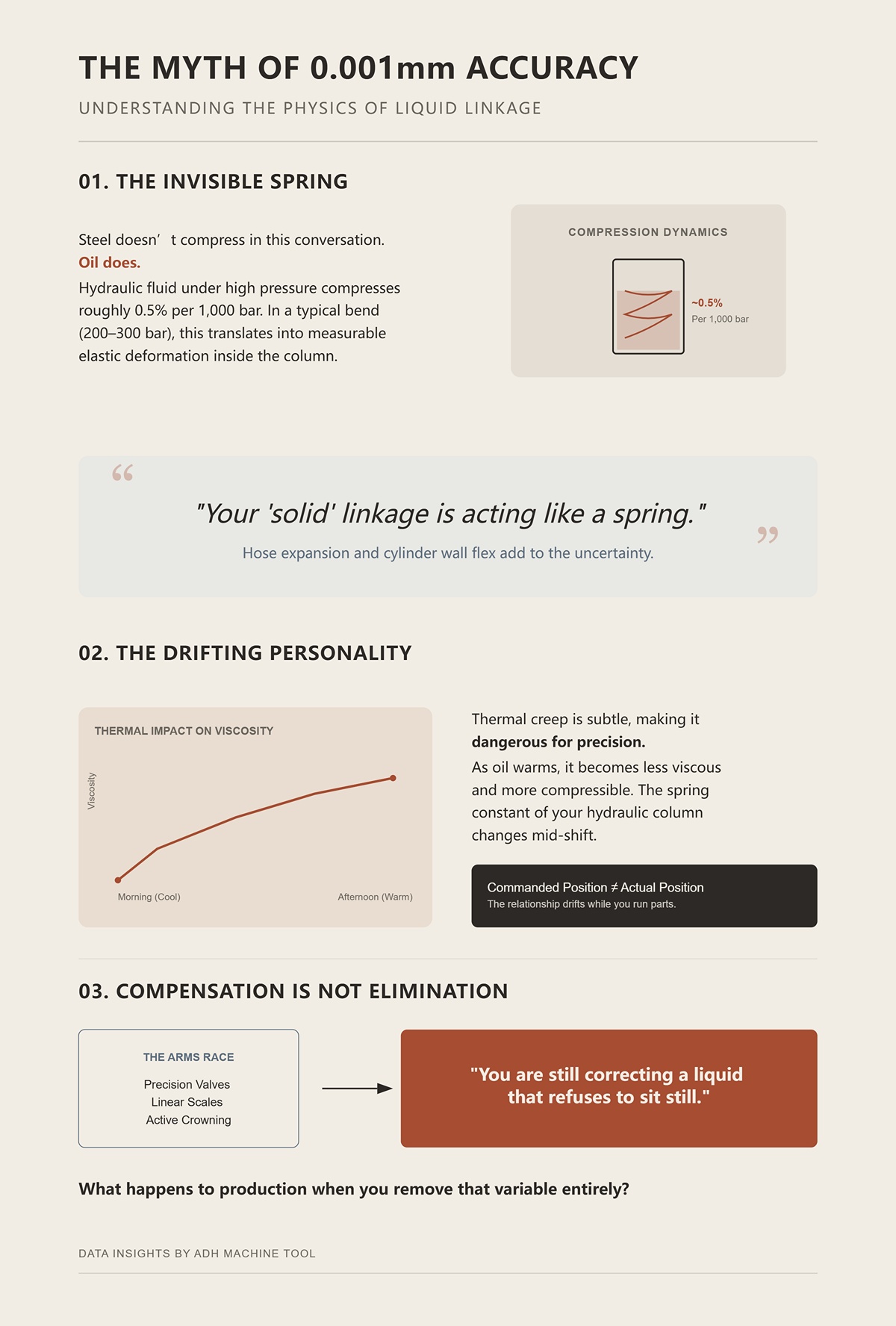
Steel doesn’t compress in this conversation. Oil does.
Not much. But enough.
Hydraulic fluid under high pressure compresses roughly 0.5% per 1,000 bar as a rule of thumb. In a press brake running, say, 200–300 bar during a typical bend, that compression translates into measurable elastic deformation inside the hydraulic column. Add hose expansion and cylinder wall flex, and your “solid” linkage is acting like a spring.
You command the ram to stop. The valve closes. Pressure equalizes. The compressed fluid relaxes slightly. The ram creeps a few microns.
Thermal creep isn’t dramatic. It’s subtle. That’s what makes it dangerous.
Now stack that with oil temperature rising through the day. Warmer oil is less viscous and slightly more compressible. The spring constant of your hydraulic column changes mid-shift. So the relationship between commanded valve position and actual ram position is drifting while you’re running parts.
Can you fight it? Sure. Precision valves. Linear scales on the ram. Active crowning systems. Closed-loop feedback. You can keep bleeding error out of the system.
But you’re still correcting a liquid that refuses to sit still.
You can’t promise 0.001 mm repeatability when your linkage is a column of fluid that expands with heat, compresses under load, and changes personality between morning and lunch. You can compensate. You cannot eliminate.
So what happens to production when you remove that variable entirely?
Every hydraulic shop I’ve ever run had a ritual. Power up. Let the pump circulate. Cycle the ram ten, fifteen times. Get heat into the oil so viscosity stabilizes before running first article.
That warm-up isn’t superstition. It’s an admission.
Cold oil flows slower through servo valves. Pressure response lags. Position control tightens only after temperature climbs into its designed band. Until then, you’re effectively calibrating a moving target.
Let’s do the math in shop terms. Ten minutes of warm-up on a $75-an-hour burdened machine rate is $12.50 before you’ve made a single part. Multiply by 250 working days. That’s over $3,000 a year in just waiting for oil to behave — per machine. That doesn’t count the first-article adjustments because the oil wasn’t quite there yet.
Now compare that to a servo-electric system with no hydraulic reservoir, no pump, no thermal mass of fluid to stabilize. You power it on. The encoder reads position instantly. The motor applies torque based on digital command, not fluid pressure building through a valve block.
First stroke is production stroke.
No chasing temperature. No guessing if today’s 62 degrees is close enough. No invisible spring hiding in 40 gallons of oil.
When bending becomes a digitally controlled torque event instead of a hydraulic pressure event, you don’t manage warm-up cycles. You manage data. And once fluid is out of the equation, the question stops being how well you can tame oil.
It becomes how precisely you can command motion.
At 7:02 a.m., I powered up a 100-ton servo-electric brake in a 58-degree shop and ran first article on 3 mm stainless. The angle probe read 89.98°. I hit cycle again. 89.99°. Fifteen parts later, the worst deviation was 0.01° — and the machine hadn’t “warmed up” because there was nothing to warm.
No reservoir. No pump. No oil column acting like a spring.
Instead of commanding pressure and hoping the fluid translates that into position, the controller commands torque to a servo motor, reads ram position through a linear encoder down to microns, and closes the loop every few milliseconds. If the ram lags by 3 microns, the drive increases current instantly. If material springback pushes back harder than expected, torque rises in the same cycle. You’re not bleeding error out of a liquid system. You’re correcting motion in real time.
That’s not refinement. That’s a different physics problem.
On a hydraulic brake, you open a proportional valve. Oil flows. Pressure builds. The cylinder moves. Then the controller waits to see where the ram actually ended up. Every step depends on fluid behavior between command and motion.
On a direct drive machine, the motor shaft is mechanically linked — often through ball screws or belt drives — straight to the ram. Command 12.6 kN·m of torque, and that torque exists at the shaft within milliseconds. The encoder reports actual position continuously. Closed-loop control means the system compares commanded position to actual position and corrects the error before it grows.
I’ve seen servo-electric brakes hold 1 micron repeatability at the ram. Hydraulics, even tight ones with linear scales, live around 10 microns in stable conditions. Ten microns sounds small until you stretch it 600 mm out to the bend line. Angular error multiplies with flange length. That’s where assemblies stop lining up.
Shop Floor Reality Check: on a panel that feeds a robotic weld cell, 0.2 mm cumulative tolerance across four bends decides whether the robot glides or crashes. If your brake repeats within 1 micron at the ram, you stop dialing in offsets every shift. If it repeats within 10, you’re chasing.
And here’s the quiet advantage: software remembers. Once you characterize springback for 3 mm 304 stainless with a specific V-die, that compensation curve is stored. The next run isn’t a negotiation with oil temperature. It’s a recalled motion profile.
But when torque is digital, not hydraulic, what does that do to power consumption sitting idle between bends?
Walk past a hydraulic brake between cycles and you’ll hear it — that rising whine of the pump maintaining system pressure even when the ram isn’t moving. Oil circulates. Heat builds. The cooler kicks on. You’re burning kilowatts to keep fluid ready.
A comparable 100-ton hydraulic machine can draw around 60 kWh in a working day. A pure electric servo model in the same tonnage class can run near 12 kWh under similar workloads. I’ve seen shops cut energy use roughly in half after switching a mid-tonnage cell to electric.
The reason isn’t magic. Servo motors draw significant current only during acceleration and bending. At dwell, power drops to near zero. No pressure to maintain. No thermal mass to stabilize. No enemy fluid expanding behind your back.
Translate that into dollars per bend. Suppose your burdened energy cost is $0.12 per kWh. Sixty kWh is $7.20 a day. Twelve kWh is $1.44. Over 250 days, that’s $1,440 versus $360. On one machine. Add in the elimination of oil changes, filters, and leak downtime, and uptime stops being theoretical.
But here’s the catch I had to admit after installing one: lower energy draw and 200 mm/s return speeds don’t automatically mean twice the output.
So where does the speed actually matter?
A spec sheet will brag about 200 mm/s return speed on a servo-electric brake versus under 120 mm/s on many hydraulics. Sounds like a race car.
Now watch a real job: approach down, slow to bending speed, form, return up, reposition backgauge, operator flips part, repeat. Only a slice of that cycle is at maximum travel speed. The actual bending stroke — where tonnage and precision matter — happens at controlled, slower velocity in both machines.
One manufacturer’s data showed roughly double processing efficiency on paper, yet much of that gain came from faster non-bending travel. In a mixed job with manual handling, we measured closer to 25% shorter cycles after switching to electric. Real improvement. Not marketing fantasy.
Why? Because acceleration and deceleration are sharper under servo control. The ram hits high approach speed, then brakes precisely at mute point without overshoot. No hydraulic lag. No waiting for pressure to stabilize before reversing. Those saved fractions stack across hundreds of bends.
But it’s still brute force managed by iron and timing, not software — that’s the hydraulic mindset. With servo-electric, timing becomes programmable. You can shape the motion curve: aggressive approach, controlled forming, rapid retract, synchronized backgauge movement during ram return. That orchestration trims dead time between bends.
Imagine two operators running a 500-part batch. One spends the day nudging pressure and waiting on pump cycles. The other loads parts while the machine silently resets itself with identical motion every stroke. By lunch, the difference isn’t just speed. It’s predictability.
And predictability is what lets you schedule tight-tolerance work without padding the quote.
Of course, the minute you start talking about 1-micron repeatability and digital torque curves, someone asks the hard question: what happens when the job calls for 200 tons instead of 100?
A few years back we quoted a 220-ton job in 12 mm plate—long structural channels, deep V-dies, full-length hits. The customer wanted electric for the repeatability. The math on paper looked clean. Then we started sizing motors and screws.
The torque numbers turned ugly fast.
On a 100-ton direct drive, you’re commanding manageable shaft torque through ball screws or belts. Scale that to 200 tons and you don’t just double the load—you compound it through the mechanical reduction. Bigger screws mean larger diameters to prevent buckling, steeper costs in precision machining, and servo motors that demand serious peak current. I’ve seen analyses showing electric systems can draw roughly twice the instantaneous electrical power to generate equivalent tonnage compared to hydraulic systems. At 100 tons, that’s a design choice. At 250, it becomes a power infrastructure problem.
Physics sends you a bill.
Hydraulics cheat here. They trade copper and steel for fluid pressure. Increase cylinder bore, raise system pressure, and you get more force without asking a motor to deliver all that torque directly at the shaft. You’re still wrestling a living enemy—oil that compresses, heats, and shifts personality with viscosity—but force density is where hydraulics earn their keep.
So what exactly breaks first when you try to scale pure electric into heavy plate territory?
Start with the screw. A ball screw converts rotational torque into linear force. The relationship is clean and predictable—beautiful for control. But linear force equals torque divided by lead, multiplied by efficiency. To double force without changing lead, you double torque. There’s no fluid cushion to amplify it.
Now picture a 3-meter bed forming 16 mm mild steel across the full width. You’re asking for sustained high tonnage over a long stroke, not a quick, shallow hit. That means high continuous torque, not just a spike. Motors heat. Windings resist. Drives throttle to protect themselves. Thermal management stops being a footnote and becomes the design constraint.
And here’s the part spec sheets don’t dwell on: heavy plate jobs are often low-cycle, long-stroke work. The electric advantage—high acceleration, 5 m/s² snap into position—doesn’t pay you back when the ram crawls through a deep forming stroke under full load. In fact, some data shows pure electrics can consume more electrical energy per ton delivered in those scenarios. The famous 12 kWh versus 60 kWh daily comparison at 100 tons? That shines in short-stroke, high-frequency bending. Stretch the stroke and load, and the gap narrows.
But it’s still brute force managed by iron and timing, not software.
Durma and others will argue hydraulics provide stable motion control through pressure and flow modulation in thick-sheet work. I’ve run both. When you’re leaning on 20 mm plate, the hydraulic cylinder’s mass and damping can actually smooth the forming phase. Electric drives, if undersized, can feel like they’re straining—because they are. You can spec around that, but the cost curve climbs hard.
So if pure electric hits a practical ceiling around 150 to 200 tons for sane economics, is the answer to bolt the oil tank back on?
Walk up to a hybrid servo-hydraulic brake and you’ll notice something different right away. No constant pump scream. No “that rising whine” between cycles. The servo motor spins up only when pressure is demanded. Energy drops compared to traditional hydraulics. Heat load shrinks. On paper, it looks like the best of both camps.
What’s happening mechanically is straightforward: a servo motor drives a hydraulic pump on demand. You still generate force through fluid pressure in cylinders, but you’re not bleeding energy at idle. For 200-ton and above applications, that’s attractive. You keep hydraulic force density while trimming the worst inefficiencies.
Shop Floor Reality Check: if a conventional 200-ton hydraulic burns significant idle energy over an 8-hour shift, and a servo-hydraulic trims that by even 30–50%, you’re talking thousands per year in energy and cooling savings. Not theory. Utility bills.
But precision is where the argument tightens. You’re back to oil columns acting like springs under load. Compression may be small—fractions of a percent at high pressure—but stretch that over stroke length and you reintroduce variability. Modern systems fight it with linear scales and closed-loop feedback, and they do a respectable job. Yet you are again negotiating with temperature, seal wear, and fluid condition.
You’ve put software in charge of the pump, not removed the fluid from the equation.
Hybrids make sense for shops that need 250 tons on Monday and 80 tons of precise stainless work on Tuesday. They give strategic flexibility. But they don’t transform bending into a purely digital motion problem the way direct drive does. They reduce the battlefield. They don’t move you into the control room.
Which means the real question isn’t whether hybrids work. It’s when the trade is worth it.
Imagine two operators in the same facility.
One runs a 130-ton direct drive cell feeding a robotic weld line. Parts are 3 mm to 6 mm stainless. Tolerances stack across multiple bends. Repeatability at the ram is measured in single microns. The robot never waits. Scrap is rare. Energy use stays low because the machine only draws hard power during motion.
The other runs a 300-ton brake forming structural brackets from 20 mm plate. Tolerances are ±0.5 mm. Parts go to a weld bay with grinders and shims. The value isn’t in micron-level repeatability. It’s in moving steel reliably without stalling the machine or cooking a motor.
Different economics.
Above roughly 150 tons, especially in thick structural work, the premium you pay for scaling pure electric—oversized screws, high-current drives, reinforced frames—can outweigh the precision dividend. Hydraulics, especially servo-driven hybrids, become a necessary evil. You accept you’re back to managing oil—monitoring viscosity, chasing thermal creep, staying ahead of seal wear—because the alternative is an electric architecture that’s either cost-prohibitive or electrically impractical.
This is where the thesis sharpens, not weakens. Direct drive isn’t “better” in every case. It’s categorically better where micron-level repeatability converts directly into profit—robotic cells, tight assemblies, lights-out production. When the job is raw crushing power in thick plate, hydraulics still dominate on force density and capital efficiency.
The mistake is pretending one machine should do both at the same standard.
Once you admit that, the next question isn’t about tonnage at all. It’s about what actually breaks, what actually drifts, and what actually costs you downtime when you choose to keep—or eliminate—that living column of oil from your shop floor.
Here’s the part nobody likes to say out loud: most downtime isn’t dramatic failure. It’s drift, prep, and cleanup.
On a hydraulic brake, what fails first usually isn’t the cylinder rod snapping in half. It’s a weeping rod seal that leaves a faint sheen on the ram. It’s viscosity shifting with temperature so your first ten parts are chase-and-correct. It’s a clogged return filter nudging oil temperature up five degrees, which nudges your bend angle off just enough to make quality start asking questions. The machine still runs. You’re just bleeding time.
Direct drive changes the failure category. You’re no longer fighting a living column of oil that swells, thins, and compresses under pressure. You’re managing motors, encoders, and ball screws. When it drifts, it’s usually traceable to encoder feedback or mechanical wear you can measure with a dial indicator, not thermal creep hiding inside a tank.
One is a battlefield. The other is a control room.
So what does that mean when you’re the one signing off on maintenance budgets?
Remove the hydraulic circuit and you delete an entire column from your maintenance log.
No rod seals to swell and harden. No wipers to grit up. No suction strainers starving a pump on a cold morning. No 200 gallons of oil slowly oxidizing while you pretend it’s fine because the pressure gauge still climbs. You’re not scheduling fluid sampling. You’re not paying to haul off contaminated oil. You’re not laying absorbent pads under fittings and hoping OSHA doesn’t walk in on the wrong day.
Shop Floor Reality Check: if a hydraulic brake allocates roughly a quarter to a third of its lifecycle cost to maintenance, and a comparable all-electric machine sits closer to the low teens, that gap isn’t theoretical. Hypothetically, if that delta is even ten grand a year in parts, filters, fluid, and outside service calls, that’s several thousand bends you need to run just to stand still.
But hydraulics aren’t helpless. I’ve seen shops running half a million cycles a year extend cylinder life 30–50% with disciplined tiered checks—weekly inspections, quarterly seal kits, annual fluid analysis. Treated right, oil behaves. Neglected, it punishes you.
The difference is that with direct drive, you’re not negotiating with chemistry at all.
Which sounds clean on paper.
Walk an experienced hydraulic operator over to a direct drive with a fully digital crowning system and multi-axis backgauge, and you’ll see it in his shoulders.
Hydraulics taught a generation to listen and feel. That rising whine before pressure hits. The subtle delay between pedal and tonnage. They compensate by instinct—overbending slightly on the first hit, dialing back once the oil warms. But it’s still brute force managed by iron and timing, not software.
Direct drive asks them to trust numbers on a screen. Stroke depth in microns. Real-time angle correction. Stored bend programs that assume the machine repeats exactly what it did yesterday. That shift isn’t mechanical. It’s psychological.
And there’s a real cost there. Training time. A few weeks of slower output while the team stops chasing material variation with foot pressure and starts dialing in parameters digitally. If you undersell that transition, you lose credibility with the crew that has to make parts.
But once they cross that bridge, something changes. They stop compensating for warm-up cycles. They stop planning around oil temperature. They start expecting the first part at 7:05 a.m. to match the one at 3:55 p.m.
Expectation resets the standard.
So if oil is gone and operators adapt, what’s left to actually break?
You trade fluid problems for mechanical and electronic ones.
Ball screws wear. Bearings pit. Servo drives can fail, especially in dirty power environments. Encoders lose signal if shielding is sloppy. A cooling fan on a drive cabinet quits, and heat becomes your new enemy. None of that is mystical. It’s measurable and usually predictable with proper inspection and clean power.
What you don’t have is seal extrusion at 3,000 psi. You don’t have internal leakage bypassing in a cylinder, stealing repeatability one micron at a time. You don’t have oil acting like a spring under load and then relaxing as temperature shifts. You’ve removed compressibility from the equation.
That doesn’t make direct drive immortal. Neglect lubrication on a ball screw and it will eat itself alive. Ignore electrical grounding and you’ll chase phantom faults for weeks. A neglected electric machine will absolutely die young.
But when it fails, it fails like a machine. Not like a chemistry experiment.
And that’s the pivot point: once you understand what you’re really maintaining—fluid physics versus controlled motion—the conversation stops being about maximum tonnage and starts being about revenue per ton.
You want to know how killing hydraulic variability turns into real money.
Start with the first ten parts of the day. On a hydraulic brake, you’re bending, measuring, nudging depth, bending again because oil at 55°F doesn’t behave like oil at 95°F. That’s thermal creep. The fluid thins, compresses differently, relaxes differently. You’re chasing it. Those corrections are small, but they stack up—extra hits, extra handling, extra inspection. On a servo-electric, the ram position at 7:05 a.m. is the ram position at 3:55 p.m. within microns because motion is closed-loop controlled by encoder feedback, not by a column of oil that changes personality with temperature.
The measurable gain isn’t magic speed. It’s first-part acceptance and fewer correction cycles.
If you save even one re-hit per part on 300 small brackets a day, that’s 300 pedal strokes, 300 gauging checks, 300 chances to scrap stainless because you overshot by half a degree. Multiply that across a year and you’re not talking about theory. You’re talking about labor hours you can bill instead of bleed.
But that only matters if those brackets are where your money lives.
Walk your shop floor and look at what’s actually in the racks.
If 80% of your revenue comes from 14-gauge panels, appliance brackets, enclosure parts—short strokes, high frequency, tight tolerances—then your machine spends most of its life cycling in a range where servo acceleration and positional repeatability pay off. Modern electric brakes can hit ram accelerations north of 5.0 m/s². Hydraulics are typically under 1.0 m/s². That gap shows up only on short, repetitive bends. On long strokes or heavy plate, the advantage shrinks.
Imagine two operators.
One runs 400 small parts a shift. The other runs eight heavy base plates. The first operator benefits every time the ram moves—faster approach, faster return, no warm-up drift, no angle chasing. The second operator is dominated by material handling and setup time. Ram speed barely moves the needle.
If your profit sits with the first operator, why would you buy a machine optimized for the second?
That’s the uncomfortable question.
Most buyers still anchor on maximum tonnage because it feels safe. Bigger number. More capability.
But revenue per ton is what keeps the lights on.
Take a hypothetical shop: 100-ton electric brake consuming around 12 kWh in an eight-hour shift versus roughly 60 kWh for a comparable hydraulic. Energy isn’t your biggest line item, but it’s real. Now add maintenance—filters, seals, oil, service calls. Say the delta is ten grand a year. That’s not abstract. That’s margin.
Now add throughput. If servo control boosts productivity 30–50% on short-stroke, high-frequency parts—and only there—that increase applies directly to the jobs that dominate your schedule. More parts per hour with the same labor. Or the same parts in fewer hours.
Shop Floor Reality Check: If a light-gauge part brings in $2 of contribution margin and you can run 50 more per hour because you’re not chasing oil temperature or waiting on slower approach speeds, that’s $100 an hour in theoretical upside. Even if reality gives you half of that, it changes your break-even math fast.
What removing hydraulic variability really buys you is predictability. Predictable cycle time. Predictable angle. Predictable scrap rate. Predictability turns quotes into contracts you can trust.
But it cuts the other way if your money is tied to thick plate.
Electric brakes cannot match the raw crushing force of big hydraulics. When you’re bending thick, hard material where ±0.05 mm is acceptable and the job demands 220 tons all day, hydraulics still rule. In shipbuilding or heavy structural work, micron-level repeatability is theater. The customer won’t pay for it.
And there’s another trap: not all “direct drive” is servo-electric. Mechanical direct drive with fixed stroke can be brutally fast but rigid. If your shop runs a mixed bag of oddball parts, adjustable stroke and flexible force curves matter. A hydraulic system can be more forgiving there. Versatility has value.
So here’s the pivot.
If 80% of your profit comes from light-gauge, high-repeat work, buying a 220-ton hydraulic “just in case” is chaining your cost structure to the 20% of jobs that don’t define you. You end up dragging around oil tanks, seals, and energy draw for capacity you rarely monetize.
But if your bread and butter is heavy plate and occasional precision work, a full electric flagship might be an expensive badge on the wall.
The lens isn’t force. It isn’t even precision.
It’s alignment—between where your margins are born and how your ram moves to create them.
Once you start viewing drive technology as a financial amplifier instead of a mechanical spec, the spec sheet stops asking, “How much can it crush?” and starts asking, “Where does your money actually come from?”