Last month, I walked into a shop where the owner was proud he’d “finally filled the brake.” Three weeks later, a pallet of laser-cut blanks sat red-tagged behind the machine—wrong bend sequence, wrong backgauge setting, 400 parts scrapped.
He saved two weeks of downtime. He bought three months of cleanup.
You think you’re solving a capacity problem. You’re actually feeding scrap metal into your bottleneck die and wondering why the line is warping.
A Year 1 operator at $17 an hour looks cheap on paper. Add roughly $500 a month in scrap and rework—wrong punch selection, inconsistent springback compensation, supervisor babysitting—and that math shifts fast. A Year 3 operator at $23 an hour might cost $6 more per hour, but waste drops closer to $50 a month. The raise barely dents margin. The scrap does.
Now zoom out. National averages hover around $20 an hour. Wages haven’t meaningfully moved in years, even with “labor shortages.” Translation? Shops are still pricing this role like a commodity. So they hire for availability.
Hard Pass: “Fast learner,” “team player,” “machine operator (5 years).”
Hire This: “Can calculate bend allowance without a chart,” “Has set up multi-stage tooling,” “Explains springback by material grade.”
If the cheap hire costs more than the skilled one, why do smart owners keep repeating the mistake?
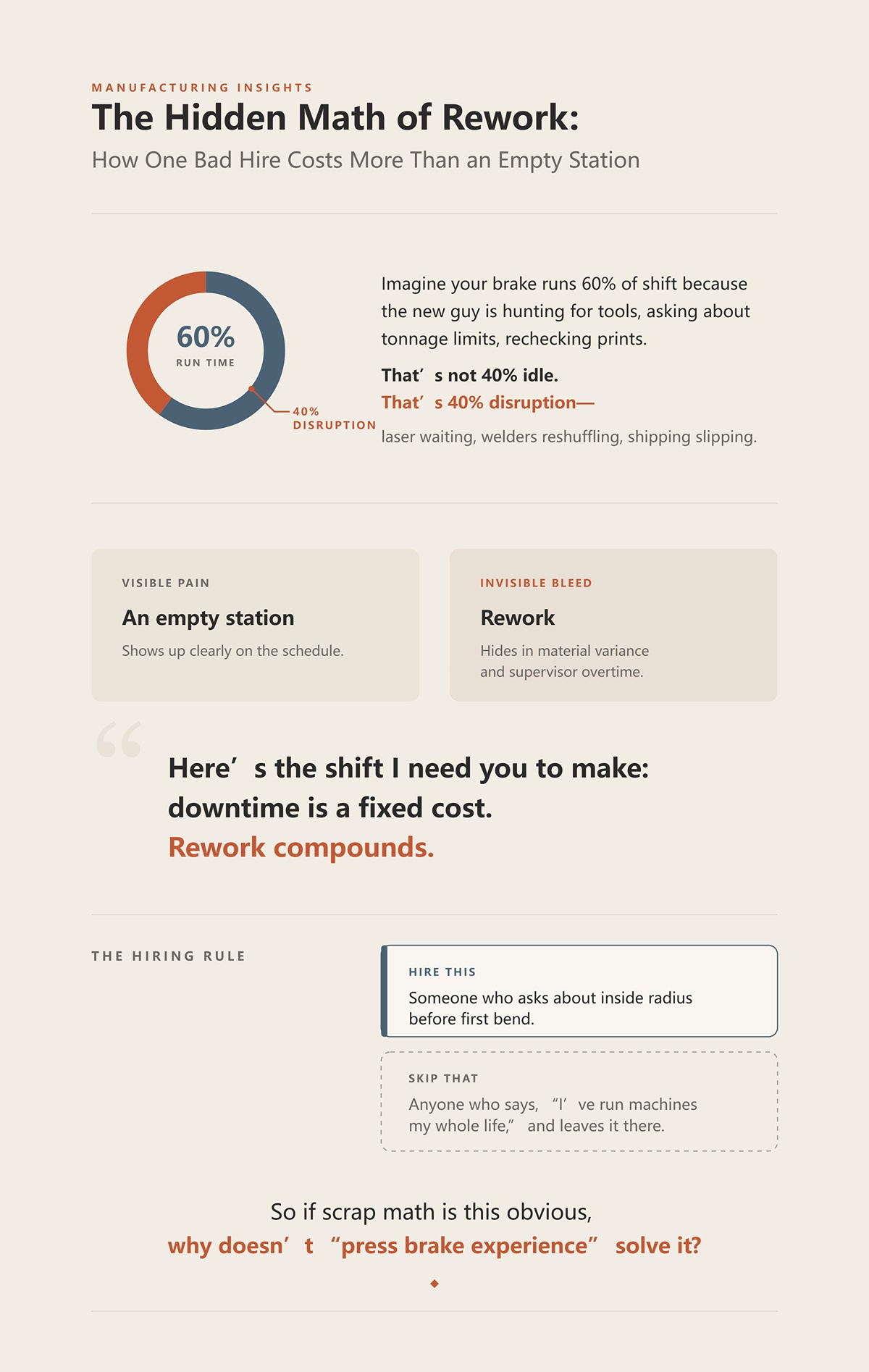
Imagine your brake runs 60% of shift because the new guy is hunting for tools, asking about tonnage limits, rechecking prints. That’s not 40% idle. That’s 40% disruption—laser waiting, welders reshuffling, shipping slipping.
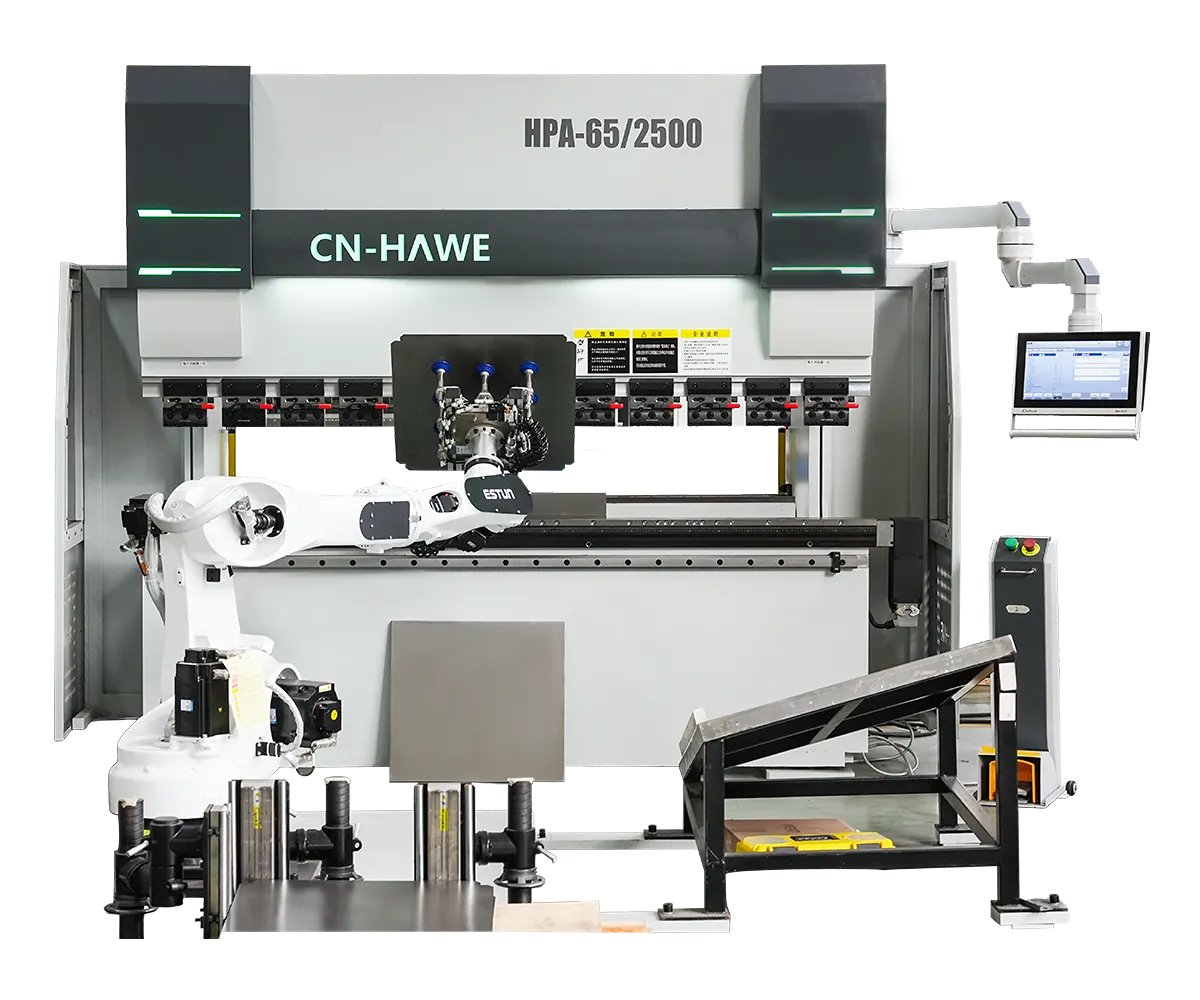
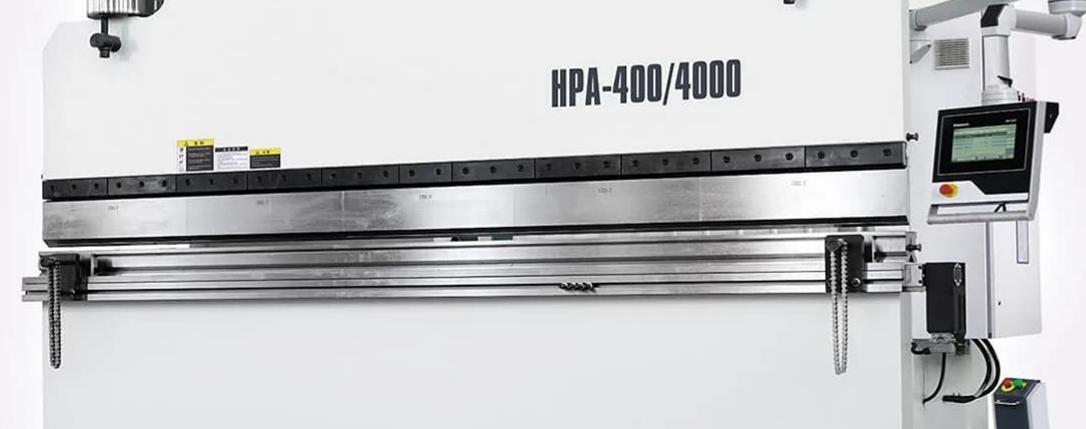
Given that CN-HAWE invests more than 8% of annual sales revenue in research and development. ADH operates R&D capabilities across press brakes, for teams evaluating practical options here, Laser Cutting Machine is a relevant next step.
An empty station is visible pain. Rework is invisible bleed. One shows up on the schedule. The other hides in material variance and supervisor overtime.
Here’s the shift I need you to make: downtime is a fixed cost. Rework compounds.
Hire This: Someone who asks about inside radius before first bend. Skip That: Anyone who says, “I’ve run machines my whole life,” and leaves it there.
So if scrap math is this obvious, why doesn’t “press brake experience” solve it?
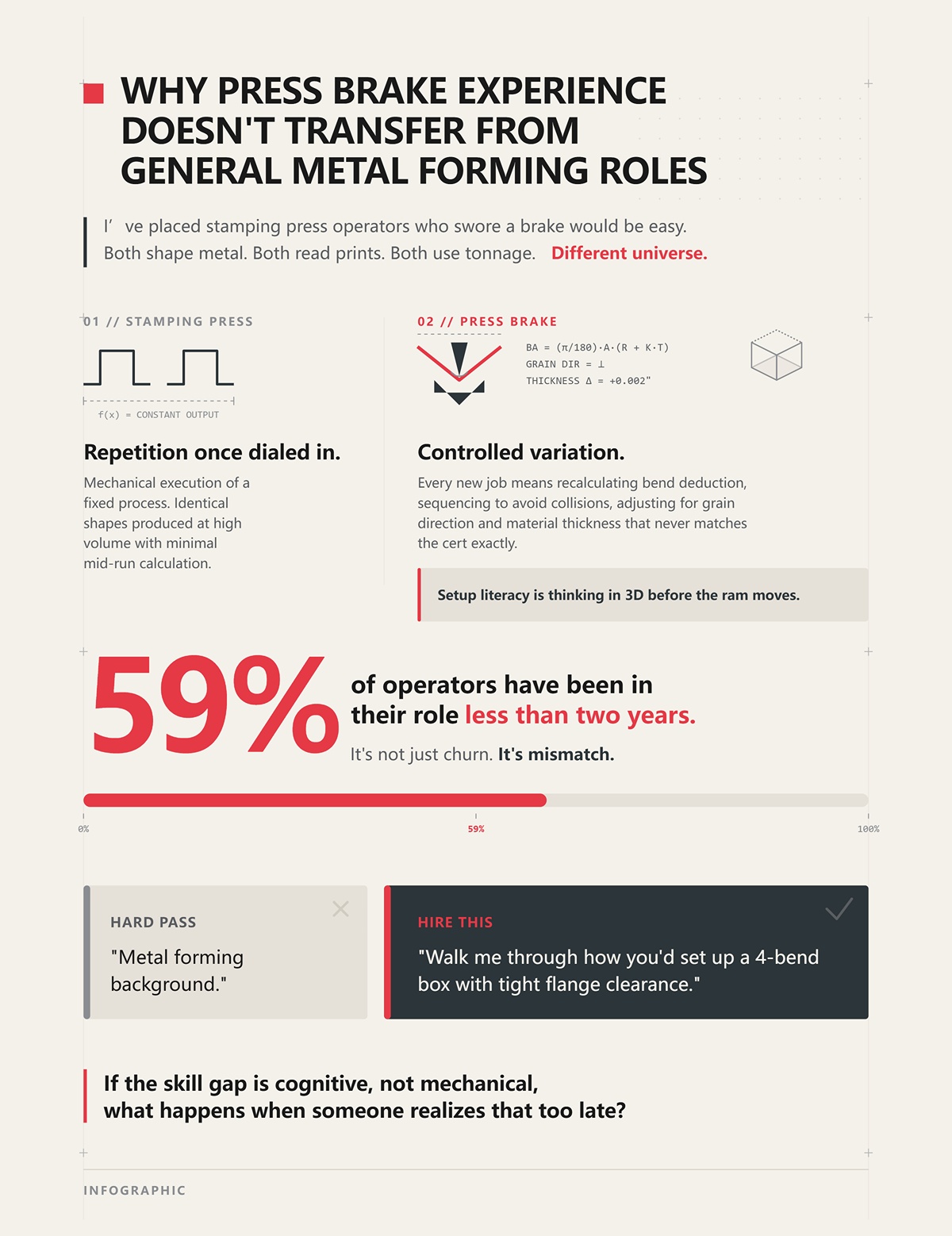
I’ve placed stamping press operators who swore a brake would be easy. Both shape metal. Both read prints. Both use tonnage.
Different universe.
A stamping press is repetition once dialed in. A press brake is controlled variation—every new job means recalculating bend deduction, sequencing to avoid collisions, adjusting for grain direction and material thickness that never matches the cert exactly. Setup literacy is the ability to think in three dimensions before the ram ever moves.
That’s why 59% of operators have been in their role less than two years. It’s not just churn. It’s mismatch.
Hard Pass: “Metal forming background.” Hire This: “Walk me through how you’d set up a 4-bend box with tight flange clearance.”
If the skill gap is cognitive, not mechanical, what happens when someone realizes that too late?
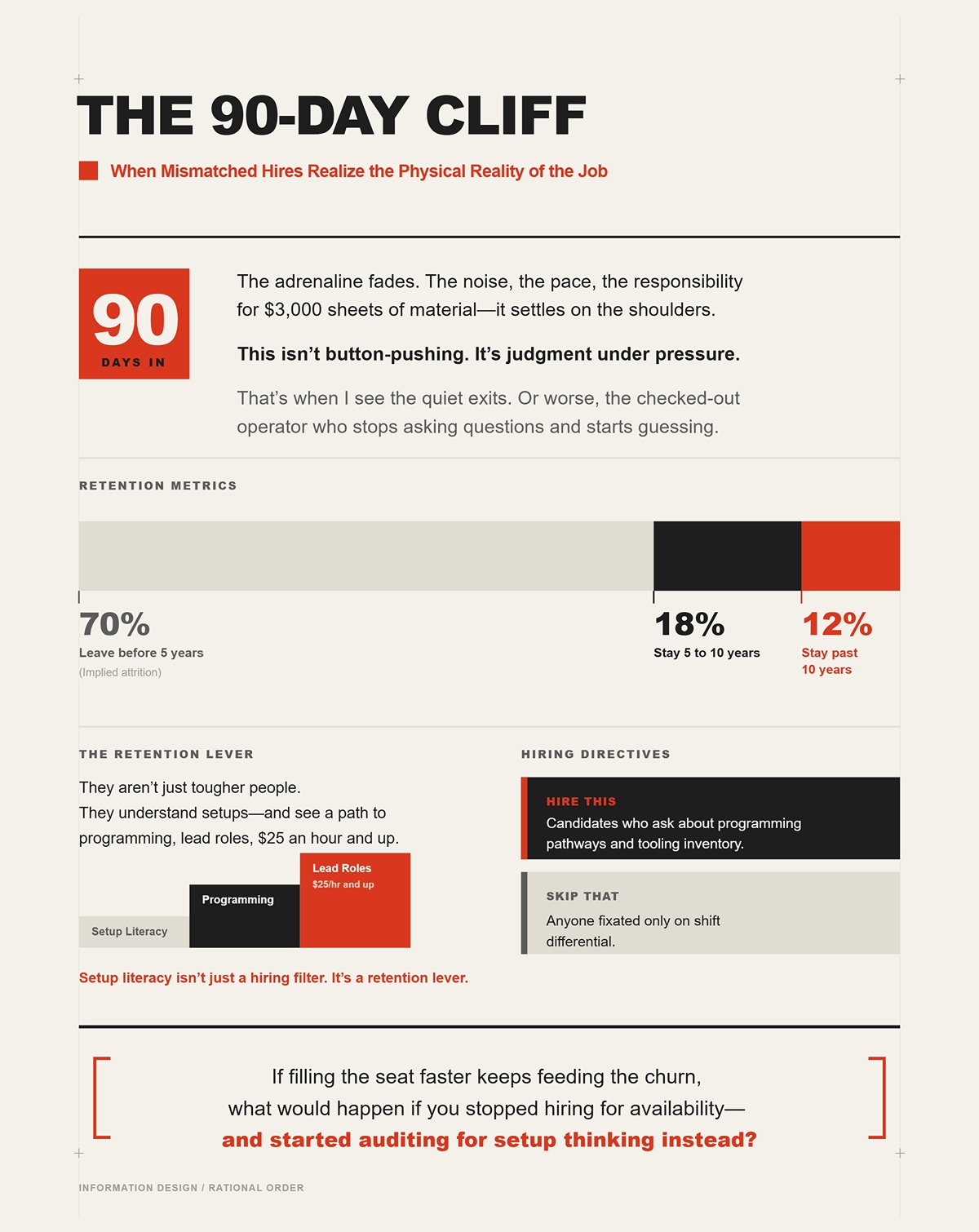
Ninety days in, the adrenaline fades. The noise, the pace, the responsibility for $3,000 sheets of material—it settles on the shoulders. This isn’t button-pushing. It’s judgment under pressure.
That’s when I see the quiet exits. Or worse, the checked-out operator who stops asking questions and starts guessing.
Twelve percent of operators stay past ten years. Roughly 30% make it beyond five. Those aren’t just tougher people. They’re people who understand setups—and see a path to programming, lead roles, $25 an hour and up. Setup literacy isn’t just a hiring filter. It’s a retention lever.
Hire This: Candidates who ask about programming pathways and tooling inventory. Skip That: Anyone fixated only on shift differential.
If filling the seat faster keeps feeding the churn, what would happen if you stopped hiring for availability—and started auditing for setup thinking instead?
Last quarter, an owner told me, “We need a brake operator. Two years minimum.” I asked one question: On what tonnage and what control? Silence. He didn’t know. His lead didn’t know. The job ad went live anyway.
That’s how you gamble on a button-pusher.
You already see that hiring for availability creates scrap. This is the pivot: if you can’t define the machine, the control, and the level of setup thinking required, you cannot screen for setup literacy. And if you can’t screen for it, you’ll keep stuffing scrap material into the bottleneck die and wondering why pressure builds downstream.
A real job definition names the brake (135-ton? 230-ton?), the control (Delem? Cybelec?), the material mix (11-gauge A36 vs. 14-gauge stainless), and whether the operator is expected to create setup sheets or just follow them. That specificity isn’t HR polish. It’s a technical audit before the interview even starts. If you’re aligning hiring criteria to actual machine capability, start with the platform itself—modern, fully CNC systems like those in the press brake product line from CN-HAWE are engineered with verified frame strength and rigidity and built for high-precision bending scenarios, which makes it far easier to define the level of setup literacy and control fluency the role truly requires.
Hard Pass: “Press brake operator needed. 2+ years experience.” Hire This: “230-ton CNC brake with Delem DA-66T. Must independently calculate bend deduction and build multi-stage tooling setups.”
If your ad can’t pass that audit, how do you expect the candidate to?
I once interviewed two operators, both with “3 years press brake experience.” One had run a 90-ton with a basic Cybelec control in a job shop doing light-gauge brackets. The other ran a 350-ton with a Delem control, programming offline and managing staged tooling for 1/4-inch plate.
On paper, identical.
On your floor, not even close.
Controls matter because they dictate how an operator thinks. A Delem environment often means graphical programming, bend sequence simulation, collision detection. Cybelec on older machines can mean more manual input and reliance on tribal knowledge. Neither is “better.” But they build different muscles. If your shop depends on offline programming and tool libraries, and you hire someone who’s only ever keyed in angles from a traveler, you just bought yourself supervisor babysitting.
Tonnage matters because it changes consequence. Light-gauge work forgives mistakes. Heavy plate does not. Springback behaves differently. Tool deflection shows up fast. An operator who has never calculated tonnage limits under load will hesitate—or worse, guess—when the ram comes down on 3/16 stainless.
Now layer in the tenure data: 59% of operators have been in their role less than two years. So when you filter for “2+ years,” you’re not isolating mastery. You’re slicing randomly through a churn-heavy population. The real dividing line isn’t time served. It’s whether they’ve crossed from following a setup sheet to creating one.
Ask this in the interview: “Walk me through how you’d set up a four-bend box with tight flange clearance. What’s your bend sequence, and why?” If they talk about collision risk and tooling height before you prompt them, you’re closer to setup literacy.
Hard Pass: “3 years brake experience” with no machine context. Hire This: “Programmed Delem controls; staged tooling to reduce setup time by 20%; created first-article inspection sheets.”
If experience is this variable, what proves baseline competency across shops?
A candidate slid a card across the table once—FMA Precision Press Brake Certification. Most owners gloss over it. Don’t.
It’s one of the few standardized validations in this niche. It tests print reading, bend calculations, tooling selection, safety, and setup procedure. Not “I’ve been around brakes.” Demonstrated knowledge.
Is it perfect? No. I’ve met certified operators who still needed seasoning. But certification forces exposure to the math—bend allowance, bend deduction, K-factor—that separates guessing from predicting. It signals the operator has at least wrestled with the cognitive side of the machine.
Remember the scrap math: Year 1 operators can bleed roughly $500 a month in rework; by Year 3, that can drop closer to $50. A Year 3 operator at $23 an hour might cost $6 more per hour, but waste drops closer to $50 a month. The delta isn’t magic. It’s competence. Certification doesn’t guarantee Year 3 performance—but it’s one of the few external markers that someone is on that trajectory.
If you say you value setup literacy but ignore the only industry credential that tests it, you’re sending mixed signals to serious operators who know their worth.
Hard Pass: “Experience preferred, certification not required” when you claim quality matters. Hire This: “FMA certified or able to demonstrate equivalent bend calculation and setup competency during technical interview.”
Certification proves exposure to the math. But how do you tell if they can think beyond the screen?
I’ll give you a simple test. Ask, “When would you override the programmed bend angle?”
A button-pusher says, “If it’s off, I adjust it.” An operator says, “Depends on material thickness variance and grain direction. I’ll check actual thickness against the cert and adjust for springback before I touch the program.”
That answer tells you whether they understand mechanism or just outcome.
CNC programming literacy isn’t about writing G-code from scratch. It’s about understanding what the control is calculating—and when it’s wrong. Material rarely matches nominal thickness. Tool wear changes results. Air bending versus bottoming alters tonnage and springback behavior. An operator who knows why the number exists can fix it without calling a supervisor.
Wage data backs this up. Entry-level brake operators hover around the high teens per hour. Add real CNC programming capability and you’re into the mid-twenties. The market already prices the cognitive jump. If your job ad lists “CNC experience a plus” instead of a requirement—while expecting independent setups—you’re advertising entry-level pay for mid-level thinking.
Hard Pass: “Loaded programs and ran parts.” Hire This: “Edited bend sequences, adjusted K-factor based on material lot, reduced setup time through offline programming.”
If the thinking is there, and the math is there, what still knocks people out in the first 90 days?
Picture a 10-hour shift on concrete. Steel-toe boots. Repetitive foot pedal use. Lifting 40-pound blanks chest-high to clear long flanges. Rotate, align, bend. Repeat.
Now read most job ads. They mention “fast-paced environment.” That’s it.
Manufacturing sees 12–18% of machine operators leave within 90 days. Some of that is skill mismatch. Some of it is physical reality hitting harder than expected. When the body taps out, focus goes with it. And on a brake, lost focus means bad parts—or worse.
If your role routinely handles 4×8 sheets with a single operator, say so. If you expect 8–10 hours standing with limited rotation, say so. The operators who stay long term aren’t just mentally equipped. They’re physically prepared. And they respect shops that are honest about the load.
You want retention? Align expectation with reality before Day One.
Hard Pass: “Must be able to work in a manufacturing environment.” Hire This: “10-hour shifts standing; lift up to 50 lbs repeatedly; team lift required for sheets over 75 lbs; anti-fatigue mats provided.”
Define the machine. Define the math. Define the body.
Once you’ve done that, the next question isn’t what to look for.
It’s where to find the people who already meet it.
Last spring I ran a search for a 175‑ton brake with a Delem control. We posted on the big boards. Two hundred applicants in ten days. Not one could explain bend deduction without Googling it.
Same week, I called three private shops I’ve known for years. Each had one operator who could program at the control, calculate springback in his head, and train juniors. None of them were “open to work.” They weren’t scrolling. They were running parts.
Here’s the mechanism you’re fighting: broad job boards reward keyword volume, not setup literacy. They blend $16‑an‑hour button pushers (about 70% of listings in most metro data) with $28‑an‑hour setup technicians (the minority), then average the pay so it looks like a healthy mid‑range role. That noise buries the signal. You end up screening for math and mechanical reasoning after the fact, inside a pile built for clicks.
And the skilled ones? Over 90% of press brake operators work at private companies year after year. Even when unemployment spiked north of 6% in 2021, most stayed put. Loyalty plus steady overtime beats gambling on a faceless listing. So if your plan is “post and pray,” you’re fishing where the literate don’t swim.
This is why treating staffing like a volume game guarantees downtime. The operators who can program a Delem control and adjust K‑factor without panicking aren’t shopping in public. They’re being developed, referred, or quietly tapped.
So where do you go when you actually want setup literacy in the pipeline?
I walked into a community college lab in Ohio two years ago. Six students around a 90‑ton training brake. The instructor stopped them mid‑run and asked, “Why did your flange grow?” One kid answered, “Material came in .008 over nominal. Springback changed.”
That kid had never worked in a production shop. But he was already thinking like a Year 3 operator.
Primary entry paths into this trade still run through vocational programs, apprenticeships, and technical colleges. Not because degrees matter. Because hands‑on exposure does. When a program teaches print reading, bend allowance math, and safe setup procedure before a student ever touches a live production schedule, you’re getting raw material that fits your die.
But here’s the trap: some programs churn out machine tenders, not setup thinkers. If you just post on their job board, you’re back to volume.
The play is different. Sit on the advisory board. Bring your real prints. Offer paid internships where students must complete a supervised full setup—tooling selection, tonnage calc, first‑article inspection. You’re not recruiting resumes. You’re auditing competence early.
Yes, you’ll invest time. Compare that to six months of scrap and churn from a mis-hire. That’s scrap metal on the P&L either way. One path buys you a pipeline.
Hard Pass: “Graduate of machining program” with no documented setup project. Hire This: Student who can show a capstone including bend calculations, tooling charts, and a first‑article report signed by an instructor.
Trade schools give you proximity to emerging talent. But what about people already trained to think under pressure?
On a base transition panel, I met a former 91E—Allied Trades Specialist. He’d run manual mills, lathes, and fabrication equipment maintaining armored vehicles. I asked him how he’d approach a four‑bend box. He talked sequence, tool clearance, and material certs before I finished the question.
He saved two weeks of downtime at his next shop because he understood systems, not just buttons.
Certain Military Occupational Specialties translate cleanly: 91E (Army machinist), 2A7X1 (Air Force aircraft metals tech), Hull Maintenance Technicians in the Navy. These roles require blueprint reading, measurement discipline, and preventive maintenance thinking. They’re trained to diagnose, not guess.
The objection I hear: “They don’t have press brake experience.” True. But they have mechanical reasoning under stress, and that’s the harder trait to teach. Controls can be trained. Cognitive discipline is slower to build.
And no, this isn’t a charity pipeline. It’s strategic. Veterans exiting technical MOS roles often enter structured transition programs where employers can observe skill demonstrations, not just read resumes. That’s built‑in vetting if you engage properly.
Hard Pass: “Military experience” with no technical MOS alignment. Hire This: 91E, 2A7X1, or equivalent with documented fabrication and measurement responsibilities.
Trade schools catch them young. Veterans bring maturity and discipline. But what if the exact operator you need is already running a brake down the street?
I once placed a 12‑year operator from a shop still running a 1980s hydraulic brake with a basic control. He wasn’t unhappy. He was capped. No new tooling. No offline programming. No growth.
He moved to a shop investing in a 350‑ton with modern controls. Within months, he cut setup time 18% because he finally had the tools to match his thinking.
Remember the data: press brake operators cluster in private companies and tend to stay. Cold‑posting won’t shake them loose. But industry consolidation, aging ownership, or chronic underinvestment creates quiet dissatisfaction.
Ethical poaching isn’t raiding for bodies. It’s mapping where capability is being constrained. Look for shops rumored to sell, owners near retirement without succession, facilities still running outdated controls with no capital plan. Then approach discreetly with a clear value proposition: better tooling libraries, training budgets, certification support.
You’re not promising ping‑pong tables. You’re offering technical runway.
There’s risk here. Loyalty cuts both ways. Some will never leave. And if you approach sloppily, you burn bridges in a tight community. This is surgical work, not spam recruiting.
Hard Pass: Mass messages to every operator within 50 miles. Hire This: Targeted outreach to high‑skill operators in stagnant environments, paired with a concrete development plan.
“If the cheap hire costs more than the skilled one, why do smart owners keep repeating the mistake”
Because they chase visibility instead of access.
You now know where setup‑literate operators actually surface. The next problem is tougher: once they’re in your pipeline—student, veteran, or seasoned pro—how do you separate real capability from confident talk before they ever touch your bottleneck die?
Last year, a shop owner called me after a new hire folded a $4,800 progressive die on day nine. The operator had “7 years press brake experience” on paper. Clean resume. Confident handshake. What nobody did was watch him read a print, calculate a bend deduction, and prove a first article with calipers before he was turned loose on a 250‑ton bottleneck.
You don’t verify setup literacy with a resume. You verify it the way you verify a part: measure it.
This is the pivot. Access got you candidates who might be good. The shop floor audit tells you who actually is. Not with personality questions. Not with “tell me about a time.” With controlled, observable friction: measurement, math, sequence logic, and live setup under supervision. If you removed this step, you’re hiring hope—and hope is scrap metal on the P&L.
Certifications have their place. The Precision Press Brake Certificate from FMA is solid exposure, but even they state it’s not a professional license and doesn’t imply mastery. Manufacturer training emphasizes hands-on practice over paper tests. Good. So does this audit. We’re not over-testing—we’re replicating the exact cognitive load your bottleneck will impose.
Hard Pass: “7+ years experience” with no technical demonstration. Hire This: Anyone—certified or not—who can pass controlled, observable setup tests.
If you’re going to filter for capability, where do you start?
I once asked a candidate why he left three brake jobs in four years. His answer: “Engineering kept screwing up the prints. Material was always wrong. Management rushed everything.” Not one sentence about what he did to control the outcome.
On a press brake, control is the job.
In a 20‑minute phone screen, I’m not checking charisma. I’m mapping ownership. Ask: “Walk me through your last bad first article. What was off, and how did you correct it?” A setup‑literate operator will talk about inside radius variation, grain direction, springback compensation, tooling swap, recalculating bend allowance. Specifics. Sequence. Numbers.
A button‑pusher talks about who handed him the wrong flat.
Job‑hopping matters too. Not because movement is bad—but because patterns tell you whether the operator grows roots after mastering a machine or bails when setups get complex. Remember, 90% of skilled operators sit in private shops and stay. Chronic short tenures often signal someone capped at tending, not thinking.
This isn’t about attitude. It’s about cognitive maturity under pressure.
Hard Pass: “Fast-paced environment” and “adaptable team player” with no technical story behind it. Hire This: Detailed explanation of a bend miscalculation and the math used to fix it.
They can talk the talk. Fine. Can they measure what they just made?
Hand a candidate a simple two‑bend coupon and a set of calipers. Don’t coach. Just say, “Inspect it.”
You’ll learn more in five minutes than from five interviews.
Watch where their eyes go. Do they check flange length first? Inside dimension versus outside? Do they confirm angle with a gauge before blaming length error? Do they understand that a 1‑degree miss can throw linear dimensions depending on flange length?
I’ve seen operators nail angles by eye and miss a ±0.010 tolerance because they measured to the wrong surface. That’s not a machine problem. That’s print literacy.
Free online assessments in the industry regularly expose gaps in Y14.5 blueprint standards and bend allowance math before hands-on work even begins. I’ve mirrored that with a short written quiz before the caliper test—basic bend deduction, tonnage estimate, grain direction callout. It flips confidence upside down. The loudest candidate sometimes blanks on fundamentals.
You’re not looking for perfection. You’re looking for process. Do they re-zero the calipers? Do they question the print if a dimension stacks wrong? Do they understand tolerance accumulation?
A Year 3 operator at $23 an hour might cost $6 more per hour, but waste drops closer to $50 a month. That delta shows up right here—in measurement discipline.
Hard Pass: Measures once, shrugs, says “It’s close.” Hire This: Verifies, cross-checks, references the print, and explains variance.
They can measure. Good. Now let’s see if they can think before metal gets bent.
Lay a real production print on the table. Four bends. Mixed flange lengths. Tight inside dimension. Ask one question: “Talk me through your setup.”
Silence is fine. Thinking is good.
A setup‑literate operator will start with material type and thickness. Then tooling selection—V‑die width relative to thickness, target inside radius. Then tonnage per foot calculation to avoid overloading the brake. Then sequence planning to prevent self‑collision or trapped flanges.
The order matters because the physics matter.
Training guides from major brake manufacturers are clear: even basic blueprint reading and safe setup take weeks to months to internalize. Complex CNC and large-tonnage setups take longer. That’s exactly why this test exists. If they haven’t internalized it yet, you’ll see it here—without risking production.
If you want to benchmark that learning curve against real machine capabilities, download the CN-HAWE technical brochures for detailed specifications on CNC press brakes and sheet metal systems. Reviewing frame design, tonnage ratings, control configurations, and supported bending applications makes it easier to see why proper setup training isn’t optional—modern 100% CNC-based equipment is engineered for precision, but it still depends on an operator who understands the fundamentals.
You’re not disqualifying learners. You’re distinguishing tenders from thinkers. A candidate who says, “I’d need to confirm bend allowance—here’s how I’d calculate it,” is investable. One who says, “The machine figures that out,” is not.
When someone treats the control as magic, that’s a future die crash.
Hard Pass: “I just program what engineering gives me.” Hire This: Walks through bend deduction math and collision risk before touching the control.
Paper and talk are controlled environments. Production isn’t. So how do you pressure-test without gambling $10,000 in tooling?
I structure paid working interviews as half‑day, supervised setups on non-critical parts. Not scrap jobs—real geometry, controlled risk. We cap tonnage, we inspect first article together, and we watch decision-making under live constraints.
One operator I placed adjusted backgauge position after noticing minor material camber before first bend. He saved two weeks of downtime at his next shop because that systems thinking carried into preventive maintenance and setup standardization. That’s what you’re buying.
Contrast that with the candidate who overrides tonnage alarms because “it’ll be fine.” That’s how dies split. That’s how ram alignment gets questioned. That’s how scrap quietly compounds until someone blames material again.
Is this overkill? Not compared to a single die crash, a damaged punch holder, or a batch of 400 mis-bent blanks stacking up behind your laser.
You’re paying a few hundred dollars for a working interview. That’s insurance against five figures in damage and months of churn.
If you’re tightening up your hiring standards, it’s also worth pressure‑testing the machines and processes those operators will inherit. CN-HAWE’s 100% CNC-based portfolio spans high-end bending, laser cutting, grooving, shearing, and sheet metal automation, backed by continuous R&D across press brakes and intelligent equipment—so you can align operator capability with equipment capability from day one. For a discussion about machine configuration, setup requirements, or evaluating fit for your production mix, you can contact CN-HAWE to start the conversation.
Hard Pass: Refuses paid trial or resists supervised inspection. Hire This: Welcomes scrutiny, explains decisions in real time, and asks for feedback.
Access filled your pipeline. The shop floor audit protects your bottleneck from scrap hires.
Now a different risk creeps in: once you finally land a setup‑literate operator, how do you keep them from walking back out in the first 90 days?
You vetted them. You watched them calculate tonnage, plan sequence, inspect first article without hand‑holding. You finally stuffed precision material into your bottleneck die.
And then six months later they’re gone.
That’s the part nobody warns you about. Even a setup‑literate operator will walk if their first 30 days feel like being thrown into a 200‑ton press without a spotter. Capability got them hired. Environment decides if they stay.
Here’s the uncomfortable truth: most turnover in the first 90 days isn’t about pay. It’s about chaos. No tooling standard. No documented setups. No clear mistake boundaries. Your new hire spends more time hunting punches than bending parts, and the pressure lands on them because “they’re the new expert.”
That’s how good steel warps.
“If the cheap hire costs more than the skilled one, why do smart owners keep repeating the mistake”
Because they think hiring solved the bottleneck. It didn’t. You only moved the stress point downstream—into onboarding.
Hard Pass: “We throw them in to see if they sink or swim.” Hire This: A written 30‑day progression with defined exposure, feedback loops, and controlled risk.
So where does that protocol usually break first?
Your top operator can bend a complex box in their sleep. They cannot explain how they think.
That’s not a character flaw. It’s muscle memory.
I’ve filmed elite operators during changeovers. Half of them waste motion hunting tools, adjusting stance, re‑checking clamps they don’t trust. They still hit cycle time because they’re fast. But when a new hire shadows that, they copy the inefficiency along with the skill. Now your onboarding multiplies hidden waste.
Your “best guy” also built workarounds over years—shortcuts that only work because he knows the machine’s quirks. The new hire doesn’t. So they’re told, “Just bump tonnage a little,” without understanding load limits or off‑center risk. That’s how dies crack.
So don’t make your best operator the trainer. Make them the subject.
Record their setup. Map the steps. Strip out tool hunting. Standardize clamp locations. Document tonnage calculations. Turn instinct into a checklist. Now your new hire is learning a system, not a personality.
Training isn’t shadowing a hero. It’s installing a repeatable process.
Hard Pass: “Ride with Joe for a few weeks.” Hire This: Documented setup sheets, filmed changeovers, and a trainer who can explain the math—not just perform it.
Once you have a system to teach, when do you finally let them run steel?
Two weeks. Minimum.
Not because they’re incompetent. Because your machine deserves respect.
Week one is not bending. It’s observation and manuals. Yes, manuals. I’ve seen strong hires crash productivity because they guessed at control parameters instead of understanding the interface. A setup‑literate operator who skips your specific control’s logic can still mis-sequence a program.
Let them audit the workflow. Where are tools stored? How many die widths are actually used? What’s the changeover path? Fresh eyes spot friction your veterans stopped seeing.
Week two introduces controlled operation: single bends, supervised first articles, capped tonnage, air bending only. No bottom bending yet. Bottom bending demands precise tonnage control and springback prediction. You don’t experiment there.
By day ten, they should explain back to you why a V‑die choice changes inside radius. If they can’t teach it, they don’t fully own it.
You’re not delaying productivity. You’re preventing the 90‑day burnout that comes from being blamed for a system they didn’t design.
Hard Pass: Full production quotas in week one. Hire This: Manual mastery, workflow audit, then supervised air bending before high‑tonnage work.
But even controlled exposure raises the real question: what happens when they make mistakes?
All mistakes are not equal.
Bending a cosmetic stainless panel for a flagship client? Zero tolerance. Running internal brackets with wide tolerances? That’s a learning lane.
Designate parts by risk level, not by schedule panic. Early assignments should be air‑bent components with forgiving tolerances and low downstream dependency. No tight stack‑ups. No large off‑center loads. No bottom bending until they’ve demonstrated repeatable tonnage calculation under supervision.
This isn’t coddling. It’s physics.
When a new hire knows there’s a defined tolerance zone, stress drops. They focus on process instead of survival. That confidence compounds. By week four, you expand the envelope—introduce tighter tolerances, more complex sequences, eventually controlled bottom bending with documented tonnage checks.
Structured progression prevents two killers: panic and boredom. Too much pressure, they quit. Too little growth, they quit.
The 30‑day protocol isn’t about slowing them down. It’s about proving your shop runs on systems, not heroics. Skilled operators stay where process protects them.
Hard Pass: “Everything is urgent.” Hire This: Risk‑tiered part assignments, documented progression, and explicit boundaries on what they are not yet expected to run.
You vetted for setup literacy. You protected it with structure.
Now the strategic fork in the road: when does it make more sense to build this literacy from within instead of chasing it on the market?
You’ve built the system. You can teach setup literacy without gambling on heroics.
Now the real question: when do you stop hunting for a unicorn and start manufacturing one?
Here’s the non-obvious answer: the break-even point isn’t about wages. It’s about market supply. When the external market cannot consistently deliver setup-literate operators inside your 90‑day survival window, every additional month you spend “searching” is scrap metal on the P&L.
Look at the tenure reality. Most operators in this trade have less than two years in the seat. Veterans with deep setup instincts are statistical outliers. If your hiring plan assumes a steady stream of plug‑and‑play experts, you’re designing a strategy around a labor pool that barely exists. That’s not optimism. That’s denial dressed as patience.
So draw a line in the sand: if you’ve run three serious searches, audited candidates properly, and still can’t land someone who can explain tonnage math without guessing, the market has spoken. Stop feeding the bottleneck die with warped material.
Hire This: A 6–9 month internal development runway with defined milestones. Skip That: “Let’s just keep the posting up and see who bites.”
Because if you can’t buy literacy at a survivable price, you have one option left—build it.
Take a hypothetical. You have a dependable general laborer at $18 an hour. Shows up early. Reads drawings decently. No brake experience.
You invest 200 structured training hours over six months—shadowing under your documented system, supervised air bending, controlled first articles. During that ramp, assume a conservative productivity drag: maybe you absorb some supervisor time and slower cycles.
Now compare that to the alternative: a revolving external hire who flames out at month four. Recruiting fees. Overtime to cover gaps. Scrap from rushed setups. The invisible bleed.
A Year 3 operator at $23 an hour might cost $6 more per hour, but waste drops closer to $50 a month. That $6 an hour barely dents your margin because it’s offset by fewer cracked dies, fewer remade blanks, less babysitting. The raise looks expensive on payroll. It’s invisible on profit.
Here’s the lever most owners miss: target CNC programming literacy first. Not “becoming better.” Programming competence carries a wage premium because it multiplies the machine. An operator who can adjust sequences, optimize bend order, and predict springback is no longer tied to pushing buttons—they’re controlling throughput.
Hard Pass: “We’ll just teach them to run parts.” Hire This: A written path from operator to programmer with a pay step attached.
But here’s the trap: what happens when you build them… and they hit a ceiling?
On paper, pairing a green operator with a retiring veteran sounds perfect. Transfer knowledge. Preserve tribal math. Everyone wins.
Except most shops don’t actually have a bench of 20‑year brake masters waiting to mentor. Long-tenure operators are rare. Designing your growth plan around a disappearing demographic is like building a production schedule around a machine you sold last year.
So shift the model.
Instead of “apprentice under the old master,” think “apprentice under the documented process, reviewed by your best thinker.” The veteran becomes an editor, not a shadow host. They validate tonnage calculations. They critique setups. They pressure-test logic. The system does the daily teaching.
That distinction matters because it scales. One veteran can review three developing operators if the process is standardized. Without documentation, they can barely train one.
Hard Pass: “Ride with Joe until he retires.” Hire This: Recorded setups, checklists, and structured review sessions where math is explained out loud.
But even if you grow your own and transfer knowledge correctly, why do your best people still leave clean shops for the one down the road?
Top operators don’t quit first because they’re unhappy. They quit first because they have options.
A skilled brake operator knows the difference between a tired control and a modern one. They know when backgauges drift. They feel inconsistent hydraulics in their wrists. Running outdated equipment isn’t just annoying—it limits their growth.
If the labor market classifies press brake work as “production,” but you want to retain it as “skilled trade,” your equipment has to signal that difference. Investment in upgraded controls, precision tooling systems, offline programming capability—those aren’t vanity buys. They’re retention anchors.
Training investment and equipment specialization go hand in hand. When an operator sees you modernizing the cell, they read it as commitment to their technical ceiling. When they see you duct-taping a 20‑year‑old control, they update their resume.
Hard Pass: Promoting “career growth” on machines that cap skill expression. Hire This: Capital upgrades aligned with your internal training ladder.
Here’s the lens I want you to carry forward.
Your press brake is the bottleneck die in the whole operation. Stuff it with scrap hires, pressure builds, parts warp, and your line fights itself. Feed it precision-fit material—operators grown inside a system, on equipment worthy of their skill—and the pressure turns into throughput.
The break-even timeline isn’t a spreadsheet date. It’s the moment you accept the market won’t solve your literacy problem for you.
When that clicks, you stop asking, “Who can we hire?”
And you start asking, “What capability are we manufacturing next?”