
The panel looked perfect under shop lights. Then the customer rolled it under a skylight and the faint V-lines showed up like fingerprints. Whole pallet rejected.
That’s usually when someone waves a urethane V-die brochure and says, “Problem solved.” Sounds clean. Sounds simple. It isn’t.
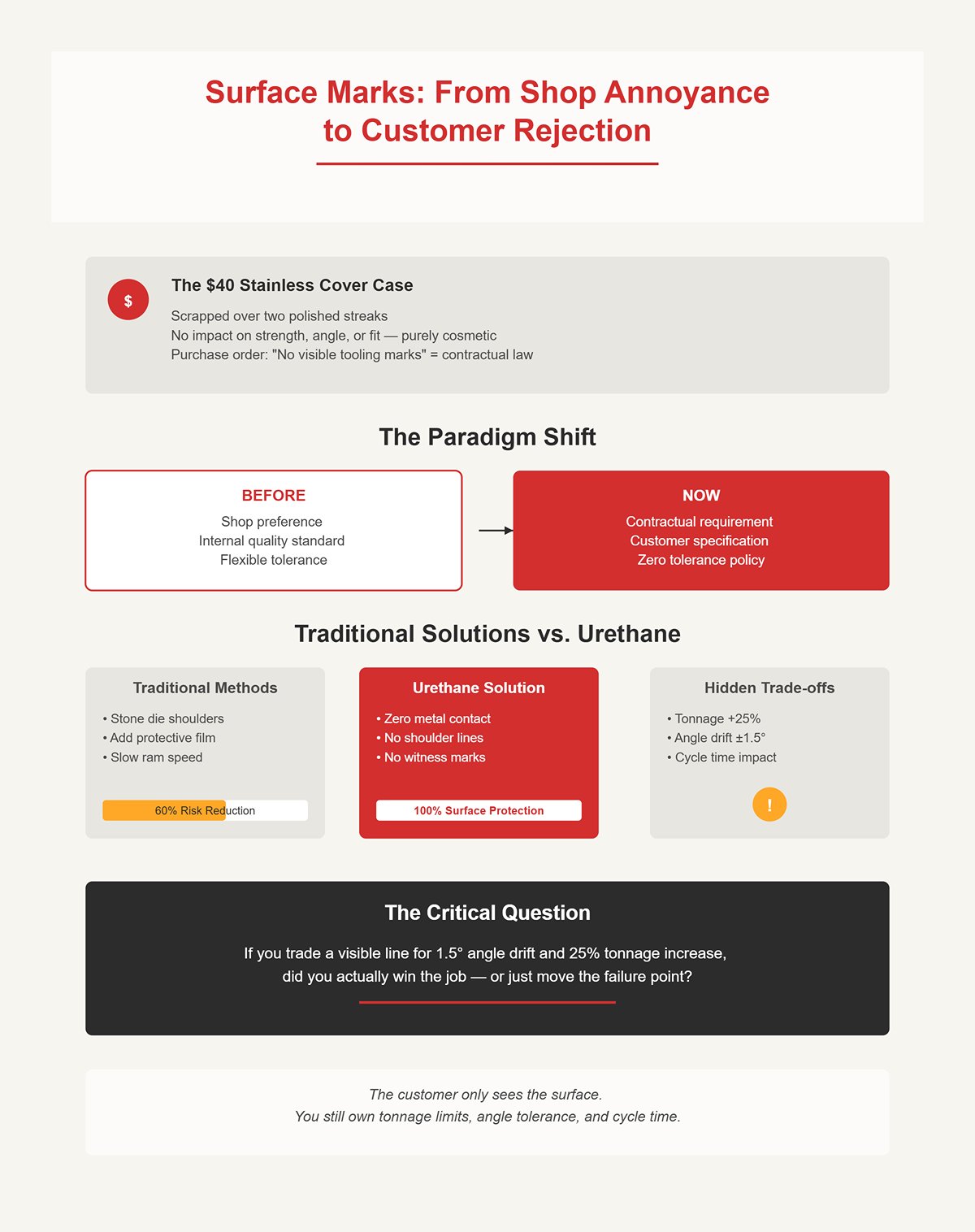
I’ve watched a $40 stainless cover get scrapped over two polished streaks that didn’t change strength, angle, or fit. Cosmetic. But the purchase order said “no visible tooling marks,” and that’s the law.
So now surface finish isn’t a shop preference; it’s a contractual requirement. You can stone the die shoulders, add film, slow the ram. Still risky. Urethane promises zero metal-to-metal contact. No shoulder lines. No witness marks. That part is real.
But here’s what changes the conversation: the customer only sees the surface. You still own tonnage limits, angle tolerance, and cycle time. If you trade a visible line for a 1.5° angle drift and a 25% tonnage increase, did you actually win the job — or just move the failure point?
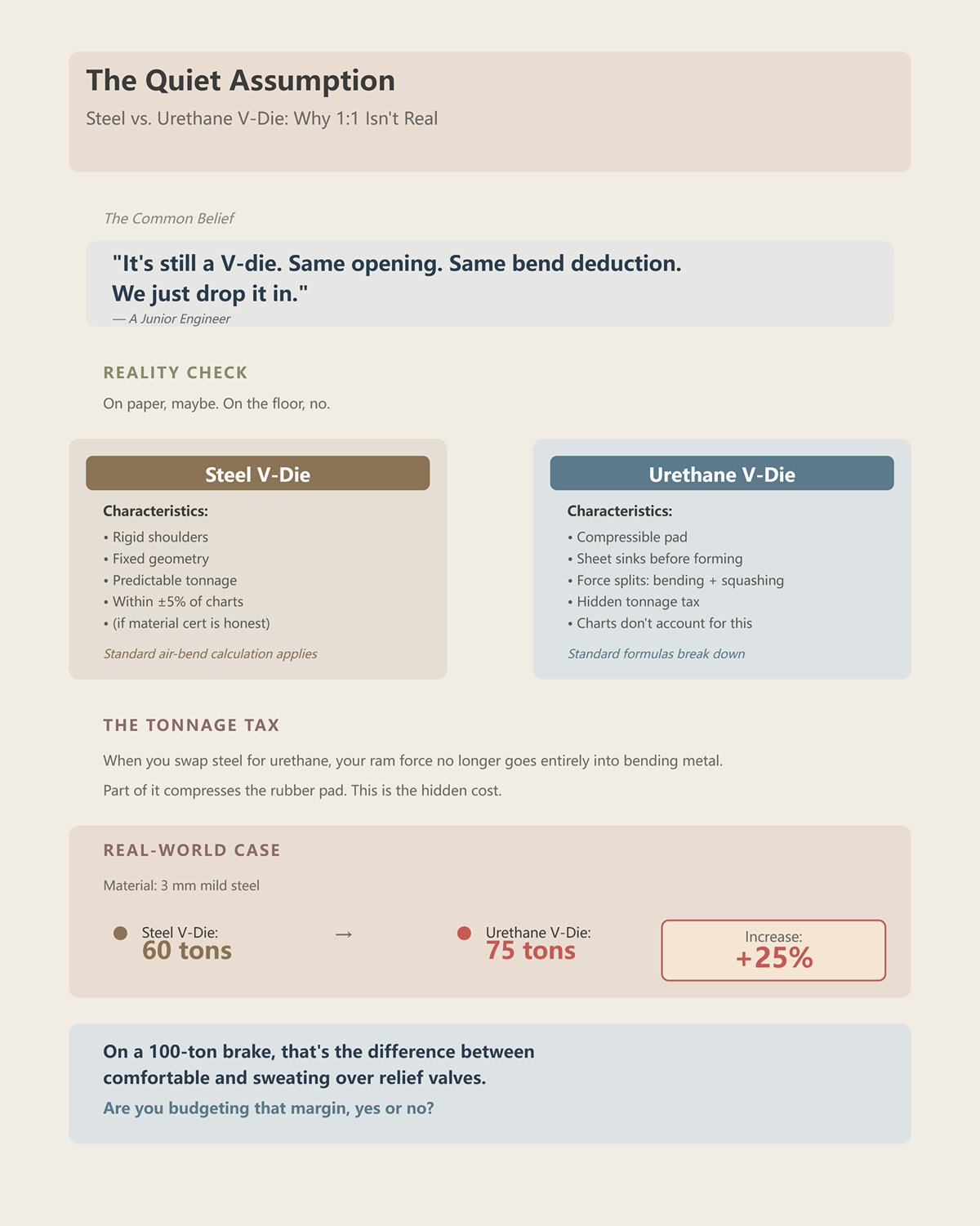
A junior engineer will say, “It’s still a V-die. Same opening. Same bend deduction. We just drop it in.”
On paper, maybe. On the floor, no.
Steel V-die: rigid shoulders, fixed geometry. You calculate tonnage off a standard air-bend chart and you’re within a few percent if your material cert is honest. Urethane V-die: the sheet sinks into a compressible pad before it ever forms a true angle. Some of your ram force goes into bending metal. Some goes into squashing rubber. That’s the tonnage tax.
I’ve seen jobs that ran at 60 tons in steel creep toward 75 when swapped to urethane on the same 3 mm mild steel. That’s a 25% jump. On a 100-ton brake, that’s the difference between comfortable and sweating over relief valves. Are you budgeting that margin, yes or no?

It usually happens on the third part.
First hit: angle looks shallow. Operator adds depth. Second hit: overbent. He backs off 0.2 mm. Third part, same depth, different grain direction — angle moves again.
With steel, the die doesn’t move. All variation lives in the material. With urethane, the die is part of the spring system. Thickness up 0.1 mm? The pad compresses differently. Grain direction changes springback? The pad rebounds differently. Now you’re tuning a dynamic stack, not a fixed triangle.
That’s the shift you need to make: you didn’t install a softer V-die. You installed an elastic forming system that shares the load with the sheet. Same press. Same paint. Different machine behavior.
If you don’t see that yet, the next section is where we break down why rigid and elastic tooling obey completely different rules.
Take a simple job: 3 mm mild steel, 8× material thickness V-opening, air bend to 90°. In a steel die, the punch comes down, the sheet contacts two rigid shoulders, and the die does not move. Zero measurable deflection in the tooling. All the geometry is fixed in steel, and all the deformation is in the sheet.
Now swap in a urethane V-pad with the same nominal opening. First contact isn’t sheet-to-shoulder. It’s sheet-to-elastic block. Before the metal yields at roughly 250 MPa, the urethane starts compressing. So part of your ram stroke goes into bending steel, and part goes into squashing polymer. Two different stress–strain curves stacked in the same system.
That single fact rewrites your setup sheet.
In steel air bending, inside radius tracks V-opening. Narrow the V and tonnage rises exponentially; widen it and tonnage drops. The die geometry governs the bend. With urethane, the “V-opening” is no longer fixed under load. It deforms. The shoulders spread microscopically, the contact patch grows, and the sheet sinks deeper before true bending moment builds. The relationship between opening width and inside radius becomes load-dependent instead of geometric.
You’re not just selecting a die width anymore. You’re selecting how much the die is allowed to move under force. Are you accounting for that displacement in your bend deduction, yes or no?
I’ve watched a job that needed 60 tons in a steel V-die climb to 75 tons in urethane on the same press. Same material. Same thickness. Same angle. That’s a 25% increase. Not because the steel got stronger, but because the first 10–20% of your stroke is spent compressing the pad before full bending stress develops in the sheet.
That’s the tonnage tax.
In steel tooling, the die resists immediately. Ram force converts almost directly into bending moment. In urethane, force first becomes strain energy stored in the pad. Only after sufficient compression does the sheet see the same effective leverage. You’re paying force to move the die out of the way before you can move the metal.
And that stored energy doesn’t disappear. It pushes back. As the punch retracts, the pad rebounds, adding its own elastic recovery to the sheet’s springback. Now the die is an active spring in the system, not a passive support.
Operators feel this as inconsistency. Thickness up 0.1 mm? The pad compresses more, changing contact pressure distribution. Grain direction shifts yield strength? The pad deforms to match, altering where the neutral axis settles. With steel, variation lives mostly in the sheet. With urethane, variation lives in both the sheet and the die.
You’re no longer fighting one spring. You’re fighting two coupled springs with different moduli and different hysteresis curves. Did you really think your old tonnage chart still applies?
Here’s where it gets ugly. In steel air bending, you overbend a predictable amount—say 2° for that mild steel—and you’re done. The die doesn’t change shape between hits. If your material cert is honest, your angle scatter might stay within ±0.5° once dialed in.
With urethane, the overbend you need is tied to how much the pad compressed on that hit. More compression means more stored elastic energy. More stored energy means more rebound when the ram lifts. So the overbend isn’t just compensating for metal springback; it’s compensating for tooling springback.
And compression depends on load.
Load depends on thickness, yield strength, and even slight variations in V-opening width along the pad. Because urethane conforms, it “tolerates” thickness variation by deforming around it. That sounds forgiving in a brochure. On the floor, it means your bend angle drifts with every coil change because the die is absorbing variation instead of resisting it.
Try running a sharp 30° acute bend. In steel, you pick the correct V, confirm tonnage, and control depth. In urethane, high local strain can exceed the pad’s strength limit, accelerating wear or forcing you to open the V to reduce stress. Open the V and your inside radius grows. Now your part print is out before you even argue about angle.
So when someone tells you urethane is just a cleaner surface solution, ask yourself: are you prepared to calibrate overbend against a die that changes stiffness with every load cycle, or were you counting on rigid geometry to do that work for you?
You asked how to calculate tonnage and overbend when the die itself is moving under load.
Start with a real job. 1 mm mild steel, 6 mm V-opening, 90° air bend. In a steel V-die, you might need roughly 8–10 tons per meter. Your 100-ton press handles it without breathing hard. Now swap in a urethane V-pad marketed as “direct replacement.” Same sheet. Same angle. The machine climbs to 35–45 tons before the angle even starts to close.
Nothing changed in the metal. The extra 25–35 tons went into the pad.
That’s the tonnage tax. You don’t pay it once. You pay it every stroke, and it comes straight out of your available press capacity. If your steel setup called for 40 tons, expect 55 to 80 tons with urethane before you see the same bend begin. If your press was running at 70% capacity before, you just pushed it into the red. Are you still calling that a cosmetic upgrade?
Let’s talk mechanism, not marketing.
Urethane behaves like a nonlinear spring. Early in the stroke, its modulus is low. As strain increases, the effective stiffness climbs sharply. That means the first few millimeters of ram travel are mostly compressing polymer, not bending steel. The sheet doesn’t see full bending moment until the pad has compacted enough to behave semi-rigidly.
Manufacturers quietly admit the multiplier: 3× is common. In tighter V conditions, 4× to 6× isn’t unusual. I’ve seen a 60-ton steel job push past 75 tons in urethane on the same machine. That’s a 1.25× multiplier in a mild case. In tighter geometries, I’ve seen it approach 2× and beyond.
Why?
Because the pad resists uniform compression. Under the punch tip, it elongates laterally while being crushed vertically. You’re overcoming internal shear in the polymer before you’re forming the sheet. The force you calculate from standard air-bend formulas only accounts for yielding the metal. Urethane adds a second stress–strain curve in series.
So your practical calculation becomes:
Steel tonnage × urethane multiplier (1.3–2.0 conservative, 3.0+ in tight V or harder durometer scenarios) = required machine tonnage.
And that’s before you account for off-center loading. A 100-ton press over 120 inches might be limited to about 1.3–1.4 tons per inch along the centerline. Urethane doesn’t load cleanly at two shoulders; it spreads pressure unpredictably. Local hotspots can exceed centerline limits even when total tonnage looks “safe.”
You think your press is rated for 100 tons. Is it rated for 100 tons distributed through a compressing rubber block, yes or no?
Watch the ram position indicator during first article.
With steel tooling, angle change tracks ram depth almost immediately. With urethane, you can travel 1–3 mm before the angle moves meaningfully. That stroke is stored as strain energy in the pad. The machine is doing work. The sheet isn’t bending yet.
That lost stroke is the displacement penalty.
On a hydraulic press brake, force rises with penetration. If 20% of your stroke is spent just compacting urethane, then a chunk of your available force curve is consumed before effective bending starts. Your press might hit its pressure limit earlier in the stroke, capping what’s left for the actual bend.
Worse, that stored energy comes back. As the ram retracts, the pad rebounds. You’re now subtracting pad springback from your angle correction. The more you compressed it—meaning the more tonnage you paid—the more it pushes back.
So part of your machine’s rated capacity never reaches the metal in a useful way. It’s tied up compressing and releasing polymer like a shock absorber.
If your brake was marginal on a 10-foot 3 mm job in steel, what happens when 15–30% of its stroke and force curve are eaten by pad compression?
Now take 4 mm mild steel. Same urethane pad rated for “light to medium gauge.” You start the bend. Tonnage spikes fast—far faster than your steel chart predicted. The pad is nearing its compression limit. Its cells are collapsing. It stops behaving like a compliant die and starts acting like a dense block.
At that point, two things happen.
First, the multiplier explodes. What was 1.5× at 1 mm thickness becomes 2× or 3× as you approach the pad’s strain limit. Second, contact pressure localizes. Instead of distributing load gently, the semi-compacted urethane transmits force more directly, and your “scratch-free” solution begins to print through if debris or hard inclusions exist.
That’s your gauge ceiling. Not the brochure’s “up to 6 mm.” The real ceiling is where required compression to achieve angle approaches the pad’s elastic limit. Beyond that, you’re effectively bottoming out a rubber block with a hydraulic press.
Deflection bars and custom pads can push that ceiling upward. You can tune durometer and thickness to reduce the multiplier for a specific job. But that’s engineering a system around the tax, not eliminating it.
So before you spec urethane on that 5 mm stainless panel because the purchase order said “no visible tooling marks,” and that’s the law, answer this: does your press have the spare 30–80% tonnage headroom to pay the tax without choking on the next job in the schedule?
You want to know before setup whether the job and the press have enough real headroom for urethane.
Here’s how I check it on the floor. I take the steel air-bend tonnage from the chart, multiply it by 1.5 as a conservative urethane factor, and then look at two numbers: available machine tonnage at working length, and the part tolerance. If the multiplied tonnage pushes the brake past 80% of its centerline rating, and the print calls for ±0.5° or tighter, I already know we’re operating without a cushion. That’s before we talk about wear.
Because the real problem isn’t just peak force. It’s that the elastic die turns a rigid geometry problem into a moving target over time.
Steel dies give you a step change: chip them and you’ll see it immediately. Urethane gives you a slope. You lose a tenth here, two tenths there, until your inspection sheet quietly turns red. Whole pallet rejected. You didn’t change the program. The pad changed under you.
That’s the degradation curve you’re signing up for.
Picture a 3 mm 304 stainless bracket, 8×V equivalent geometry, 90° bend, ±0.5° tolerance. In steel tooling, you might overbend 1.5–2° to counter material springback and dial it in after two hits. Once it’s set, angle change tracks ram depth cleanly because the die isn’t moving.
Now put a 90A urethane pad under it.
First, the pad compresses 1–3 mm before the sheet sees full bending moment. Then the sheet yields. Then, on retract, the sheet springs back. And the pad springs back too. Two elastic systems in series.
If the stainless wants to recover 1.8°, and the pad’s rebound effectively unloads another fraction of a degree depending on how much you crushed it, your compensation number isn’t tied to metal alone anymore. It’s tied to pad strain. Change batch thickness by 0.1 mm and you change pad compression. Change pad temperature over a long run and you change modulus. The springback stack shifts.
Some suppliers will tell you urethane “reduces springback error.” In thin, soft material with shallow penetration, that can be true because the pad maintains broader contact and can stabilize the radius. I’ve seen it help on 1 mm painted aluminum where the steel V was too wide and the radius wandered.
But push into harder material, higher penetration, or tighter angles, and the pad’s variable stiffness becomes the dominant variable. The more tonnage you pay, the more energy you store, and the more that rebound participates in the final angle. You’re not just compensating for metal anymore; you’re compensating for polymer fatigue that evolves with every cycle.
Are you prepared to treat your die as a consumable spring with a changing rate constant, yes or no?
Chip a steel V-die shoulder and you’ll see a line in the part on the next hit. It’s binary. Good. Then bad.
Urethane doesn’t fail like that.
Imagine a hypothetical run: 5,000 cabinet door frames in pre-brushed stainless, ±0.7° tolerance, running at 60 strokes per hour. Day one, you dial in 91.6° programmed to get 90.0° finished. By part 2,000, you’re nudging to 91.8°. By part 4,000, 92.1°. Nobody panics because each adjustment is small. But the pad has taken a compression set—permanent deformation from repeated strain. Its effective height and stiffness have changed.
You won’t find a neat published curve that says “urethane loses X% stiffness at 10,000 cycles.” That’s exactly the problem. The fatigue is load-, durometer-, and temperature-dependent. Harder pads resist marking but see higher internal stress. Softer pads protect finish but compress deeper and heat up faster.
I’ve watched a $40 stainless cover get scrapped over two polished streaks that didn’t change strength, angle, or fit. Surface was law. But I’ve also watched angle drift eat a morning’s production because the pad that was “consistent” at part 1 wasn’t the same tool at part 3,000.
With steel, your control chart jumps when something breaks. With urethane, it slopes. Do you have SPC tight enough to see a 0.2° drift before your customer does?
| Topic | Details |
|---|---|
| Title | Catastrophic chipping vs. invisible fatigue: tracking accuracy drop-off over 10,000 cycles |
| Steel Failure Mode | Chip a steel V-die shoulder and you’ll see a line in the part on the next hit. It’s binary. Good. Then bad. |
| Urethane Failure Mode | Urethane doesn’t fail like that. |
| Hypothetical Production Run | Imagine a hypothetical run: 5,000 cabinet door frames in pre-brushed stainless, ±0.7° tolerance, running at 60 strokes per hour. Day one, you dial in 91.6° programmed to get 90.0° finished. By part 2,000, you’re nudging to 91.8°. By part 4,000, 92.1°. Nobody panics because each adjustment is small. But the pad has taken a compression set—permanent deformation from repeated strain. Its effective height and stiffness have changed. |
| Lack of Predictable Fatigue Data | You won’t find a neat published curve that says “urethane loses X% stiffness at 10,000 cycles.” That’s exactly the problem. The fatigue is load-, durometer-, and temperature-dependent. Harder pads resist marking but see higher internal stress. Softer pads protect finish but compress deeper and heat up faster. |
| Real-World Consequences | I’ve watched a $40 stainless cover get scrapped over two polished streaks that didn’t change strength, angle, or fit. Surface was law. But I’ve also watched angle drift eat a morning’s production because the pad that was “consistent” at part 1 wasn’t the same tool at part 3,000. |
| SPC and Drift | With steel, your control chart jumps when something breaks. With urethane, it slopes. Do you have SPC tight enough to see a 0.2° drift before your customer does? |
A urethane pad might cost less upfront than a precision-ground segmented V set. That’s the brochure headline.
Now run the math the way a shop does. Suppose a steel die set runs 100,000 hits before regrind, and angle stays within ±0.3° with minimal correction. Your urethane pad, under a medium-load stainless job, starts needing angle compensation changes every few thousand hits and is dimensionally unreliable by, say, 15,000–20,000 hits. I’m not giving you a universal number—because there isn’t one—but that range isn’t fantasy in real shops.
Every replacement pad is another purchase order. Every mid-run requalification is operator time. Every angle drift is inspection labor and potential scrap. And remember the tonnage tax: if you’re operating at 85–90% of machine capacity to begin with, you’re accelerating wear on the brake itself—hydraulics, crowning system, ram guides.
That’s a recurring expense, not a one-time tooling choice.
If the job is cosmetic-critical, low volume, and well within your machine’s true capacity margin, urethane can be the right trade. Surface perfection in exchange for predictable consumable cost. Fine.
But if you’re near your tonnage ceiling, holding tight angles, and planning long production runs, you’re not buying a scratch solution. You’re signing up for force overhead, angle drift, and a replacement cycle you need to budget like cutting oil.
So when you price the job, are you accounting for the pad as a wear item with a declining stiffness curve, or are you still pretending it’s just a soft V-die?
Here’s the question you’re really asking: if urethane is a consumable spring with a tonnage tax attached, is there a cheaper way to kill the scratches without rewriting your capacity chart?
Start with the limitation. Steel dies mark because steel is harder than your part, and every bit of scale, burr, or shoulder wear telegraphs into the surface under load. That contact pressure is real. On a tight V opening, you’re concentrating force along two lines. But the die itself isn’t moving. No compression set. No modulus drift. Geometry stays put.
Now lay a sacrificial film over that steel—polyurethane tape, Mylar, whatever your supplier sells you in rolls.
You’ve inserted a thin, replaceable buffer without turning the whole lower tool into a sponge.
The film deforms a few tenths. It spreads contact slightly. It absorbs minor debris imprinting. But your load path is still steel-to-ram-to-frame. Your tonnage chart doesn’t change. Your crowning math doesn’t change. Your angle compensation still tracks metal springback, not polymer rebound.
That matters.
If a $20 strip of film eliminates 80 percent of your marking and costs you zero additional tonnage, you didn’t just solve cosmetics—you dodged the recurring tax of pad compression, drift, and replacement. The film wears out? You peel it. The die underneath hasn’t changed height, stiffness, or memory.
So no, film doesn’t make urethane obsolete.
But it forces you to justify why you’re paying for 100 percent scratch immunity instead of 80.
Let’s talk about what actually burns time on the floor.
Taping a die is annoying. You clean the shoulders, lay the strip straight, trim it, cycle a test hit, and watch for bunching. On a short run—say 200 cosmetic panels—that’s ten extra minutes. Maybe fifteen if the operator is green. When the tape gets chewed, you reapply. It’s fussy work.
But the first bend angle you hit is the same angle you’ve always hit.
Dialing in a urethane block is a different animal. You’re not just protecting a surface; you’re establishing a new load-deflection relationship. First hits are softer than you think. You increase penetration. The pad compresses more than expected. Now you’re chasing angle because both metal and pad are recovering. On thicker stock, you may find you’re 20–30 percent higher in required force compared to the equivalent steel V setup, depending on how deep you’re driving the pad.
That’s not brochure talk. That’s cylinder pressure.
And if you’re on a 100-ton brake already running at 75–80 tons on steel, you don’t have 30 percent in your back pocket. You’re borrowing it from safety margin. From seals. From guides.
So which setup friction do you prefer: ten minutes with a tape roll, or a half hour of iterative depth changes plus a permanent hit to available tonnage?
Answer that with your machine’s nameplate in mind.
This is where the brochure gets quiet.
Because sometimes 80 percent isn’t good enough. I’ve watched a whole pallet rejected because of faint die lines you had to tilt under light to see. But the purchase order said “no visible tooling marks,” and that’s the law. In that world—architectural stainless, appliance skins, prefinished panels—the difference between “mostly clean” and “surgically clean” is the difference between paid and unpaid.
That’s when urethane earns its keep.
Low volume. Wide capacity margin. Moderate angles. Material that would otherwise telegraph every shoulder imperfection. Jobs where surface is contractually king and you can afford to treat the pad as a consumable, budgeted per run.
But if you’re bending 3 mm stainless at ±0.5° over 5,000 parts and you’re already managing drift on steel, adding an elastic layer under the part is not a cosmetic tweak. It’s a structural change to your process. You’ll pay in force overhead, in angle monitoring, and in replacement frequency.
So here’s the clean way to frame it.
Film on steel: small recurring nuisance, minimal physics change, partial cosmetic relief.
Solid urethane pad: near-total cosmetic protection, plus a standing tonnage tax and a decaying spring under every hit.
If the job truly demands zero visible marking and your machine has 30 percent idle capacity, urethane is the right call. If you’re anywhere near your tonnage ceiling or holding tight angular tolerances over long runs, steel plus film may be the smarter compromise.
Are you buying surface insurance—or are you rewriting your process physics for a problem tape could have handled?
The limitation is simple: your press has a nameplate, and it doesn’t care about brochures.
Before you commit to urethane, run this in pencil. Take your known steel setup tonnage for the job — not the chart value, the number you actually see on the screen at depth. Multiply it by 1.25 as a conservative starting point. If you’re bending near the pad’s working limit or chasing sharp angles, use 1.30. That’s your tonnage tax estimate.
Now look at your machine. If that new number pushes you past 80 percent of rated capacity, you’re not buying surface protection — you’re spending safety margin, seal life, and frame deflection. If it keeps you under 70 percent with room for correction hits, you at least have the mechanical headroom.
That’s the first gate. Capacity.
The second is angle stability. Ask yourself: what’s the angular tolerance on the print, and how many parts are in the run? If you’re holding ±1.5° on 300 cosmetic covers, you can babysit it. If you’re holding ±0.5° on 5,000 parts, you just signed up to fight a moving spring for three shifts.
So the litmus test isn’t “does urethane prevent scratches?” It’s this: after adding 25–30 percent to your real tonnage and accepting elastic drift, do you still have capacity margin and tolerance slack left over — yes or no?
You can’t serve two masters when one of them moves under load.
Steel gives you geometry. Inside radius tracks V-opening — roughly 16–17 percent of the opening in mild steel — and once you dial depth, it repeats. Urethane gives you contact forgiveness, but the radius forms partly from pad displacement, not just V geometry. Change penetration a few tenths, and you change both angle and effective radius.
That means when cosmetics and tolerance collide, you must rank them.
I’ve watched a whole pallet rejected because of faint die lines you had to tilt under light to see. But the purchase order said “no visible tooling marks,” and that’s the law. In that case, ±1° was acceptable, and the surface paid the invoice. Cosmetics won.
Flip the scenario. Tight enclosure, ±0.5°, mating to a laser-cut frame. No one cares about a light witness line inside the bend. Fit is king. In that hierarchy, tolerance wins, and urethane becomes a liability because its compliance works against angular predictability.
So when they conflict — and they will — which one gets you paid?
The limitation here is pad life.
Urethane is a consumable spring. Every hit compresses it, heats it, and inches it toward compression set. On thin, pre-painted aluminum or #4 stainless under 2 mm, the tonnage tax is manageable because base force is low to begin with. Add 25 percent to a small number, and your press barely notices.
In short cosmetic runs — 100, 300, maybe 800 parts — you can treat the pad as a line item. Budget it. Swap it when it softens. Angle-check every first-off per batch. The surface comes off clean, no telegraphed shoulders, no scale ghosts. I’ve watched a $40 stainless cover get scrapped over two polished streaks that didn’t change strength, angle, or fit. In that environment, the pad earns its keep because perfection is contractual.
But even here, do the math first. If your steel setup pulls 20 tons and urethane projects to 26, you’re fine on a 100-ton brake. If your steel setup pulls 60 and urethane projects to 75, and your machine is rated at 80, you’re gambling every stroke.
Does your capacity margin absorb the tax without living on the relief valve?
The limitation now is cumulative drift.
Heavy plate multiplies the tonnage tax because you’re already deep into the load curve. Add 30 percent to a 90-ton job and you’re not tweaking — you’re rewriting the stress picture of the machine. Frame deflection increases. Crowning demand increases. Pad compression increases. Everything stacks.
Then there’s run length. Steel dies, treated right, are lifetime tools. Urethane pads decay. Not catastrophically. Gradually. Day one and day three do not behave the same under identical stroke. That means your bend depth setting becomes a moving target over thousands of hits.
On a 5,000-part run with ±0.5° tolerance, that’s not surface insurance — that’s a recurring process correction. More checks. More tweaks. More opportunity for a stack-up that ends in “Whole pallet rejected.”
Maintenance can slow the decay. Store pads flat. Keep them clean. Avoid over-penetration. That stretches life. It does not eliminate modulus loss. You’re still paying the tax; you’re just spreading it over more invoices.
So here’s the lens I want you to carry forward.
Running urethane is not a tooling choice. It’s a financial model. You are agreeing to a recurring tonnage tax, a stability tax, and a replacement tax in exchange for flawless surfaces. If surface perfection is what the customer audits and angular tolerance has slack, pay it. If tolerance drives the assembly and capacity margin is thin, walk away.
Before you sign off on the pad, multiply your real steel tonnage by 1.25, compare it to 70–80 percent of your press rating, and read the tolerance block on the print. After that, the answer isn’t philosophical.
It’s operational.